Split Canopy: Open the center section
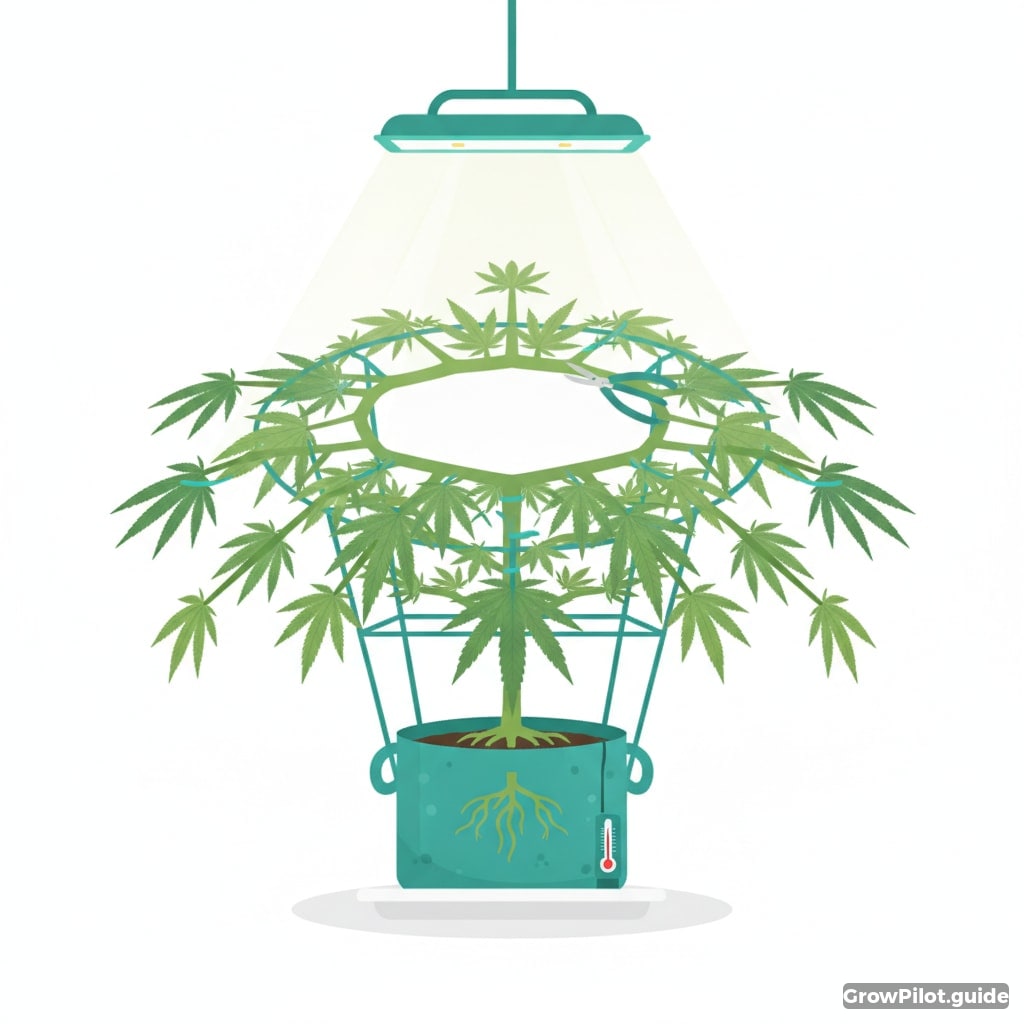
Split-Canopy opens up dense plants without topping or netting: main and side shoots are guided outward in pairs so that light penetrates deeper and the canopy becomes more even.
Introduction
Split-Canopy is a structured low-stress training method in which the canopy is not shaped into a ring, a spiral, or formed under a net, but is deliberately divided into two open halves. The goal is to create a sort of “light corridor” through the center of the plant: the inner area is opened up, dominant shoots are guided to the sides, and the canopy spreads out wider to the left and right.
This method is particularly suitable for plants that naturally grow very bushy or quickly become too dense in the center. Unlike classic LST, tie-down ring, spiral LST, or SCROG, the focus here is not on filling the space in a circular or net-based pattern, but on deliberately relieving pressure on the center of the plant.
What Split-Canopy is Designed to Achieve
When applied correctly, the method primarily improves:
- Light penetration into the inner canopy
- More uniform height of multiple shoots
- Better distribution of side shoots
- more controlled plant width instead of a dense center
- less self-shading in the center
This training method does not replace strong HST or an SCROG structure. It is a distinct form of targeted spreading and guiding.
Best Time to Start
Split-Canopy is started during the vegetative phase, when the plant has already formed several stable nodes and the shoots are still flexible.
It is usually suitable:
- from 5–7 nodes
- for healthy, actively growing plants
- when several side shoots are already present
- before the center becomes heavily woody and inflexible
During the early flowering stretch phase, you can still carefully adjust existing ties, but no longer force any drastic corrections. From around week 3 of flowering, no major reshaping should take place.
Basic Principle of the Method
Instead of distributing all shoots around the pot, you work with a left and right side of the canopy. The center is intentionally left more open.
The principle:
- Gently pull a dominant main shoot or upper leader slightly away from the center
- Guide the strongest side shoots on the left half to the left
- Guide the strongest side shoots on the right half to the right
- Redirect shoots pushing upward from the inside so that no dense core forms
This results not in a round disc like with the Ring-LST, but rather in a broad, centrally open crown.
Step-by-Step
1. Analyze the plant
Look at the plant from above. Mentally mark:
- the tallest shoot
- the two to four strongest side shoots
- the area with the heaviest shading in the center
The goal is not to pin every shoot immediately, but first to identify the growth axis.
2. Create the first opening
Gently bend the main shoot or the uppermost dominant shoot to the side from the center. Work slowly, preferably in small steps. Secure it with soft plant ties to an outer anchor point.
Important:
- Do not pull jerkily
- Do not create sharp kinks
- Do not tie the twine too tightly
- Always pull slightly diagonally outward, not forcefully downward
3. Build up the left and right sides
Now guide the strongest side shoots outward in pairs:
- left shoots to the left
- right shoots to the right
- inner shoots slightly diagonally away from the center
This leaves an open area between the two halves, allowing light to penetrate deeper into the plant.
4. Level the height
If one shoot is growing significantly faster than the others, lower it slightly more than its neighbors. Leave weaker shoots standing more upright. This way, you level the canopy without forcing the entire plant into a rigid pattern.
5. Adjust regularly
During the growing season, check the training every 2–3 days. New tips will grow upward again; these should be gently guided outward once more. Split-Canopy thrives on several small adjustments, not a single drastic intervention.
Common Mistakes
Spreading Too Early
Very young plants with little lateral structure benefit little from this. Wait until there are enough shoots.
Too Much Tension at Once
If you pull the center apart abruptly, the risk of tears or crushed vascular pathways increases.
Allowing the center to close up again
Without consistent training, many plants quickly close the light corridor again. The method only works if you consistently redirect new inner tips.
Confusing it with SCROG
Split-Canopy requires no net and does not aim for complete grid coverage. It is a free-form training method.
Who this method is suitable for
Split-Canopy is particularly useful for:
- bushy genetics with a tight internode structure
- plants with heavy internal shading
- growers who want to work without a net
- limited depth but usable width in the grow room
It is less suitable for very slender plants that already grow open and naturally form hardly any dense center.
Conclusion
Split-Canopy is a precise yet simple structuring method for the vegetative phase. Instead of shaping the plant in a circular or net-based pattern, you deliberately open up the center and spread the canopy to both sides. This improves light distribution, reduces self-shading, and creates a more controlled, wider canopy with minimal stress.
Pro Tips
- Use soft ties made of rubber or fabric
- It's better to bend the shoots gently twice than once too hard
- Check the crown shape from above
- Guide dominant inner shoots outward early on
- No major corrections after the third week of flowering
More Growing Knowledge & Smart Grow Help
GrowPilot.guide is the cannabis grow tracker and weed cultivation app with smart plant analysis, indoor cannabis growing guide, grow diary, community, cups and autoflower grow tracker for growers worldwide.
Open GrowPilot.guide App →