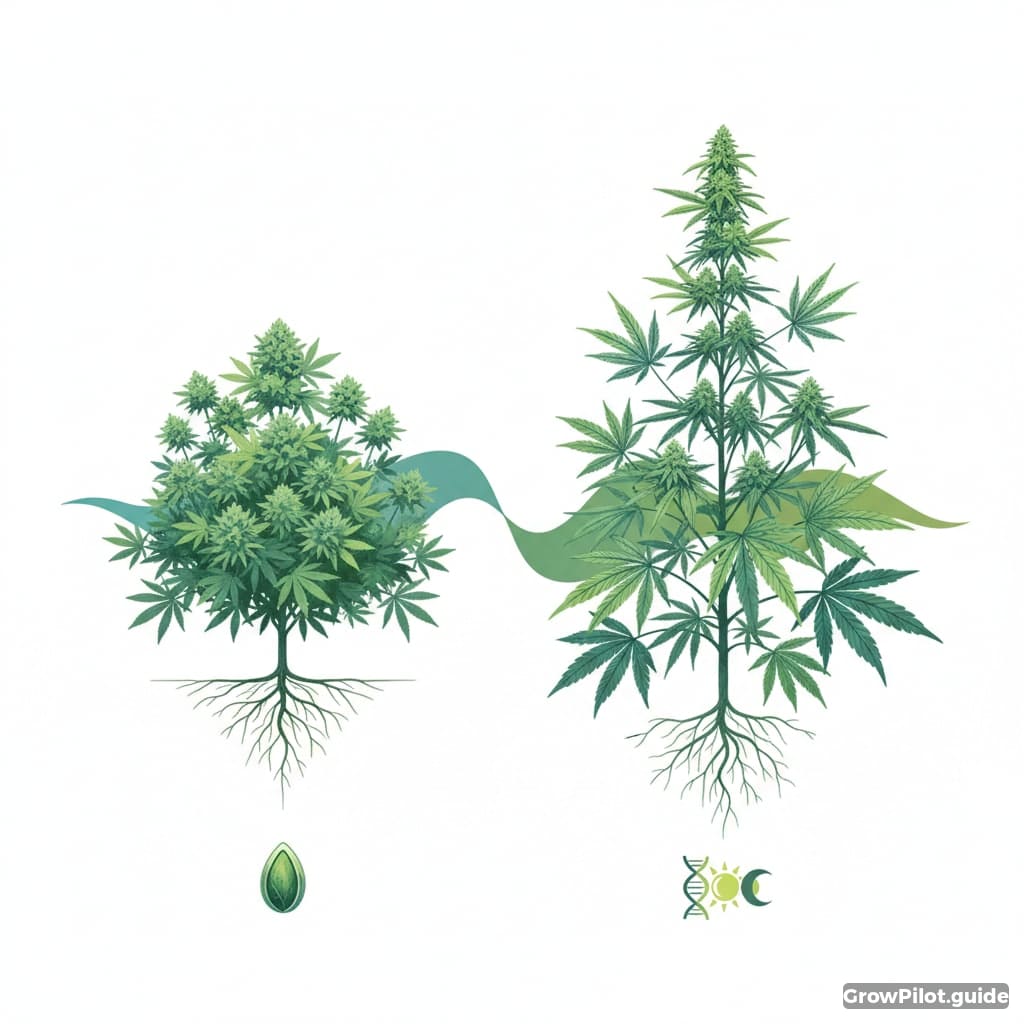
Power Plant: Genetics, Yield, and Its Distinct Sativa Growth Pattern

Power Plant is a classic, high-yielding hybrid strain with a sativa-dominant growth pattern. This article explains its origins, flowering, terpenes, effects, and key growing tips.
# Power Plant: Genetics, Yield, and Its Distinct Sativa Growth Pattern
Power Plant is one of those strain names that, since the late 1990s, has been consistently described in international seed bank archives, strain databases, and grow reports with a similar profile: vigorous, predominantly Sativa-style growth, good yield per unit area, comparatively rapid flowering for this growth type, and an aroma ranging from spicy, woody, and earthy to slightly sweet and peppery. Unlike some modern “hype” strains, Power Plant is less about an extreme dessert or “fuel” profile and more about functional genetics selected for cultivation performance.
That’s exactly what makes it interesting for growers. In many sources, Power Plant is mentioned not primarily because of a spectacular myth, but because of a relatively clear practical track record: vigorous growth, significant stretching, solid to high yields, and a structure that responds strongly to light, root space, and precise climate control. At the same time, the usual caveat applies here as well: Depending on the breeder, conservation efforts, and seed batch, differences in phenotype may occur under the same name. Anyone growing Power Plant should therefore not rely solely on the strain name but should look for reliable traits in their own grow.
What is known for certain about Power Plant’s genetics and origin?
Historically, Power Plant is most often associated with Dutch breeding efforts from the late 1990s. Breeder descriptions and strain archives frequently describe the line as a predominantly sativa hybrid traced back to South African genetics. The commonly cited core of the narrative is that Power Plant was stabilized from a selection of South African lines. However, this early history is not documented with the same precision in every source.
Two things, in particular, seem certain:
- Power Plant was marketed early on as a yield-oriented, homogeneous seed line.
- Over the years, many grow reports have described it as relatively more uniform than some other sativa-dominant hybrids.
How does Power Plant grow in a grow room or greenhouse?
In international grow reports, Power Plant is usually described as moderate to vigorous in growth. The strain tends toward rapid vertical growth during the vegetative phase, but often develops more lateral branching than very narrow Haze strains. This makes it suitable for various setups, but requires some planning.
Typical Growth Profile
- Indoor height: often medium to tall, approximately 80 to 150 cm depending on the veg phase duration and phenotype
- Outdoor/greenhouse height: significantly taller under good conditions, sometimes ranging from 180 to over 250 cm
- Structure: upright, with a distinct main stem and productive side shoots
- Stretch: usually significant after switching to flowering, often about 1.5 to 2.5 times the original height
- Foliage: Leaves tend to be slimmer than in Indica-dominant strains, but not extremely delicate
- early transition to flowering
- controlled plant density with training
- flat, even canopy systems
- Screen-of-Green or gentle low-stress training
What flowering time and yields are realistic?
Power Plant is often described as a strain that flowers relatively quickly for a sativa-like structure. Many breeder specifications cite a flowering time of about 8 to 10 weeks. In field reports, many phenotypes fall within the 9-week range, some slightly below, some slightly above. Outdoors, maturity depends heavily on climate, light intensity, and phenotype; harvest is often described as occurring in the mid- to late fall window.
When it comes to yield, it’s wise to take catalog claims with a grain of salt. Although Power Plant has a reputation as a productive strain, high yields are only achieved with adequate lighting, sufficient root space, good nutrition, and a clean environment. Realistic figures reported in many accounts are:
- Indoors: about 400 to 550 g/m² under good conditions
- Outdoor: often several hundred grams per plant, and significantly more for large, well-established plants
How does Power Plant smell and taste?
Compared to modern Candy or Gas strains, Power Plant often has a more classic aroma. Many descriptions from seed banks, archives, and user reports cite a profile featuring:
- spicy notes
- earthy undertones
- woody-herbal accents
- a slight peppery note
- sometimes sweet, anise-like or fresh, green nuances
For growers, it’s more important in practice that Power Plant usually has a distinct smell, but isn’t always as overwhelmingly heavy or sweet as some dessert hybrids. The aroma often becomes much stronger starting in mid-flowering and can take on a spicier note during drying.
How are the effects described?
Reports from users and strain archives frequently describe Power Plant as clear-headed, active, stimulating, and mentally alert, with some phenotypes offering a physical relaxation that sets in later. This profile aligns with its common classification as a sativa-dominant hybrid. At the same time, it’s important to note that effects depend not only on the strain but also on chemotype, terpene profile, degree of maturity, dosage, and individual sensitivity.
Recurring descriptions include:
- mentally alert or focused
- more energetic than heavily sedating
- sometimes described as creative or communicative
- at higher intensities, it can also be overwhelming for sensitive individuals
Who is Power Plant suitable for when growing?
Power Plant is generally not considered an extremely finicky strain, but neither is it a completely foolproof beginner’s strain. The main reason is its growth: If you don’t pay attention to stretching, nutrient supply, and airflow, you’ll quickly compromise quality.
Difficulty Level
- Beginners: possible if height and climate can be well controlled
- Intermediate growers: very suitable, especially for training and space optimization
- Experts: interesting for phenotypic selection and yield control
- prefer sativa-like growth but don’t want extremely long flowering times
- are looking for productive plants with good lateral branching
- actively use training techniques
- appreciate classic spicy-woody flavor profiles
What growing tips are really important for Power Plant?
1. Plan for stretching early
The most common planning mistake is a vegetation phase that’s too long. Power Plant often reacts strongly to the flowering transition. If your plants aren’t very tall, you should train them early and switch over in a timely manner.
2. Use Airflow and Pruning in Moderation
The plant often produces many active shoots. This is good for yield but can impair air circulation in a dense canopy. The following are recommended:
- moderate thinning in the lower and inner areas
- clear shoot selection
- even distribution under the light
3. Maintain Optimal Growing Conditions
During the vegetative phase, temperatures around 24 to 28 °C with moderate humidity are generally well tolerated. During flowering, it’s advisable to gradually lower the humidity, especially as the flower mass increases. Many growers aim for the following rough guidelines:
- Veg: about 60 to 70% relative humidity for young plants, later slightly lower
- early flowering: about 50 to 60%
- late flowering: closer to 40 to 50%, depending on plant density and airflow
4. Don’t Just Follow a Set Feeding Schedule
Power Plant can grow vigorously, but high growth potential doesn’t automatically mean unlimited nutrient tolerance. Common mistakes include:
- too much nitrogen during early flowering
- taking corrective action too late when the plant starts to stretch
- overfeeding according to heavily promoted high-yield schemes
Conclusion: Why Does Power Plant Remain Interesting?
Power Plant isn’t just a nostalgic name. The strain remains relevant because it offers a profile that’s still in demand today: vigorous hybrid growth, sativa-driven vigor, solid to high yields, and a classically spicy flavor profile. Growers who don’t want to rely solely on modern Candy or Kush strains will find genetics here that deliver clear cultivation performance.
The most important factor here is managing expectations realistically. Power Plant truly shines when canopy management, climate, and stretch control are just right. Those who master these three factors will often get exactly what this strain has been prized for over the decades: a vigorous, productive, and comparatively straightforward hybrid line with a distinct character of its own.