Tropicana Cookies: Genetics, Color, and Citrus Terpenes

Tropicana Cookies combines Girl Scout Cookies and Tangie lineage with purple hues, distinctive citrus aromas, and vigorous growth. This article covers genetics, flowering, yield, and growing practices.
# Tropicana Cookies: Genetics, Color, and Citrus Terpenes
Tropicana Cookies is one of the modern hybrid strains that has attracted attention primarily due to three characteristics: a striking orange-citrus flavor profile, frequent violet to dark purple coloration, and a typically vigorous, sativa-dominant stretch during early flowering. This strain is of interest to growers because it combines visual appeal, resin production, and a relatively distinct terpene profile. At the same time, it suffers from a fundamental problem common to many well-known U.S. strains: the name is not always used internationally to refer to genetically identical plants.
Anyone wishing to classify Tropicana Cookies accurately should therefore distinguish between the historically known core of the strain, later seed versions, and individual phenotypes. However, a consistent picture emerges across strain archives, breeder specifications, and numerous grow reports: Tropicana Cookies is usually described as a cross between Girl Scout Cookies and Tangie, often with reference to the Tropicana Cookies F1 selection from the Oni Seed Co. circle. It is precisely this combination that explains much of the strain’s practical profile: Cookies contributes density, resin, and dessert-like undertones, while Tangie provides vigorous growth and its distinctive citrus flavor.
What is genetically established about Tropicana Cookies?
The most commonly cited lineage is Girl Scout Cookies x Tangie. In archives and breeder descriptions, Tropicana Cookies is usually listed as a polyhybrid line, not as an old, fully standardized strain. This is important because polyhybrid lines are naturally more prone to phenotypic variations than long-stabilized inbred lines.
Origin and Breeding Context
Historically, Tropicana Cookies emerged on the international scene primarily as aroma-rich U.S. genetics that helped shape the trend toward fruitier, visually striking hybrids. Many subsequent crosses with the abbreviation Trop or Tropicanna/Tropicana can be traced back to this line or to close relatives. It should be noted, however, that spellings and marketing terminology are not always consistent. For growers, therefore, the name itself is less important than the specific breeder’s information and the description of the parent lines.
Which phenotypes are commonly observed?
Grow reports repeatedly describe two broad categories:
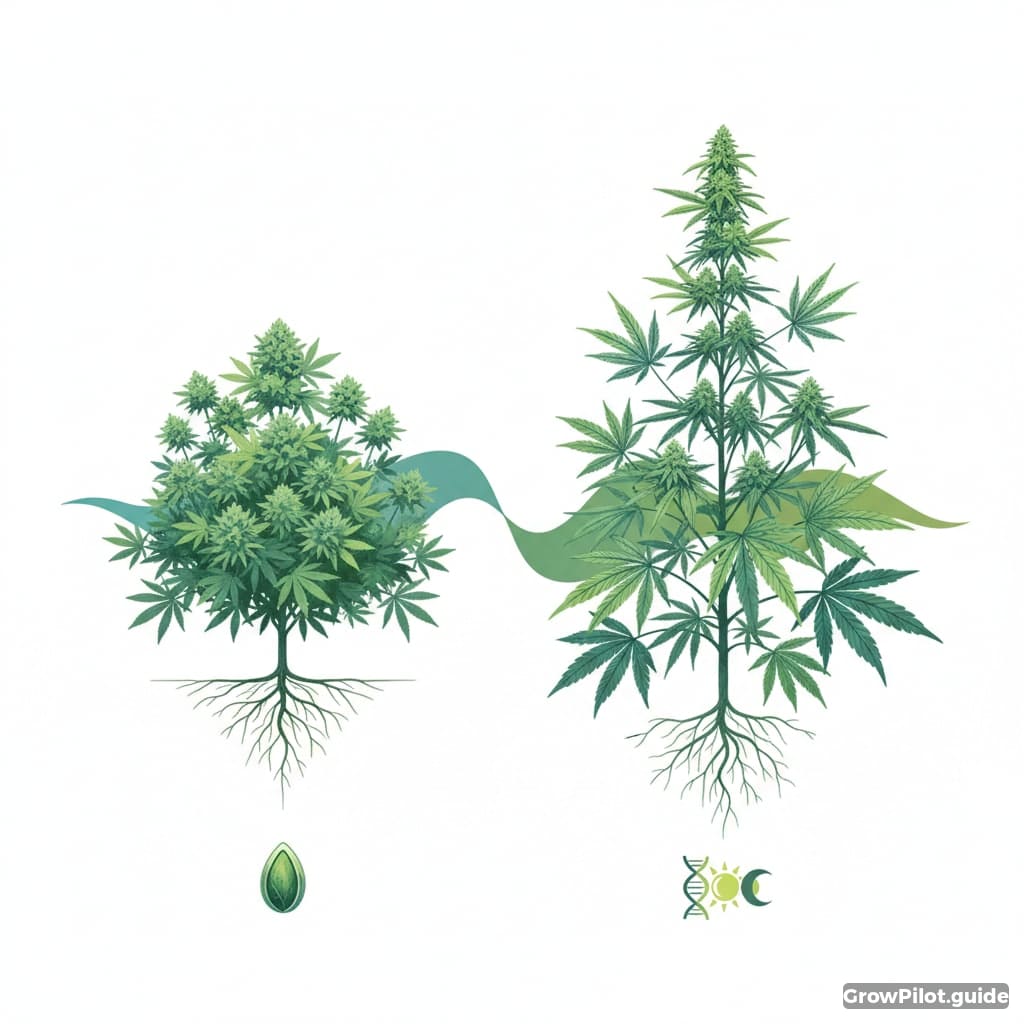
- Tangie-dominant phenotypes with more stretch, a more open flower structure, and very bright orange peel aromas
- Cookies-dominant phenotypes with a more compact structure, darker coloring, and slightly denser bud formation
How does Tropicana Cookies grow in practice?
Tropicana Cookies is described in many reports as a medium- to large-sized hybrid plant with vigorous lateral branch growth. Its growth often appears vigorous but is not always uniform. Especially during the vegetative phase, the strain often exhibits strong growth momentum and responds to sufficient light with shorter internodes. Under weaker lighting, however, it can shoot up more quickly.
Height, Bushy Growth, and Stretch
Typical characteristics include:
- Indoor: usually about 80 to 140 cm, depending on pot size, veg duration, and training
- Outdoor: often 150 to over 220 cm under favorable conditions
- Stretch during early flowering: frequently 1.5 to 2.5 times the initial height
Indoor, Outdoor, or Greenhouse?
Tropicana Cookies performs well in all three environments, but each has different requirements:
- Indoor: The strain is easy to manage if training begins early and the canopy is kept open.
- Outdoors, it benefits from plenty of light and air movement. During very humid late stages, keep an eye on flower density.
- In a greenhouse, it can perform exceptionally well but requires precise climate control due to stretching and humidity.
What flowering time and yields are realistic?
For photoperiod Tropicana Cookies strains, breeders and user reports typically cite a flowering time of about 8 to 10 weeks. Many plants fall within a range of 9 weeks, while some Tangie-dominant phenotypes may take a bit longer to mature.
When it comes to yield, it’s best to be realistic. Marketing claims are often very high, but under real-world conditions, the following ranges seem more plausible:
- Indoor: about 350 to 500 g/m² with well-managed foliage
- Outdoor: often 400 to 700 g per plant, and even higher with sufficient size, sunlight, and a long growing season
Why does Tropicana Cookies have such an intense orange scent?
The aroma profile is described with remarkable consistency in reviews as orange, mandarin-like, sweet, slightly tart, and somewhat cookie-like. Chemically, this impression can often be explained by a terpene profile in which limonene plays a key role. Depending on the phenotype, myrcene, caryophyllene, pinene, and sometimes linalool or humulene also come to the fore.
Typical Aromas and Flavors
Frequently mentioned are:
- fresh orange peel
- mandarin
- sweet citrus candy notes
- herbal and cookie undertones
- occasionally light gas or spice notes
What effects do users and growers describe?
User reports often describe Tropicana Cookies as clear-headed, stimulating, mood-lifting, creative, and sociable, though it doesn’t always produce effects typical of pure sativa. According to user reports, some phenotypes also exhibit a noticeable physical calmness later on. However, such descriptions of effects are subjective and can vary significantly depending on chemotype, dose, method of consumption, and individual sensitivity.
It’s worth noting that Tropicana Cookies is often not described as a heavily sedating evening strain, but rather as a functional hybrid with mental clarity and a strong sensory profile.
Who is Tropicana Cookies suitable for when growing?
The level of difficulty generally ranges from beginners with good preparation to advanced growers. The strain isn’t extremely finicky, but it’s also not a surefire success for completely unguided grows.
It’s particularly well-suited for growers who:
- prioritize terpene profile over mere yield
- know how to handle training
- have an eye for phenotype selection
- appreciate colorful, resinous buds
What growing tips are particularly important for Tropicana Cookies?
Climate and Environmental Control
During the vegetative phase, a moderately warm climate usually works well. Many growers maintain a stable temperature of about 24 to 28 °C under light and slightly cooler temperatures during the dark phase. During flowering, controlled relative humidity is important, especially if a denser Cookies phenotype develops. The following are often used as a rough guide:
- early vegetative phase: 60 to 70% RH
- late vegetative phase: 55 to 65% RH
- early flowering: 45 to 55% RH
- late flowering: 40 to 50% RH
Training and Canopy Management
Tropicana Cookies often responds well to:
- Topping after the plant has become well-established
- LST to promote lateral growth
- SCROG for even light distribution
- Selective thinning of large fan leaves if the interior becomes too dense
Common Mistakes
Recurring problems mentioned in user reports include:
- too long a vegetative period in low-ceilinged rooms
- Insufficient airflow during dense flowering
- Over-fertilization during mid-flowering, especially with darker phenotypes that have a slightly slower metabolism
- Harvesting too early, before the citrus profile and resin maturity are fully developed
Conclusion: What Makes Tropicana Cookies Special?
Tropicana Cookies isn’t a strain that relies solely on hype. Its profile is distinct enough in practice to set it apart from many other modern hybrids: distinct orange-citrus aromatics, often intense color development, vigorous stretch, and solid resin production. At the same time, it remains a strain with phenotypic variation, so selection and careful cultivation make a big difference.
For growers looking for a visually striking, terpene-rich hybrid with good indoor and outdoor performance, Tropicana Cookies is particularly appealing when canopy control, climate, and harvest timing are precisely managed. That’s exactly where the strain usually shows its strongest profile.