Set the Light Cycle & Timer Correctly
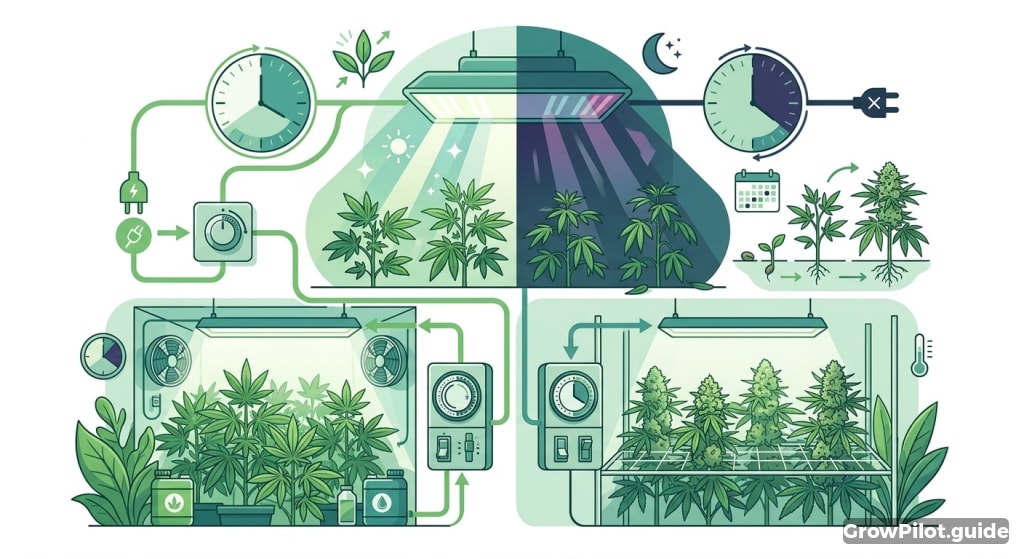
Here's how to set up 18/6 and 12/12 cycles properly with a timer, avoid common timer mistakes, and handle daylight saving time without disrupting the light cycle.
Introduction
The light cycle is one of the most important basic settings in indoor growing. It not only controls when the light is on, but also—for photoperiodic strains—determines whether the plant remains in the vegetative phase or enters the flowering phase. This guide focuses exclusively on the practical setup of 18/6, 12/12, and the correct handling of daylight saving time adjustments for timers.
Important: Autoflowering strains do not require a 12/12 flip to flower. They flower on a time-controlled schedule and are usually grown under long light cycles such as 18/6 or 20/4.
The Two Main Light Cycles
18/6
18 hours of light, 6 hours of darkness is a classic cycle for the vegetative phase of photoperiodic plants. It provides a high daily light input while maintaining a fixed dark phase.Typical uses:
- Photoperiodic plants during the vegetative phase
- Autoflowers from seedling to harvest, when a longer cycle is not desired
12/12
12 hours of light, 12 hours of uninterrupted darkness are used for photoperiodic plants to initiate flowering and maintain a stable flowering phase.Typical uses:
- Only for photoperiodic plants in the flowering stage
Important to note:
- The 12 hours of darkness must be the same length every day
- The dark phase must not be interrupted by light
- Once the schedule is set, the rhythm should not be constantly adjusted
Choosing the Right Timer
Both mechanical and digital timers are suitable for growing. Reliability is more important than the type of timer.
Look for:
- sufficient switching capacity for the lamp or ballast
- consistent daily repetition
- easy-to-read programming
- for digital models: check how it behaves after a power outage
Digital timers are often more precise. Mechanical models are simple but can cause errors due to accidentally shifted segments or inaccurate settings.
Programming 18/6 Correctly
Choose a fixed daily light window that fits your daily routine. Example:
- Lights on: 6:00 a.m.
- Lights off: 12:00 a.m.
Alternatively, the light window can also be in the evening and at night, as long as the rhythm remains the same every day.
Important for 18/6:
- No daily changes to start times
- Check the timer for a full day after setting it
- Check the current time after a power outage
Setting Up a Clean 12/12 Cycle
When switching photoperiodic plants to the flowering phase, the cycle is clearly set to 12/12. Example:
- Lights on: 8:00 a.m.
- Lights off: 8:00 p.m.
What matters is not the specific time, but absolute consistency. The dark phase must remain continuous and uninterrupted.
The following applies specifically to 12/12:
- No spontaneous shifts of one to two hours
- No “exceptions” on weekends
- No manual switching on or off of the light
Daylight Saving Time: Handling Summer and Winter Time Correctly
The legally mandated time change is biologically irrelevant for plants. What matters is only when the light is actually turned on and off. Therefore, there are two clean approaches:
Option 1: Maintain the plant’s rhythm
You run the light at the same actual time of day and adjust the timer by one hour. This is the best solution if you want to maintain your previous lighting schedule exactly.
Example:
- Before: Light on at 8:00 a.m., off at 8:00 p.m.
- After the time change: Adjust the timer so that the lights are still on from 8:00 a.m. to 8:00 p.m. in reality
Option 2: Adopt the new time for daily use
You adopt the new time and let the timer continue running without making an immediate adjustment. In this case, the light period will actually shift by one hour. This is usually not a problem, as long as the cycle remains exactly the same length.
For photoperiodic plants, Option 1 is usually the more precise solution because it maintains the familiar rhythm exactly.
Common Mistakes with Timers
Incorrectly Set Time
The most common mistake is simple: The timer is programmed correctly, but the internal clock is set incorrectly.
AM/PM errors with digital timers
With a 12-hour display, on and off times are easily mixed up. Therefore, always perform a test run after programming.
Accidental manual override
Many timers have a manual switch for On / Auto / Off. If this switch remains set to “On,” the light will stay on continuously.
Unintentional Cycle Shifts
Even small, repeated shifts can make the lighting schedule unreliable. Especially in a 12/12 cycle, the schedule should not be constantly readjusted.
Practical Schedule for Hobby Growers
- Photoperiodic Vegetation: 18/6
- Photoperiodic Flowering: 12/12
- Autoflower: usually 18/6 or 20/4, no 12/12 required
- Check the timer thoroughly after every change
- When the clocks change, make a conscious decision: keep the actual light duration the same or adopt the new time
Conclusion
A good light cycle isn’t rocket science, but it must be implemented consistently and without errors. 18/6 and 12/12 work reliably if the timer is set correctly, the dark phase remains protected, and daylight saving time changes are handled systematically. Especially with photoperiodic strains, a stable, repeatable light schedule is more important than constantly readjusting it.
Pro Tips
- Autoflowers don't need a 12/12 light cycle.
- Always perform a test run after making changes to the timer.
- With a 12/12 cycle, never interrupt the dark phase.
- Check digital timers after a power outage.
- Adjust summer/winter time intentionally and just once.
More Growing Knowledge & Smart Grow Help
GrowPilot.guide is the cannabis grow tracker and weed cultivation app with smart plant analysis, indoor cannabis growing guide, grow diary, community, cups and autoflower grow tracker for growers worldwide.
Open GrowPilot.guide App →