Use Far Red specifically for daily margin control
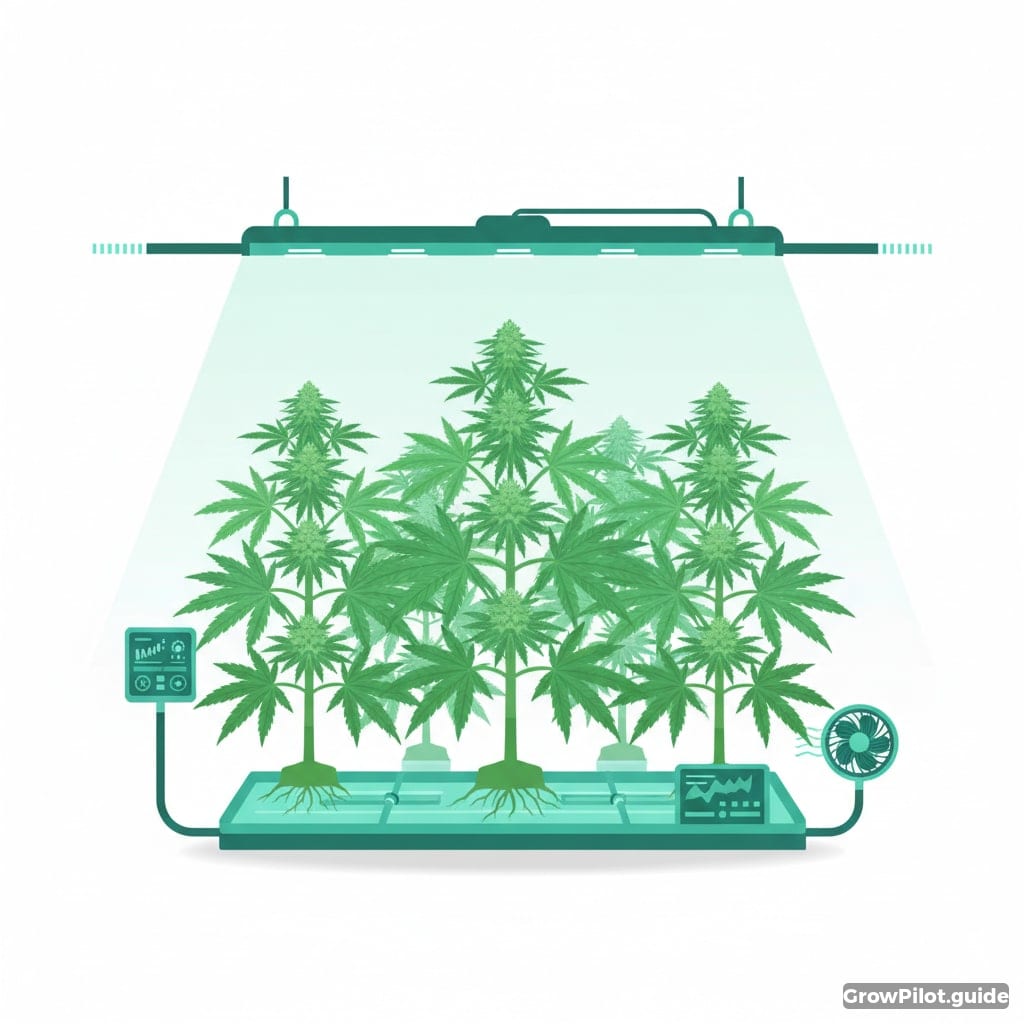
How 730-nm Color Red is used in indoor grow specifically at the end of the day to control phytochrome signals without replacing light cycle, PPFD or main spectrum.
Introduction
Far Red in the range around 730 nm is a special light control tool. It is not used to replace the main lighting, to bring more PPFD onto the surface or simply to make classic flowering spectra "redder". Its main benefit lies in the signaling effect on the plant's phytochrome system.
This guide therefore deals exclusively with the targeted use of Far Red for daytime edge control in indoor growing. The topic is clearly different from general spectrum guides, PPFD tables or light cycle basics.
What Far Red actually does in cannabis grow
Cannabis reacts not only to the amount of light, but also to its spectral composition. Particularly important is the ratio between:
- Red light in the range around 660 nm
- Far Red in the range around 730 nm
The plant uses the phytochrome system to recognize whether "daylight" or "end of day/shade" is being signaled. Far Red shifts the phytochrome state more quickly towards the night signal. This is precisely why Far Red is mainly used in practice as End-of-Day-Far-Red.
Important:
- Far Red is not a substitute for a correct light cycle.
- Far Red turns a wrong photoperiod not a correct one.
- Autoflower strains do not need a 12/12 flip; Far Red is only an optional control tool, not a flowering trigger in the classic sense.
Useful areas of application
Far Red is most useful in setups where:
- the main light is already properly planned,
- the photoperiod runs precisely on a timer,
- a separate, switchable Far Red module is available,
- you want to work specifically with light signals instead of more intensity.
Far Red is not a must-have tool for beginners. Anyone who does not yet have stable basic lighting will benefit considerably more from correct main lighting, a suitable photoperiod and clean surface illumination.
Practical application: End-of-Day-Far-Red
The most common method is a short Far-Red window directly after switching off the main light. The aim is to signal a clear end of day to the plant.
This is how it is implemented
- Use a separately switchable 730 nm module.
- Let the main light end regularly.
- Then switch on only Far Red for a short time window.
- Keep this window consistently the same every day.
Typical practice duration
In practice, short intervals of around 5 to 15 minutes are usually used. Longer durations are not automatically better and often only increase complexity without any clear additional benefit.
What Far Red should not do
Far Red is often used incorrectly. Avoid these mistakes:
- Do not plan as an additional main light source
- Do not calculate to increase the PPFD
- Not as a replacement for red light in the PAR range
- Do not switch on in the middle of the dark phase
- Do not operate uncontrolled together with general spectrum boosters
The last point in particular is important: an improperly tuned spectrum with a permanently high far-red component can promote undesirable stretching reactions because the plant is more likely to perceive a shadow or competition signal.
Differences between vegetation and flowering phase
Vegetation phase
In the vegetation phase, Far Red should usually be used with restraint. Too much signal in the direction of shade avoidance can unnecessarily stretch the plants. If at all, then only very selectively and with clear observation of the internode spacing.
Flowering phase for photoperiodic varieties
During flowering, End-of-Day-Far-Red can be used to mark the end of the day in a more defined way. However, the correct 12/12 cycle with an uninterrupted dark phase remains decisive. Far Red does not replace this requirement.
Autoflower
Autoflower plants flower dependently of age, not because of 12/12. Far Red can be used here at most as a subtle light signal, but is not necessary to initiate flowering.
Choice of technique
Pay attention to the hardware:
- clearly labeled 730 nm emitters
- separate switchability from the main panel
- reproducible timer control
- No mixing with undefined "bloom boost" switches without spectral information
A system in which Far Red can be activated independently of the full spectrum is ideal. This is the only way to test the daily edge control properly.
Common errors
- Allowing Far Red to run for the entire light day
- Confusing 660 nm and 730 nm
- Consider Far Red as a yield guarantee
- Use irregular switch-on times
- mistakenly expect a 12/12 effect with autoflowers
Conclusion
Far Red for end-of-day control is a specialized tool for advanced indoor growers. Used correctly, it can make the light signal at the end of the day more precise. The key lies in a short, separate, constant application around 730 nm. Those using Far Red should not think of it as a main light, but as a targeted phytochromic pulse.
Pro Tips
- Only use Far Red with a separate timer.
- Pay attention to the manufacturer's genuine 730 nm specifications.
- Start with short end-of-day windows.
- Never evaluate Far Red on PPFD values alone.
- Autoflowers do not need a 12/12 flip to flower.
Frequently Asked Questions
How does far-red light work in day-length control for indoor growing?
Far-red light (730 nm) affects the phytochromes that control plant growth. Through targeted application at the end of the light cycle, plant behavior—such as flowering and growth—can be optimized.
What are the advantages of using far-red light compared to conventional light?
Far-red light can influence plants' photoperiodic response without disrupting the main light cycle. It promotes flowering and can support growth during the vegetative phase.
How long should far-red light be used at the end of the light cycle?
Exposing plants to far-red light for 10 to 15 minutes at the end of the light cycle is often sufficient to activate the desired phytochromatic signals.
More Growing Knowledge & Smart Grow Help
GrowPilot.guide is the cannabis grow tracker and weed cultivation app with smart plant analysis, indoor cannabis growing guide, grow diary, community, cups and autoflower grow tracker for growers worldwide.
Open GrowPilot.guide App →