Control dew point and condensation in the grow room
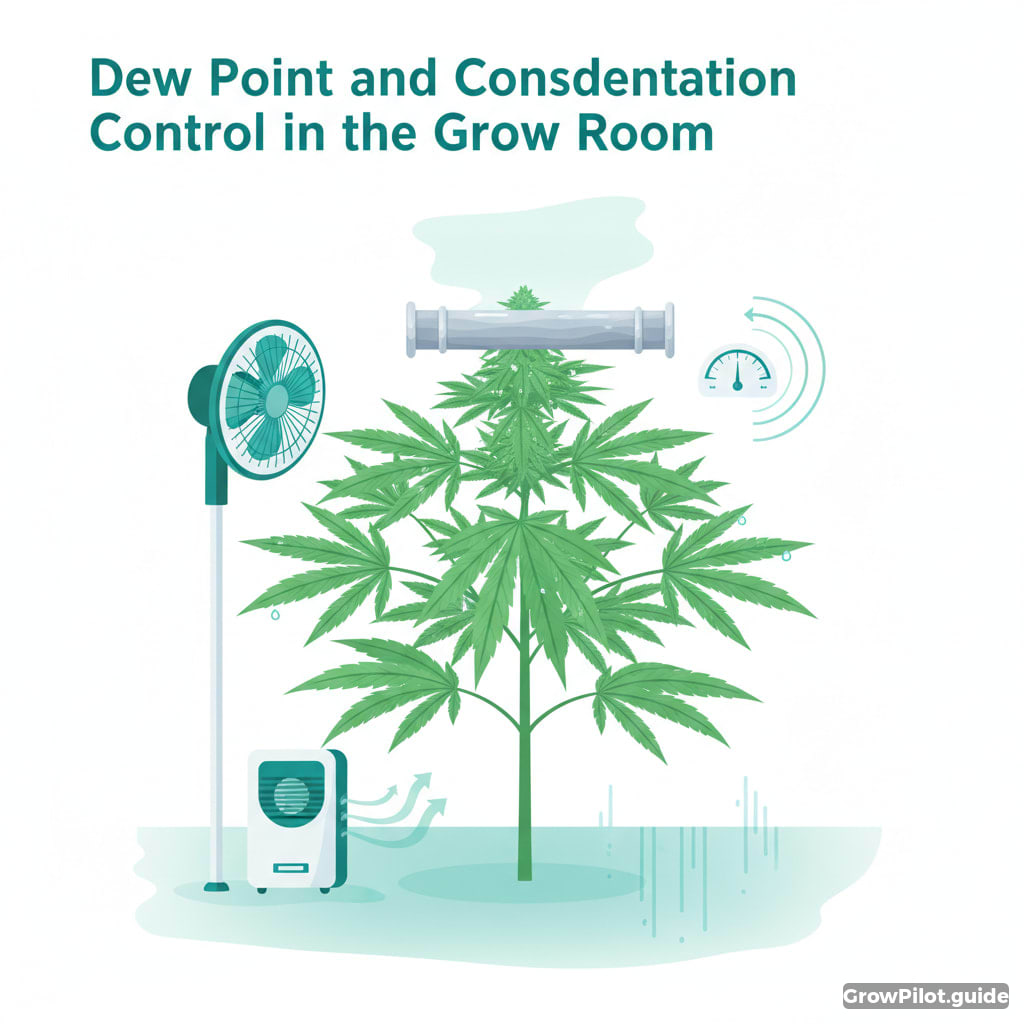
Control dew point and condensation in the grow room: assess surface temperatures and air flow to safely prevent dripping water and hidden moisture pockets.
Introduction
Condensation is an often underestimated climate problem in the grow room. It is not only the measured relative humidity that determines the risk, but above all the ratio of air temperature, dew point and surface temperature. As soon as a surface is colder than the dew point of the room air, water condenses. This is exactly where dripping water, damp corners, mold growth and an unstable microclimate occur.
This guide focuses exclusively on the climatic side: Understanding the dew point, recognizing cold surfaces, guiding air flows sensibly and minimizing condensation risks in the grow tent or grow room.
Why condensation occurs
Warm air can store more water vapor than cold air. If moist air cools down on a cold surface, the relative humidity rises sharply locally. If the dew point is reached, water condenses out.
Typical problem areas are
- Tent walls in winter
- Windows, exterior walls and metal parts
- Uninsulated air ducts
- Areas directly next to cold supply air
- dead corners without air movement
- Ceiling areas with temperature gradients
Important: A room can still appear inconspicuous on average, while condensation is already occurring locally. Therefore, not only the central value is decisive, but also the microclimate on critical surfaces.
Understanding the dew point in practice
The dew point is the temperature at which the existing humidity condenses into water. The higher the temperature and absolute humidity, the higher the dew point.
Practical examples:
- 24°C at 60% RH results in a dew point of around 15.8°C.
- 22°C at 70% RH result in a dew point of approx. 16.3°C.
- 20°C at 80% RH result in a dew point of approx. 16.4°C.
This shows that even with moderate room values, cold surfaces below around 16°C can become critical. Particularly in cold seasons, a single poorly insulated surface is enough to attract moisture permanently.
Critical differences between air and surface
In practice, the decisive factor is how far the surface temperature is above the dew point.
Orientation for the risk
- >3°C above dew point: mostly safe
- 1-3°C above dew point: increased attention
- 0-1°C above dew point: high risk
- below dew point: Condensation likely or already present
An infrared thermometer helps to quickly identify problematic areas. Measure:
- Tent wall inside
- Wall behind the tent
- Outside and inside air hose
- Window frames
- Corners near floor and ceiling
Particularly critical situations
Dark phase
When the room temperature drops, the relative humidity often rises significantly. At the same time, external surfaces cool down. As a result, the surface temperature approaches the dew point. Condensation therefore often occurs at night or shortly before the lighting is switched on.
Cold supply air
If cold outside air flows directly onto plants, walls or pipes, cold zones are created locally. These areas can attract water despite acceptable average values.
Poorly ducted extract air
If humid air is forced into cavities, false ceilings or poorly ventilated adjacent areas, condensation can form there unnoticed.
Measures against condensation
1. reduce cold surfaces
- Thermally decouple external walls and window areas where possible
- Insulate uninsulated air ducts
- Do not place cold metal surfaces directly in the main humid air flow
- Do not place tents close to very cold walls
2. move air evenly
- Ensure gentle air circulation at corners, walls and under the canopy
- Do not direct hard jets of air permanently at individual parts of the plant
- Avoid stagnant air in peripheral zones
The aim is not to create a strong wind load, but to reduce damp boundary layers on surfaces.
3. guide supply air sensibly
- Do not direct cold supply air directly onto cold wall surfaces
- Allow the supply air to mix in the room first
- Avoid strong temperature islands
4. actively limit humidity peaks
Condensation is often caused by short-term peaks in humidity. Stable climate values are therefore more important than just good average values. Sudden increases in RH when the temperature drops are particularly critical.
Phase-related classification
Vegetative phase
Here, the risk of condensation is particularly relevant on walls, floor edges and poorly ventilated corners. Dense leaf mass can retain moisture locally, even if the room value still looks acceptable.
Flowering phase
Condensation becomes much more critical in the flowering stage, because moist micro-areas in and around the flowers increase the risk of Botrytis and other fungal problems. Uniform airflow and avoiding cold surfaces near the canopy are particularly important.
Drying phase after the harvest
Condensation also remains a climate issue during drying. Aim for 18-22°C and around 60% RH with gentle air movement without direct airflow onto the plant material. Cold walls, uninsulated exhaust air ducts or strong night-time cooling can also lead to moisture pockets.
Conclusion
If you want to prevent condensation, you should not only monitor the temperature and RH, but always check the dew point against actual surface temperatures. A climatically stable grow room is achieved when no surface falls within the critical range of the dew point and the air is conducted without dead zones.
Pro Tips
- Measure critical areas with an infrared thermometer.
- Check values especially before the light starts.
- Insulate cold air hoses consistently.
- Keep tents away from outside walls.
- Always assess dew point plus surface temperature.
Frequently Asked Questions
What is the dew point, and why is it important in a grow room?
The dew point is the temperature at which the air is saturated and water vapor begins to condense. In a grow room, it is important to prevent condensation and mold growth by keeping surface temperatures above the dew point.
How can I control the humidity in my grow room?
Humidity can be controlled by using dehumidifiers, fans, and proper ventilation. Regular monitoring with hygrometers helps keep humidity levels within the optimal range.
What role does airflow play in a grow room?
Proper airflow ensures an even distribution of temperature and humidity, which helps regulate the dew point and minimize the risk of condensation and mold.