Intelligently control exhaust air to the outside environment
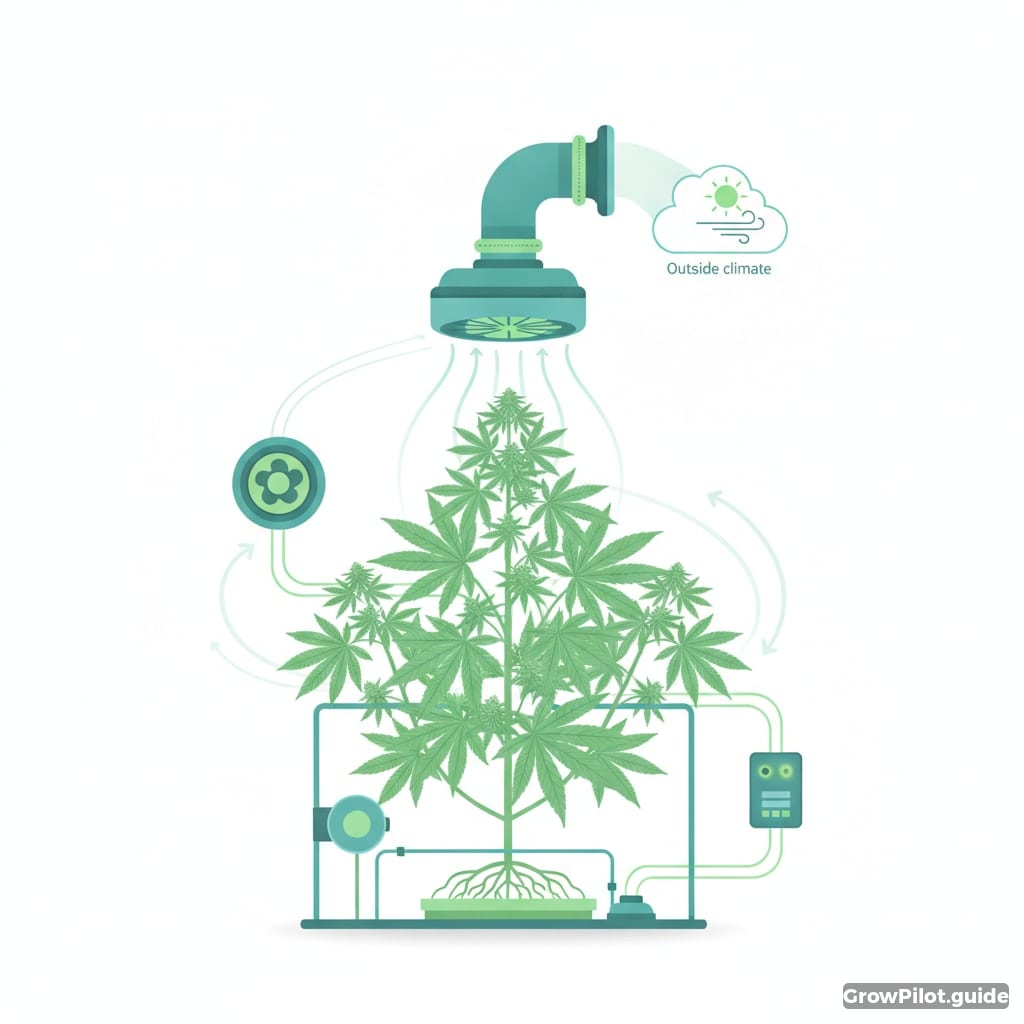
Here's how to adjust the exhaust air in your grow room to match hot, cold, humid, or dry outdoor air, in order to maintain stable temperature and humidity levels and avoid sudden changes in climate.
Introduction
Many growers regulate their exhaust airflow based solely on a fixed schedule or exclusively on the indoor temperature. This often works only when the outdoor climate is stable. In practice, however, the air being drawn in is constantly changing: hot and humid in summer, cold and dry in winter, suddenly more humid when it rains, and very dry after warming up during frost. This is precisely what causes many climate problems in the grow room.
This guide does not cover general target values for each growth phase and does not address the design of complete ventilation systems. The focus is on the question: How do you respond climatically to changing outdoor air so that your indoor climate remains stable?
Why the outdoor climate changes the exhaust air strategy
Exhaust air removes warm and humid air from the room. At the same time, it determines how much outside air flows in. This inflow is never neutral:
- warm outside air reduces the cooling effect of the exhaust air
- cold outdoor air can cool the room down abruptly
- humid outdoor air makes dehumidification more difficult
- dry outdoor air can significantly lower relative humidity after heating
It is therefore important to note: More exhaust air is not automatically better. If the outside air is unfavorable, too much air exchange can actually worsen the indoor climate.
What measurements you need in parallel
Indoor measurements alone are not sufficient for effective control. You need at least:
- Indoor air temperature at ceiling height
- Indoor RH at ceiling height
- Outdoor air temperature directly in front of or at the intake side
- Outdoor RH preferably in the shade and protected from the weather
A 24- to 72-hour trend is also helpful. This allows you to identify patterns:
- Does indoor humidity always rise after rain?
- Does RH drop sharply after sunrise?
- Can nighttime air be used for cooling?
Basic principle of intelligent exhaust air control
Instead of using just a single threshold value, you work with priorities:
- Avoid critical temperature spikes
- Limit humidity increases
- Avoid sudden climate changes
- Use outdoor air windows strategically
In practice, this means:
- Increase exhaust air gradually; do not constantly switch between minimum and maximum
- Evaluate changes with a delay, because the room reacts slowly
- Assess outdoor air not only for “freshness,” but also for its thermal and hygrometric effects
Typical outdoor climate situations and the correct response
Hot and dry outside
In this case, higher exhaust air flow often removes moisture well but provides only limited cooling. The room may remain warm despite high fan output.
Recommended:
- Increase exhaust air only to the extent that it actually improves the temperature
- Avoid sustained maximum output if it provides little cooling benefit
- Counteract rising temperatures early, before the room heats up
Hot and humid outside
This is one of the most challenging climatic conditions. Increased exhaust airflow often provides neither effective cooling nor effective dehumidification.
Recommended:
- Maintain exhaust air at a level that ensures sufficient air exchange, but do not blindly maximize it
- Monitor humidity increases particularly closely
- Prioritize dehumidification in the room, if available
- Actively take advantage of brief periods of slightly drier outdoor air
Cold and dry outside
Very common in winter. Incoming air feels extremely dry after heating. At the same time, excessive exhaust air can create cold zones.
Recommended:
- Limit exhaust air to the necessary minimum plus a safety margin
- Avoid large fan speed changes
- Evaluate temperature drops and RH drops together
- Mitigate cold intake phases instead of constantly cycling the room up and down
Cool and humid outside
This air can be useful in terms of temperature, but it increases the risk of humidity problems if the room cannot absorb much additional moisture.
Recommended:
- Do not rely solely on the cooler temperature
- Monitor RH trends after each increase in exhaust air
- When moisture removal is slow, operate at a moderate and constant rate rather than in short, full-throttle intervals
Control Strategy in Practice
A robust practical strategy looks like this:
- Set Basic Level for constant air exchange
- Level 2 when temperature or humidity rises
- Level 3 only during actual load or when outside air is clearly favorable
- Re-evaluate any change only after a few minutes
Pay special attention to these mistakes:
- Controlling exhaust air based on a single sensor
- Mounting the outdoor sensor in direct sunlight
- Hoping for maximum dehumidification via exhaust air when outdoor air is humid
- Ventilating unnecessarily aggressively during winter dry spells
Clearly separate phases
This strategy applies during growth and flowering, but the assessment of humidity sensitivity differs. The issue is also relevant during post-harvest drying, though with its own, significantly narrower climate target. The key point is: Here, too, only the indoor air is regulated; the crop is not watered or treated in any similar way.
Conclusion
Effective exhaust air control is based not only on the indoor environment but always on the interaction between indoor and outdoor climates. Those who view outdoor air as an active climate factor avoid humidity fluctuations, unnecessary temperature drops, and inefficient fan cycles. The result is a more stable, better-controlled growing climate.
Pro Tips
- Always install outdoor sensors in a shaded area
- Adjust fan speed gradually rather than abruptly
- Log internal and external values together
- Examine periods of rain as a distinct climate pattern
- Winter air is often extremely dry after warming
More Growing Knowledge & Smart Grow Help
GrowPilot.guide is the cannabis grow tracker and weed cultivation app with smart plant analysis, indoor cannabis growing guide, grow diary, community, cups and autoflower grow tracker for growers worldwide.
Open GrowPilot.guide App →