Reliably detect excess magnesium in hydro
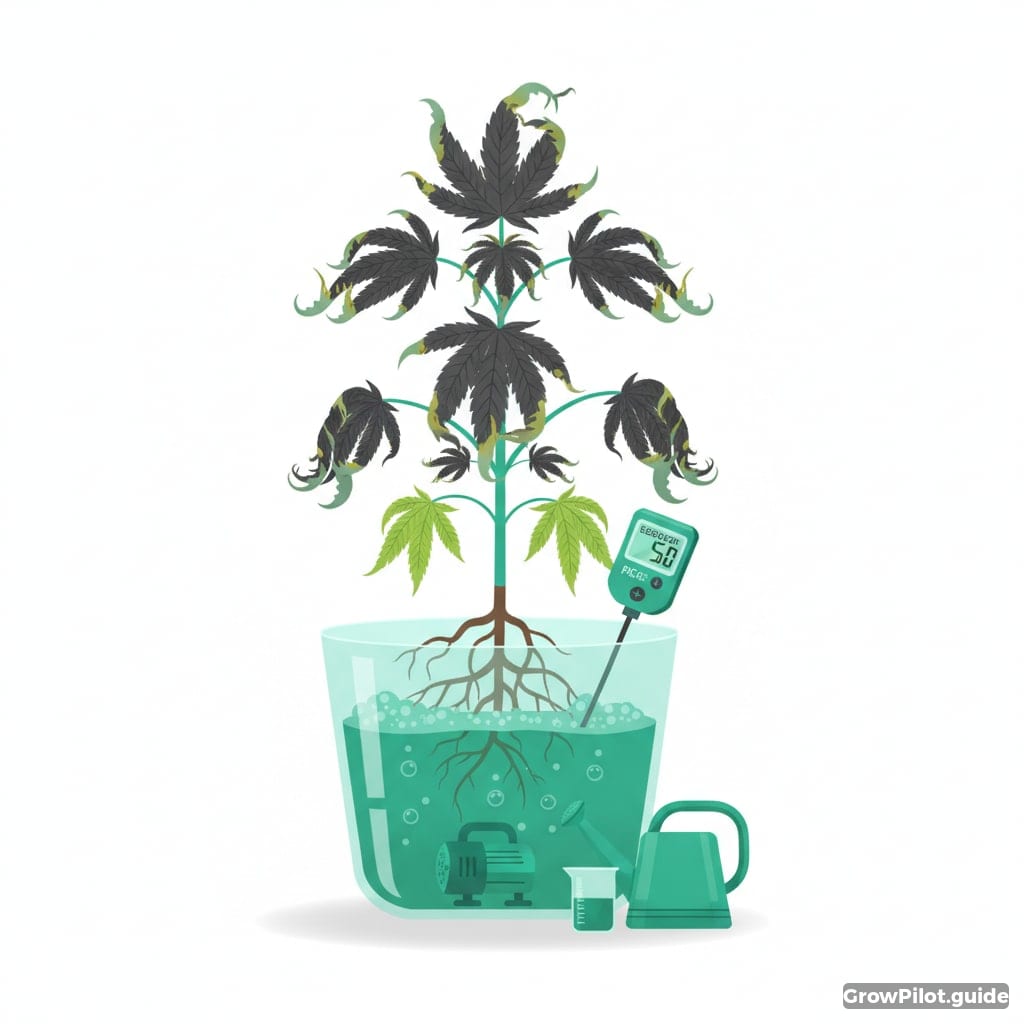
Excess magnesium in hydro is often misinterpreted as a calcium or potassium problem. This guide shows typical symptoms, causes and clean corrections in the reservoir.
Classification
Excess magnesium (excess Mg) is less common in hydroponics than a magnesium deficiency, but it does occur - especially with heavy use of CalMag products, Epsom salt, magnesium-rich base fertilizers or with soft/RO water that has been overcorrected. In hydro, the issue is important because the system has hardly any buffering effect: even small mixing errors in the reservoir can quickly shift the ion ratios in the root zone.
Too much magnesium not only damages the plant directly, but also interferes with the absorption of other nutrients. Calcium (Ca) and potassium (K) are particularly frequently affected. This is precisely why an excess of Mg is often wrongly interpreted as a Ca deficiency, K deficiency or general pH problem.
This guide deals exclusively with excess magnesium in hydroponics.
Why too much magnesium is problematic
Magnesium is an essential secondary nutrient and a central component of chlorophyll. The plant therefore absolutely needs it - but only in a balanced ratio to other cations. In hydro, dissolved ions compete directly at the root surface. If the magnesium in the reservoir is too high, it can displace the uptake of other nutrients.
Typical consequences of an excess of Mg:
- Calcium uptake is inhibited
- Potassium uptake can fall**
- EC increases unnecessarily due to excess salts
- Root stress increases, especially with poor oxygen supply
Typical symptoms of excess magnesium
A genuine excess of Mg rarely manifests itself as a single clear leading symptom. Often a mixed situation of excess and secondary blockages is seen.
Early signs
- Overall unnecessarily high EC, although the plant does not grow more vigorously
- Foliage sometimes appears unusually dark green
- Leaf tips may appear slightly stressed or dull
- Growth slows down despite "full" nutrient solution
Frequent secondary symptoms due to antagonisms
- Calcium-like symptoms on new growth: slightly deformed young leaves, irregular leaf edges, small necrotic spots
- Potassium-like symptoms on older leaves: marginal chlorosis, browned leaf margins, decreasing leaf tension
- General signs of salt stress if the total concentration is too high
What is not typical
- A classic interveinal yellowing on older leaves is more indicative of Mg deficiency, not excess.
- Severe chlorosis on very young leaves without a dark foliage pattern is more likely to indicate iron or manganese problems.
Common causes in Hydro
In Hydro, Mg surpluses are almost always caused by mixing or dosing errors:
- too frequent or too high administration of CalMag
- additional use of Epsom salt (magnesium sulphate) without a real need
- Combination of several fertilizers, all of which already contain magnesium
- Hardening osmosis water without calculating the target values
- Refilling with highly mineralized water without re-evaluating EC and nutrient profile
- changing reservoirs too infrequently, causing imbalances to build up
How to clearly delimit excess Mg
Before correcting, always check the hydro base values:
- pH target range: 5.5-6.0
- Water temperature: 18-22°C**
- Sufficient oxygen supply to the roots
- Actual EC compared to the fertilization strategy
An excess of Mg is particularly likely if:
- the pH is within the target range,
- the EC is rather high,
- magnesium has been deliberately added,
- and Ca- or K-like symptoms occur at the same time.
Corrective measures in the reservoir
1. stop magnesium sources immediately
Temporarily discontinue CalMag, Epsom salt and other Mg supplements. Also check the label of the base fertilizer so that you do not continue to add magnesium unnoticed.
2. re-start the reservoir
In Hydro, the cleanest solution for a significant excess is usually a complete change of nutrient solution. Do not rinse the system endlessly with clean water, but quickly prepare a fresh, balanced nutrient solution with the appropriate EC.
3. keep EC moderate
After the correction, the EC should not be run at the upper limit. A slightly reduced EC that matches the plant phase relieves the roots and improves the reabsorption of blocked nutrients.
4. Keep pH stable in the hydro range
Keep the pH stable at 5.5-6.0 after the new batch. Outside of this range, the diagnosis becomes impure because additional absorption problems then arise.
5. observe the plant for 3-5 days
Old damage does not heal. The decisive factor is whether new growth appears cleaner and whether marginal necroses or deformations do not increase further.
Important practical rule
In hydro you should never supplement magnesium according to the "a lot helps a lot " scheme. Clean, calculated mineralization is particularly important for RO water. Without a buffer in the system, a small excess will lead to antagonisms more quickly than in soil.
If severe symptoms continue to occur after a reservoir change, correct pH and adjusted EC, there is often not just an excess of Mg, but already a combined Ca/K uptake disorder. In this case, the solution remains the same: clean nutrient solution, correct ratio, stable hydro values.
Pro Tips
- Only dose CalMag after water analysis
- Do not routinely use Epsom salt in hydro
- If suspected, always check the entire tank
- High EC plus Ca symptoms is suspicious
- Evaluate new sheets, not old damage
More Growing Knowledge & Smart Grow Help
GrowPilot.guide is the cannabis grow tracker and weed cultivation app with smart plant analysis, indoor cannabis growing guide, grow diary, community, cups and autoflower grow tracker for growers worldwide.
Open GrowPilot.guide App →