Hydro-IPM for cuttings and young plants
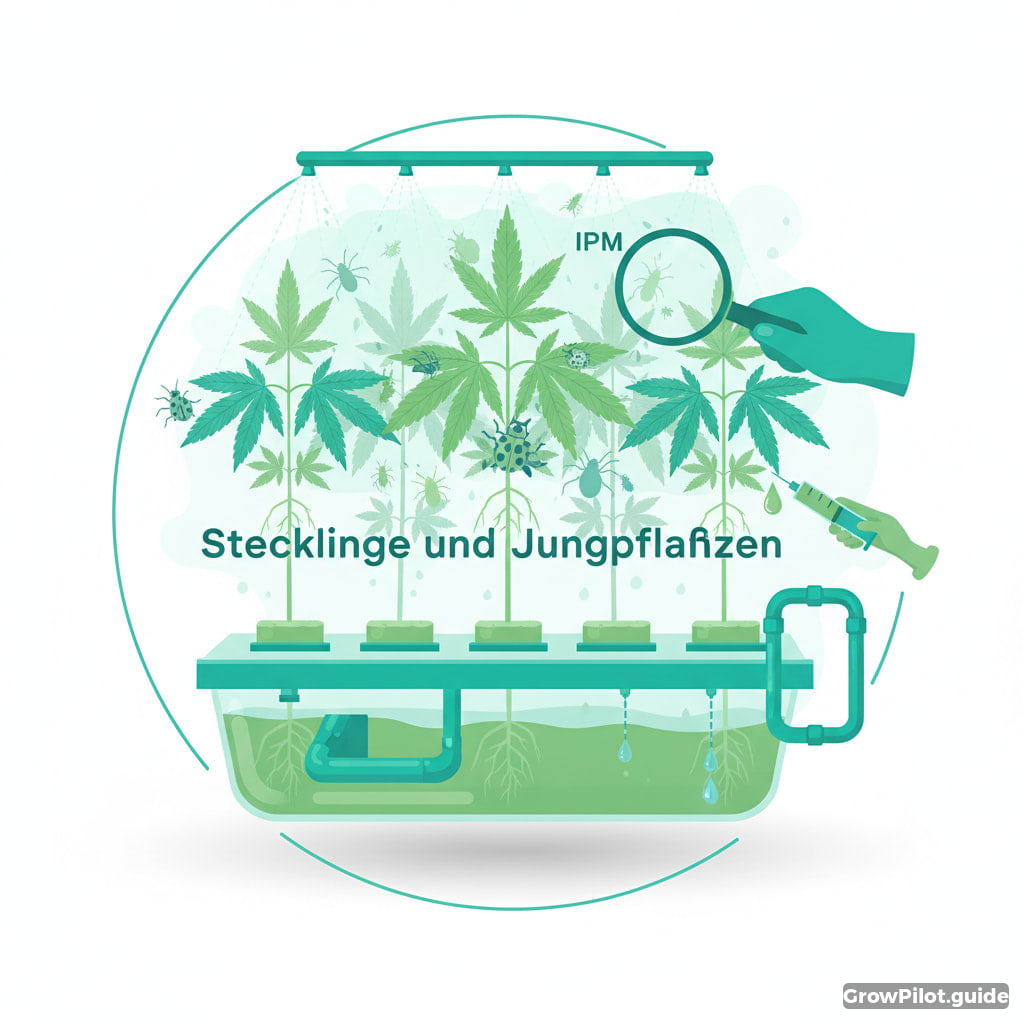
This Hydro-IPM guide shows you how to preventively safeguard the most sensitive establishment phase of cuttings and young plants and systematically limit pest pressure at an early stage.
Introduction
The phase from rooted cuttings to established young plant is a separate IPM risk window in hydro cultivation. At this stage, plant tissue is soft, root mass is small and tolerance to stress is low. Even slight pest pressure or unfavorable hygiene can quickly spread throughout the entire crop. At the same time, the hydro system lacks a buffer: deviations in pH 5.5-6.0, EC, oxygen supply and water hygiene quickly weaken young plants and make them more susceptible to infestation.
This guide deals exclusively with IPM for cuttings and young plants in hydroponics: i.e. prevention, separation, environmental management, early interventions and safe transfers to the main stock.
Why this phase needs its own IPM protocol
Young plants are particularly critical from an IPM perspective because several risks come together:
- high plant density in propagation areas
- Frequent handling when repotting or transplanting
- sensitive leaves with low resistance
- small root systems that react quickly to a lack of oxygen
- often increased humidity during early establishment
A mistake in this phase is often carried over into the vegetation later on. The aim is therefore not maximum treatment, but maximum exclusion and stability strategy.
1. starting material as the first IPM barrier
The most important IPM decision is made before insertion into the hydro system.
Safe selection
- Only accept visibly vital, uniform cuttings or young plants.
- Do not bring plants with bent new shoots, punctured leaves, sticky surfaces or irregular leaf color into the main area.
- Only use cubes, net pots and propagation trays that are clean and free from organic contamination.
Separate entrance area
New plants should not be placed directly next to established plants. A separate growing or entrance area is useful for hydro so that a possible entry does not immediately affect the entire system.
2. secure the growing area in a hydro-typical manner
In hydro cultivation, the environment is a decisive factor for IPM success.
Water and root hygiene
- Keep nutrient solution for young plants mild and stable; overfertilization causes stress and weakens resistance.
- Keep the pH constant at 5.5-6.0** and do not allow it to fluctuate greatly.
- Maintain a water temperature of 18-22°C**; warmer water increases microbial pressure and lowers the oxygen content.
- Ensure strong aeration of the root zone, as young roots react particularly sensitively to a lack of oxygen.
- Clean the reservoir, pipes and small growing modules regularly to prevent biofilms from building up as a stress factor.
Climate as prevention
- Humidity in the early phase only as high as necessary, not permanently excessive.
- Create gentle air movement so that leaf surfaces do not remain moist for long.
- Avoid temperature jumps; stress reduces resistance and impairs IPM stability.
3 Work processes for the young plant phase
IPM in the cultivation phase depends on routine and sequence.
Fixed sequence
- Always work with the youngest and visibly healthy plants first.
- Handle suspicious batches last.
- Clean tools, hands and work surfaces between batches.
No unnecessary vectors
- Do not exchange plant tags, scissors, spray bottles and trays uncontrolled between areas.
- Remove excess plant material immediately.
- Avoid standing water on tables or under trays.
4 Early detection in the establishment phase
What counts in this phase is not broad diagnostics, but consistent early control.
What is checked
- undersides of leaves
- New shoots
- Transition from stem to leaf base
- Surface of cubes, trays and net pots
- Root base for cleanliness and odor
Rhythm
Young plants should be checked several times a week, ideally briefly at each care session. This makes sense in Hydro because problems can quickly multiply due to the close system coupling.
5. intervene without endangering the crop
If abnormalities occur, the following applies in the young plant phase: isolate before escalating.
Step-by-step plan
- separate suspicious plants immediately.
- observe the affected batch separately
- check environmental factors: pH, EC, water temperature, oxygen supply, leaf wetness, air movement.
- use only targeted IPM measures appropriate to the young plant stage.
- consistently remove highly conspicuous individual plants from the cultivation area if they pose a risk to the entire crop.
Especially in small hydro systems, removing less problematic plants is often a better IPM decision than carrying a risk into the vegetation area.
6 Release into the main stand
A young plant should only be transferred to the main stand when it is:
- has been stable and inconspicuous for several days
- shows clean, light-colored, vital roots
- has no abnormalities in fresh growth
- is under stable hydro values without stress
This turns the cultivation into a real IPM firewall instead of a source of contamination.
Conclusion
Hydro-IPM for cuttings and young plants means above all clean starting material, separate cultivation, stable climate, clean rooting conditions and uncompromising isolation in case of suspicion. If you manage this early phase with discipline, you will significantly reduce pest pressure throughout the later growing phase.
Pro Tips
- Never integrate young plants directly into the main stock.
- Water temperatures above 22°C increase the risk pressure in the Hydro.
- Small pH and EC fluctuations have an immediate effect on young plants.
- Always process suspect batches last and keep them separate.
- Gentle air movement is an important IPM factor in cultivation.
Frequently Asked Questions
What is Hydro-IPM, and how does it work with cuttings?
Hydro-IPM stands for integrated pest management in hydroponic systems. It combines preventive measures such as hygiene, monitoring, and the use of biological control methods to detect and control pests at an early stage.
What are the most common pests affecting cuttings and young plants?
The most common pests are aphids, spider mites, and thrips. These pests can cause damage quickly, so early identification and control are crucial.
How can I protect my cuttings from pests?
To protect cuttings from pests, keep the area clean, check regularly for signs of pests, and use organic insecticides or neem oil as a preventive measure.
More Growing Knowledge & Smart Grow Help
GrowPilot.guide is the cannabis grow tracker and weed cultivation app with smart plant analysis, indoor cannabis growing guide, grow diary, community, cups and autoflower grow tracker for growers worldwide.
Open GrowPilot.guide App →