Pre-buffer coco and start nutrients correctly
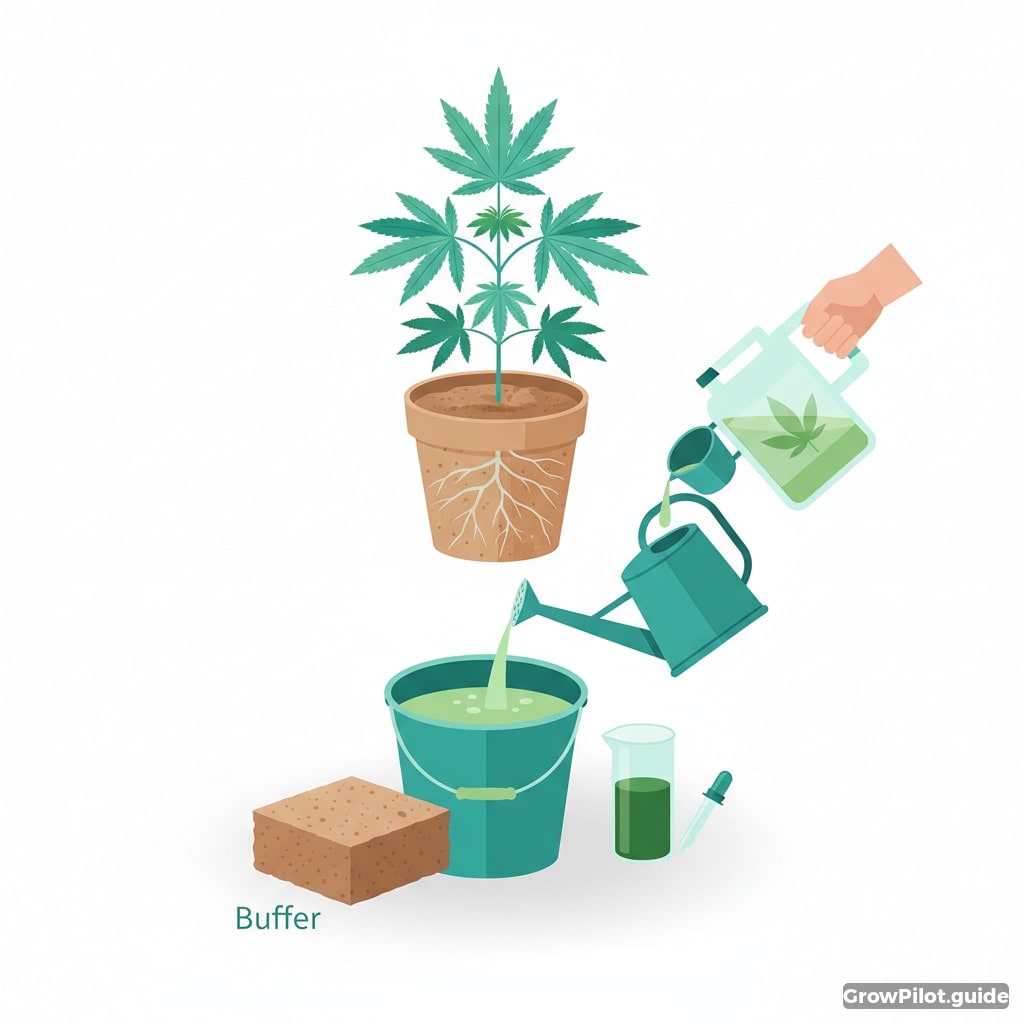
How to properly pre-buffer fresh coco with calcium and magnesium before first use and then prepare a stable starter fertilizer for young plants.
Introduction
Fresh or poorly pre-treated coco/coco substrate can bind nutrients at the start of the grow, especially calcium and magnesium. This is not a classic fertilization error, but a property of the medium: coco has cation exchange sites where calcium and magnesium can be preferentially bound. If the plant is potted and watered unprepared, it will lack these elements in the root zone despite a correctly mixed nutrient solution.
This guide therefore deals with a topic that is crucial in coco cultivation: the pre-buffering of coco and the correct starting fertilization in the first few days. The aim is a stable nutrient start without early Ca-Mg problems, without unnecessarily high EC and without salt stress.
Why pre-buffering in Coco is necessary
In contrast to soil, Coco itself provides hardly any plant-available nutrients. At the same time, it can initially:
- bind calcium
- bind magnesium**
- show relatively high potassium and partly sodium in the exchange behavior
In practice this means
- Coco is not a pre-fertilized long-term medium
- the plant should be supplied with nutrient solution in Coco from the first watering
- without pre-buffering, the risk of early calcium and magnesium deficiencies increases significantly
Young plants in particular react quickly to this because Coco is hardly forgiving and nutrient changes quickly reach the root area.
How to recognize good coco
Not every coco substrate needs the same pre-treatment. High-quality coco is usually:
- washed
- buffered or declared as "buffered"
- low in salt
- airy and structurally stable
Even if the product is already buffered, a light initial supply of calcium and magnesium in the coco cultivation makes sense. Targeted pre-buffering is particularly important for unbuffered or cheaper coco.
How to pre-buffer Coco correctly
1. moisten the substrate completely
First moisten the coco evenly with water or a weak nutrient solution so that dry areas disappear. Dry coco absorbs nutrients unevenly.
2. prepare buffer solution
A solution containing is suitable for pre-buffering:
- pH 5.8 to 6.0
- EC approx. 0.8 to 1.2 mS/cm
- a clear focus on calcium and magnesium
In practice, this is usually done via:
- a Cal-Mag additive
- or a coco-base fertilizer that already contains sufficient Ca and Mg
It is not important to use extremely high doses, but that the cation exchange sites in the substrate are filled with Ca and Mg before planting.
3. allow a reaction time
The moistened coco should be completely saturated with the buffer solution. It is then left to stand for several hours. Many growers work with 8 to 24 hours contact time so that the ion exchange can run smoothly.
4. do not reset dry
After pre-buffering, Coco should not dry out completely. It is used in a slightly moist state so that the starting conditions remain stable.
The correct starting fertilization after planting
Coco is not started with pure water as in heavily pre-fertilized soil. The following applies after planting:
- any watering contains nutrients
- pH 5.8 to 6.0**
- Starting EC for young plants usually approx. 0.6 to 0.9 mS/cm
For rooted cuttings or more vigorous young plants, depending on genetics and product line, you can start a little higher, but in Coco a moderate, complete start is usually safer than aggressive early fertilization.
Composition of the starting solution
The starting solution should contain:
- some nitrogen for new growth
- sufficient calcium
- sufficient magnesium
- a complete micronutrient base
A typical mistake is to give only a very weak growth fertilizer without checking whether there is enough Ca and Mg in the final mix.
Common mistakes when starting nutrients in Coco
Too low EC with unbuffered Coco at the same time
The medium then binds some of the Ca and Mg, and the plant starts with an undersupply despite fertilization.
Water only with water
This works poorly in Coco because the medium itself provides hardly any nutrients.
pH too high
If the pH is significantly higher than 6.0, the availability of individual elements deteriorates. For Coco, 5.8 to 6.0 remains the clean target range.
Only add Cal-Mag when symptoms are visible
It is better to preventively provide a suitable basic supply instead of only reacting to signs of deficiency.
How to recognize that the start is right
A successful nutritional start in Coco is usually indicated by:
- rapid, uniform new growth
- Stable leaf color without early brightening
- no rusty spots or marginal necrosis on young tissue
- no burnt tips due to overcoated starting EC
If plants appear pale, blotchy or faltering in the first few days, they should be checked first:
- was the coco really buffered?
- Is there enough calcium/magnesium in the solution?
- Is the pH 5.8 to 6.0 correct?
- Is the starting EC suitable for the stage of development?
Conclusion
In coco cultivation, the preparation of the medium is often decisive for a problem-free start. If you pre-buffer Coco, prepare it properly with calcium and magnesium and then use a light, complete nutrient solution from the first watering, you will avoid many typical early problems. Coco reacts quickly and directly. This is precisely why it is worthwhile to start the nutrient supply precisely and in the right medium.
Pro Tips
- Never start unbuffered coco with water alone.
- Keep the pH in Coco at 5.8-6.0.
- Cal-Mag is an integral part of Coco-Start.
- It is better to fertilize young plants in Coco completely but mildly.
- Coco that has already been buffered still benefits from clean start EC.
Frequently Asked Questions
How do I supplement Coco with calcium and magnesium?
To buffer Coco before use, mix it with a solution of water and calcium and magnesium fertilizer in a ratio of about 1–2 g per liter of water, and let it soak for at least 24 hours.
What nutrients are important for the initial fertilization of young plants?
For the initial fertilization of young plants, nitrogen, phosphorus, and potassium in balanced proportions are important; these are often provided in a special starter fertilizer formulation.
How often should I change the nutrient solution for young plants?
The nutrient solution should be changed every 1–2 weeks to prevent salt buildup and ensure nutrient availability.
More Growing Knowledge & Smart Grow Help
GrowPilot.guide is the cannabis grow tracker and weed cultivation app with smart plant analysis, indoor cannabis growing guide, grow diary, community, cups and autoflower grow tracker for growers worldwide.
Open GrowPilot.guide App →