Pineapple Express: Genetics, Growth, and Its Tropical, Resinous Profile
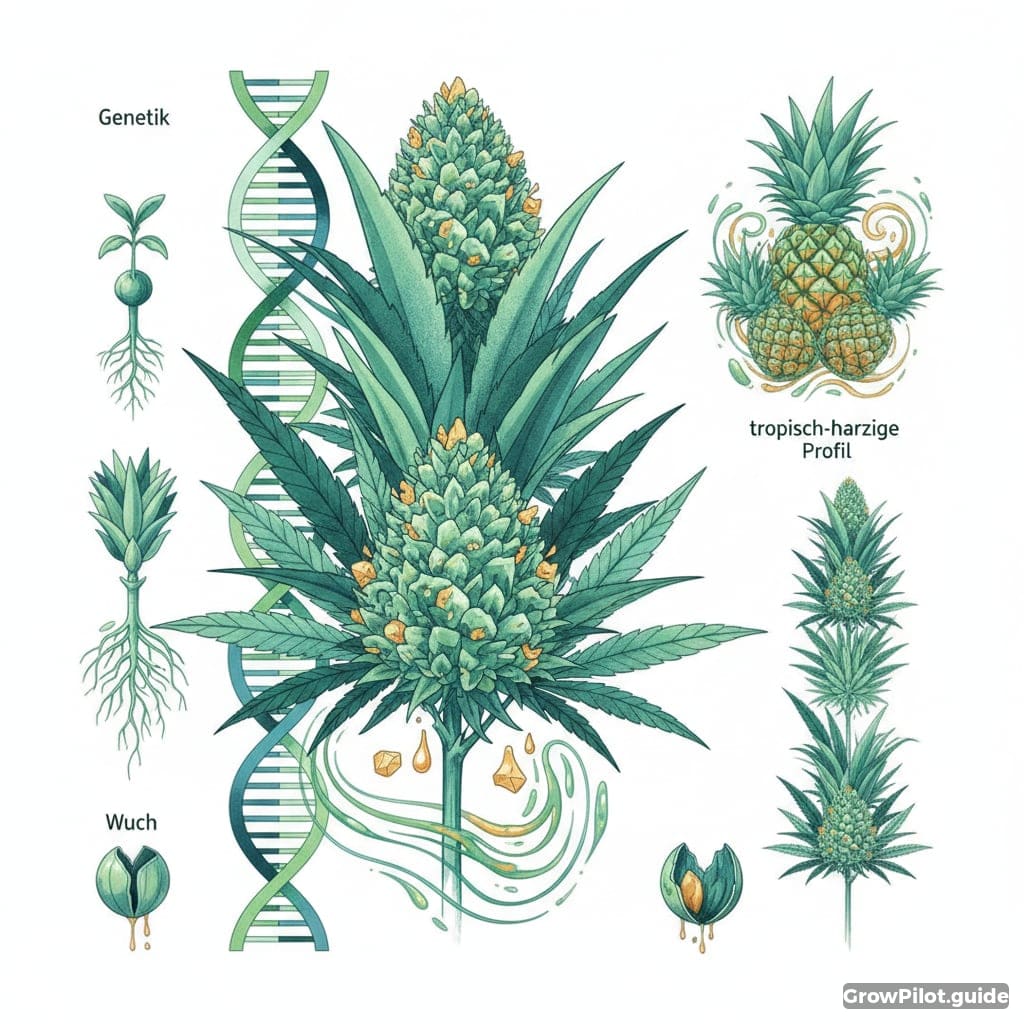
Pineapple Express combines tropical, fruity aromas with vigorous hybrid growth. This article provides practical information on its origin, flowering, terpenes, effects, and key growing tips.
# Pineapple Express: Genetics, Growth, and the Tropical-Resinous Profile
Pineapple Express is one of those strain names that has become famous far beyond the actual growing scene. This is due not only to pop culture but also to the fact that the strain is described in many archives, seed bank catalogs, and grow reports with a relatively clear core profile: fruity-tropical aroma, vigorous hybrid growth, good resin production, and mostly medium flowering times. At the same time, as with many popular names, not every line marketed as Pineapple Express is genetically identical. Differences between breeder versions, selections, and phenotypes are real and should be taken into account when classifying the strain.
For growers, the strain is particularly interesting because it often presents as a medium-sized to robust hybrid with active lateral branching. It’s easy to manage indoors, but according to many reports, it also performs convincingly in greenhouses and warm outdoor setups. Anyone growing Pineapple Express should rely less on the brand name alone and pay closer attention to reliable characteristics: lineage, stretch, flower density, climate requirements, and terpene development.
What is Pineapple Express genetically?
The most commonly cited genetic foundation of Pineapple Express is a cross between Trainwreck and Hawaiian. This classification can be found in international strain archives, on several seed bank websites, and in many older user reports. Historically, therefore, there is good reason to believe that this exact combination forms the most well-known genetic foundation of the strain.
Nevertheless, caution is advised. As with other widely used names, there are now several seed lines and breeder-specific interpretations that can differ in growth habit and aromatic profile. Some versions tend to be more fruity and sweet, while others exhibit more spicy, woody, or slightly diesel-like undertones. In practice, this means that while the name provides a general direction, it does not guarantee absolute standardization.
What the parent strains typically contribute
- Trainwreck is often associated with vigorous growth, pronounced branching, and, in some cases, spicy-fresh notes
- Hawaiian is described in many accounts as having tropical-fruity accents and a lighter, sweeter aroma
- The combination often results in Pineapple Express having a balanced to slightly Sativa-dominant hybrid character
How does Pineapple Express grow in everyday cultivation?
In practical cultivation, Pineapple Express is usually described as medium to tall. Indoors, it often remains manageable with a controlled vegetative period, but may exhibit a clearly noticeable stretch in early flowering. A typical growth pattern features a robust main stem and active side shoots, making the strain well-suited for low-profile canopy structures and even light distribution.
Many growers report a plant structure that is more open than that of heavy Kush strains, yet more compact than that of very tall Haze types. This is precisely what makes Pineapple Express versatile in many setups.
Typical Growth Characteristics
- Indoor height: usually medium-sized, but can exceed this with vigorous vegetative growth
- Outdoor height: can be significantly taller in warm, long growing seasons
- Stretch: often moderate to significant, especially during the first two to three weeks of flowering
- Branching: usually well-developed
- Flower structure: rather elongated to compact, depending on the phenotype
What flowering time and yields are realistic?
For photoperiod Pineapple Express strains, many breeders and grow reports cite a flowering time of about 8 to 10 weeks. The practical range is often around 9 weeks, though individual phenotypes may mature slightly earlier or later. Outdoors, harvest is typically described as occurring in the early to mid-fall window, depending on climate, latitude, and selection.
When it comes to yield, it’s worth taking a realistic look. Marketing claims can sometimes be optimistic, but realistic yields are usually in the moderate to good range.
Realistic Yield Ranges
- Indoors: often about 400 to 550 g/m² under good conditions
- Outdoors: frequently 400 to 700 g per plant; even higher yields are possible with a long growing season and ample root space
What does Pineapple Express smell and taste like?
Its aroma profile is the main reason why the strain remains in demand to this day. Across many sources, a relatively consistent core emerges: pineapple, tropical fruits, citrus, sweet woody notes, and a slight spiciness. Depending on the line, earthy, resinous, or slightly pine-like undertones may also be present.
Frequently Mentioned Terpenes
Across breeder descriptions and lab profiles of similar lines, the following terpenes are frequently mentioned:
- Myrcene
- Limonene
- Caryophyllene
- sometimes Pinene or Ocimene in smaller amounts
What effects do users describe, and what are the limitations of such descriptions?
Descriptions of effects are inherently subjective. They depend, among other factors, on chemotype, terpene profile, dose, method of consumption, tolerance, and individual response. Accordingly, user reports should not be interpreted as fixed laws of effect.
The common thread running through many reports is this: Pineapple Express is often described as mood-lifting, clear-headed, mildly stimulating, and at the same time not entirely light on the body. Many users classify it as a hybrid offering mental alertness and moderate physical relaxation.
Frequently Cited Impressions
- focused or attentive
- creative or talkative
- relaxed, but not necessarily heavy
- at higher doses, sometimes noticeably calmer and more physical
Is Pineapple Express suitable for beginners?
To a certain extent, yes. In many grow reports, Pineapple Express isn’t considered an extremely finicky diva, but it’s not exactly a foolproof strain either. Those who have mastered the basic rules regarding climate, watering, and canopy management usually do well. However, completely inexperienced growers may still stumble over two typical challenges: stretch management and humidity control during late flowering.
Difficulty Level
- Beginners: possible if the setup is stable
- Intermediate growers: often very well suited
- Experts: interesting for selecting for aroma and structure
What growing tips are particularly important for Pineapple Express?
Climate and Environment
Pineapple Express has been reported to perform well under consistently warm temperatures and with good air circulation. Recommended conditions are:
- Vegetation: about 24 to 28 °C
- Flowering: about 22 to 26 °C
- Humidity: moderate during veg, significantly lower in late flowering
Training and Canopy Management
Due to its active side branches, this strain often responds well to:
- LST for flat canopies
- Topping during the vegetative stage, allowing sufficient recovery time
- SCROG in smaller indoor spaces
- targeted thinning for better light and air distribution
Nutrients and Common Mistakes
Pineapple Express is generally not described as extremely hungry. A balanced fertilization regimen without over-fertilization is often advisable. Common mistakes include:
- too long a vegetative phase before the flowering transition
- too much nitrogen during early flowering
- insufficient support for longer side shoots
- too high humidity in the final weeks
- harvesting too early, before full terpene maturity
Conclusion: Who Should Grow Pineapple Express?
Pineapple Express is particularly appealing to growers who want to combine fruity, tropical aromas with vigorous yet manageable hybrid growth. The strain isn’t a pure yield record-breaker or an ultra-compact beginner’s strain, but it offers a compelling balance of resin, aroma, and plant vitality in many setups.
Growers should not confuse the name with complete uniformity. The resilient core remains clear, however: Trainwreck-Hawaiian lineage, medium flowering time, good stretch, a tropical-sweet profile, and solid cultivation performance. It is precisely this blend that explains why Pineapple Express has remained relevant despite many new trends.
Frequently asked questions about Pineapple Express
What genetics is Pineapple Express most commonly attributed to?
Pineapple Express is most commonly described as a cross between Trainwreck and Hawaiian. However, the article also emphasizes that there are several breeder-specific strains and interpretations, so the name does not guarantee complete genetic uniformity.
How does Pineapple Express typically grow when cultivated indoors?
Pineapple Express is generally described as medium to tall when grown indoors and can stretch significantly during early flowering. It typically features a robust main stem and active side shoots, which is why early pruning may be advisable in smaller spaces.
How long does Pineapple Express typically bloom?
Many breeders and grow reports cite a flowering time of about 8 to 10 weeks for photoperiod Pineapple Express strains. The practical window is often around 9 weeks, although individual phenotypes may mature slightly earlier or later.
According to typical descriptions, what does Pineapple Express smell and taste like?
The core profile is described as fruity and tropical, with notes of pineapple, tropical fruits, citrus, sweet woody notes, and a hint of spice. Depending on the line, earthy, resinous, or slightly pine-like undertones may also be present.
Is Pineapple Express suitable for beginners?
To a certain extent, yes: The article doesn’t describe Pineapple Express as extremely finicky, but it doesn’t describe it as completely foolproof either. With a stable setup and a basic understanding of climate, watering, and canopy management, beginners can usually manage, but they should pay special attention to stretch management and moisture control during late flowering.


