Targeted control of root zone wetting in the pot
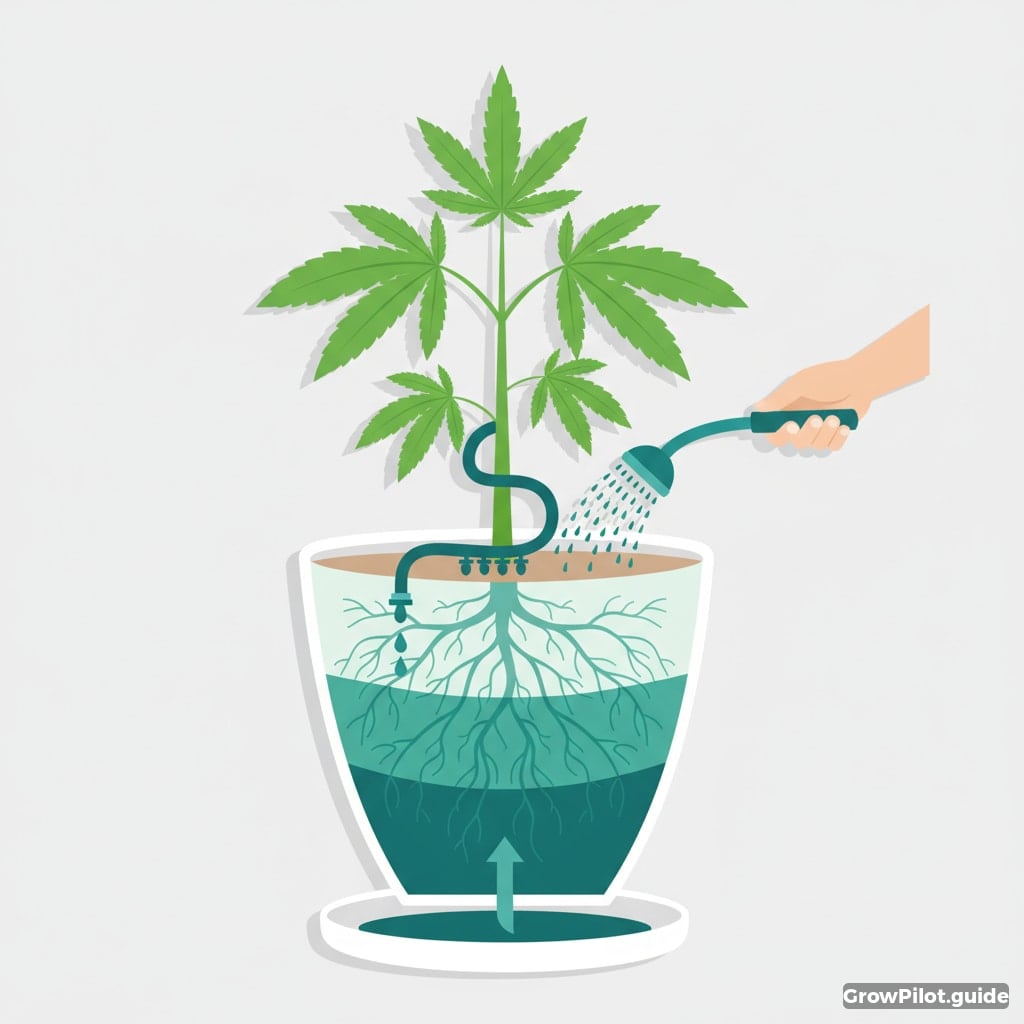
This guide shows you how to maintain even wetting in the pot when watering, avoid drying channels and safely reabsorb substrate that has become hydrophobic.
## Introduction
Not every watering problem is a question of **too much** or **too little** water. Often the cause lies in **uneven wetting of the substrate**. Water then runs past the edges of the pot, forms preferential flow paths or only moistens the upper area, while parts of the root zone remain dry. The result: despite apparently regular watering, the plant shows symptoms of stress because the roots are not evenly supplied everywhere.
This guide focuses exclusively on **how water is distributed in the pot** and how you can reliably reach the entire root zone.
## Why uneven wetting is problematic
When substrate absorbs water unevenly, dry and wet zones are created side by side. This has several disadvantages:
- **Roots develop the pot less well**
- Drain can occur even though there are still dry areas inside**
- Salts accumulate more locally** if individual zones are repeatedly skipped over
- Pot edges often dry out first** and then become water-repellent
This is particularly common when the substrate is very dry, with mixtures containing peat or when water is only ever poured quickly into the center of the pot.
## Typical signs of wetting problems
Look out for these signs:
- Water runs **immediately down the pot wall**
- Even after a small amount **much drainage** appears
- The surface is dark and wet in places, other areas remain light and dry
- The pot appears **unusually light** after watering
- The substrate pulls away from the sides of the pot
- In the finger test, only the top layer is moist, but deeper down it is dry
Important: A lot of drainage does not automatically mean that the whole pot has been well moistened.
## How to water for even distribution
The most effective method is **slow watering in several stages**.
### Staged method
1. initially give only a **small pre-wetting**.
2. wait **1 to 3 minutes** so that dry areas can absorb water.
3. slowly pour in the next partial quantity.
4. repeat this until the substrate is evenly moistened.
This method is much better than a large amount of water in one go. Dry substrates often only absorb water reliably after a short period of pre-wetting.
### Watering direction in the pot
Don't just distribute the water centrally. It makes sense to use a pattern:
- **outer ring near the pot wall**
- **middle area**
- **lightly pouring in towards the center**
This will prevent the edges from remaining permanently dry. However, do not water so directly against the wall that the water immediately runs down between the pot and the substrate.
## Moisten hydrophobic substrate again safely
Very dry soil can become **hydrophobic**, i.e. repel water. Water then runs off or shoots down through channels.
### Procedure for hydrophobic areas
- Water **very small quantities** one after the other instead of one large quantity.
- Allow **short periods of time between watering**.
- Repeat the process until the surface no longer repels water.
- Then check whether the pot has become noticeably heavier.
If the substrate is highly water-repellent, bottom watering** can also help as a corrective measure: The pot is briefly placed in a shallow bowl of water so that the substrate draws water capillary from below. This method should be used selectively, not permanently as standard, because otherwise wetting patterns and salt distribution can develop unfavorably.
## Check wetting in the pot
After watering, you should not only pay attention to drainage, but also to **distribution**.
### Practical check
- Compare the **pot weight** before and after watering
- Check the surface at **several points**, not just in the middle
- Make sure that the pot rim remains dry
- With fabric pots, check the outer zones in particular, as they dry out more quickly
A well-wetted pot feels **evenly heavy** after watering and does not show any extremely dry edges.
## Common mistakes
### Watering too quickly
Rapid watering creates preferential flow paths. The water runs through instead of being distributed.
### Always water the same spot
If you always water in the middle, you promote uneven root zone wetting.
### Allowing the substrate to dry out too much
The drier the substrate, the more difficult it is to absorb water evenly.
### Misinterpret drain
Early drainage is not proof of complete soaking.
## Conclusion
Good watering means not only giving the right amount, but also wetting the **entire root zone evenly**. Slow watering in stages, deliberate distribution over the pot surface and timely recognition of hydrophobic areas prevent dry channels and unsupplied root areas. If you control the wetting instead of just adding water, watering is much more precise and stable.
## Pro Tips
- Pour in 2 to 4 batches instead of all at once.
- Pay particular attention to the dry edges of the pot.
- Early drainage may indicate channel formation.
- Do not allow the substrate to dry out excessively.
- Only use bottom-watering as a targeted correction.
🌿 More Growing Knowledge & Smart Grow Help
GrowPilot.guide is the cannabis grow tracker and weed cultivation app with smart plant analysis, indoor cannabis growing guide, grow diary, community, cups and autoflower grow tracker for growers worldwide.
Open GrowPilot.guide App →