How to Properly Interpret Rolled-Up Cannabis Leaves
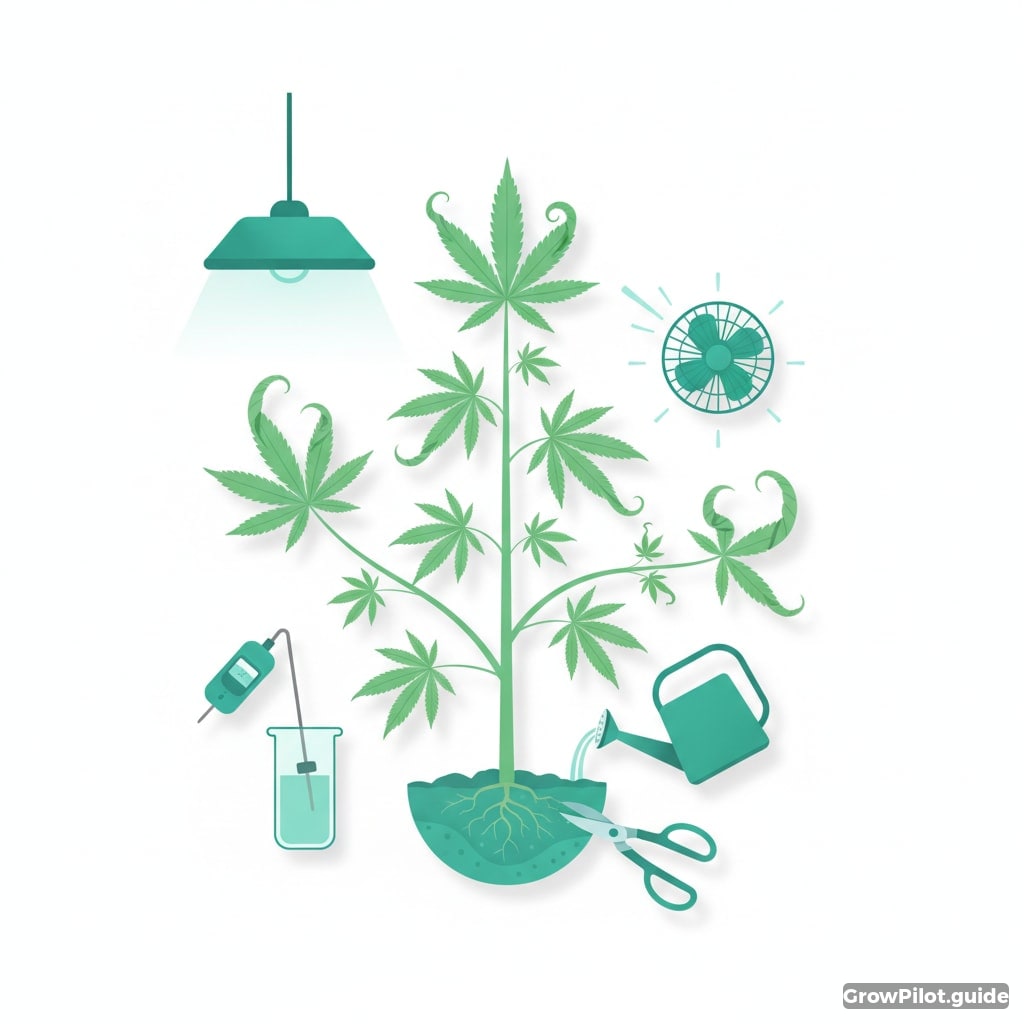
If cannabis leaves curl upward like a taco or hook downward like claws, it’s usually due to environmental or root stress. Here’s how to clearly identify these patterns.
Introduction
Curled leaves are among the most common warning signs in cannabis cultivation. There are two main patterns to look out for: taco leaves, where the leaf edges curl upward, and claws, where the tips of the leaves or entire leaves hook downward. Both forms look similarly conspicuous but often have different causes. Therefore, it’s not just the symptom itself that matters, but when, where, and under what environmental conditions it occurs.
This guide addresses the topic exclusively as a growing question of symptom identification and narrowing down causes. The focus is therefore on correctly interpreting leaf curling based on pattern, stage, and environment—not on fertilization plans, watering schedules, or harvesting techniques.
What Is Meant by “Taco” and “Claws”
Taco Leaves
The term “taco” is used when the leaf edges curl upward at the sides. The leaf then appears bowl-shaped or like a folded taco. Often, the leaf color remains normal at first, while the shape visibly changes.
Typical accompanying signs:
- upright or tense leaf posture
- dry, hot, or very bright location
- upper canopy more severely affected
Claws
Claws appear when leaf tips or entire leaf lobes bend downward. The leaf appears hooked, heavy, or unnaturally pulled downward. Depending on the cause, the leaf may appear dark, soft, firm, or generally unbalanced.
Typical accompanying symptoms:
- Middle to lower foliage is more severely affected
- Compact, stocky overall appearance
- Uneven distribution throughout the crop or on individual plants
Why the curling pattern is important
Leaf shape is a rapid response to stress. Cannabis alters leaf position to cope with light, temperature, humidity, root space, or general stress. Therefore, curled foliage is not a problem in and of itself, but rather an indication of an environmental disturbance.
Important: A single, slightly deformed leaf is often not a cause for alarm. It becomes a concern when:
- several new leaves exhibit the same pattern
- the symptom worsens within 24 to 72 hours
- specific areas of the plant are particularly affected
- other signs of stress appear, such as drooping, curling, twisting, or stunted growth
Taco Leaves: Common Causes
Taco leaves are most often caused by excessively high leaf surface temperature or excessive light exposure. The plant then tries to reduce the area directly exposed to light.
Common triggers in a growing context:
- light that is too intense relative to the plant’s growth stage
- insufficient distance from the light in indoor growing
- Heat buildup in the upper part of the plant
- Dry air combined with heat
- Sudden full sun exposure after insufficient acclimation when growing outdoors
“Taco rolls” are particularly typical when the topmost leaves directly beneath the light source are affected, while lower leaves still look normal.
Claws: Common Causes
Clawing tends to indicate stress in the root system or metabolism rather than pure light stress. This doesn’t automatically mean the cause lies in the same specific factor, but the pattern more often points to a problem that makes the plant appear “heavy” or unbalanced overall.
Common causes during cultivation:
- A root zone that is consistently too wet with little air in the growing medium
- Compacted or poorly aerated growing medium
- A pot that is too large for the early stages of growth, especially if the environment remains cool and damp for an extended period
- severe environmental stress after repotting or moving the plant to a new location
- root binding in containers with heavily root-bound plants
Clawing often appears not only at the top but at multiple levels of the plant. If the leaves also appear heavy and inelastic, it’s worth taking a closer look at the pot, substrate structure, and root zone climate.
Classify Correctly by Growth Stage
Seedlings and Early Young Plants
In the early stages, leaf curling is often caused by excessive light, heat stress, unsuitable starting conditions, or an unstable environment. Young plants react more quickly than established ones.
Vegetative stage
Here, patterns can usually be compared easily because the plant is actively forming new foliage. The key question is: Are only new leaves affected, or older ones as well? New deformities are more likely to indicate a current environmental problem.
Flowering Stage
During flowering, “taco” leaves—especially in the upper part of the crown—can indicate excessive light or heat. During this phase, claw-like deformations must be clearly distinguished from normal aging of individual older leaves. Not every downward-pointing leaf automatically indicates the same symptom.
How to Systematically Narrow Down the Cause
Instead of immediately assuming a single cause, use a simple checklist:
- Where is the symptom located?
- Spread throughout: likely the root zone or general stress
- Which leaves are affected?
- older and middle leaves: long-standing stress more likely
- When did it start?
- Is the pattern consistent?
- Only individual plants: more likely a pot- or plant-specific cause
Common Misinterpretations
- “Tacos” and “claws” are often confused. Edges curled upward are different from tips hooking downward.
- Not every drooping leaf is a “claw.” Limp drooping and active hooking look similar but do not mean the same thing.
- Individual leaves are not very indicative. What matters is always the pattern across multiple leaves and their distribution on the plant.
Conclusion
Curled cannabis leaves are not a coincidence but a useful diagnostic sign. Taco leaves more often indicate light, heat, or drought stress in the upper part of the plant, while claws tend to point to stress related to the root zone, substrate climate, or general plant stress. By considering not only the leaf itself but also its position, growth stage, and environment, you can narrow down the cause much more reliably and avoid making the wrong decisions.
Pro Tips
- Always compare the upper and lower leaf layers separately.
- Do not treat new and old leaves as the same signal.
- After changing the location or replacing the bulb, monitor the plant closely for 2 to 3 days.
- A consistent symptom throughout the entire population often points to the room.
- Photos taken from the same angle help to clearly compare rolling patterns.
More Growing Knowledge & Smart Grow Help
GrowPilot.guide is the cannabis grow tracker and weed cultivation app with smart plant analysis, indoor cannabis growing guide, grow diary, community, cups and autoflower grow tracker for growers worldwide.
Open GrowPilot.guide App →