Using watering rings and watering edges correctly
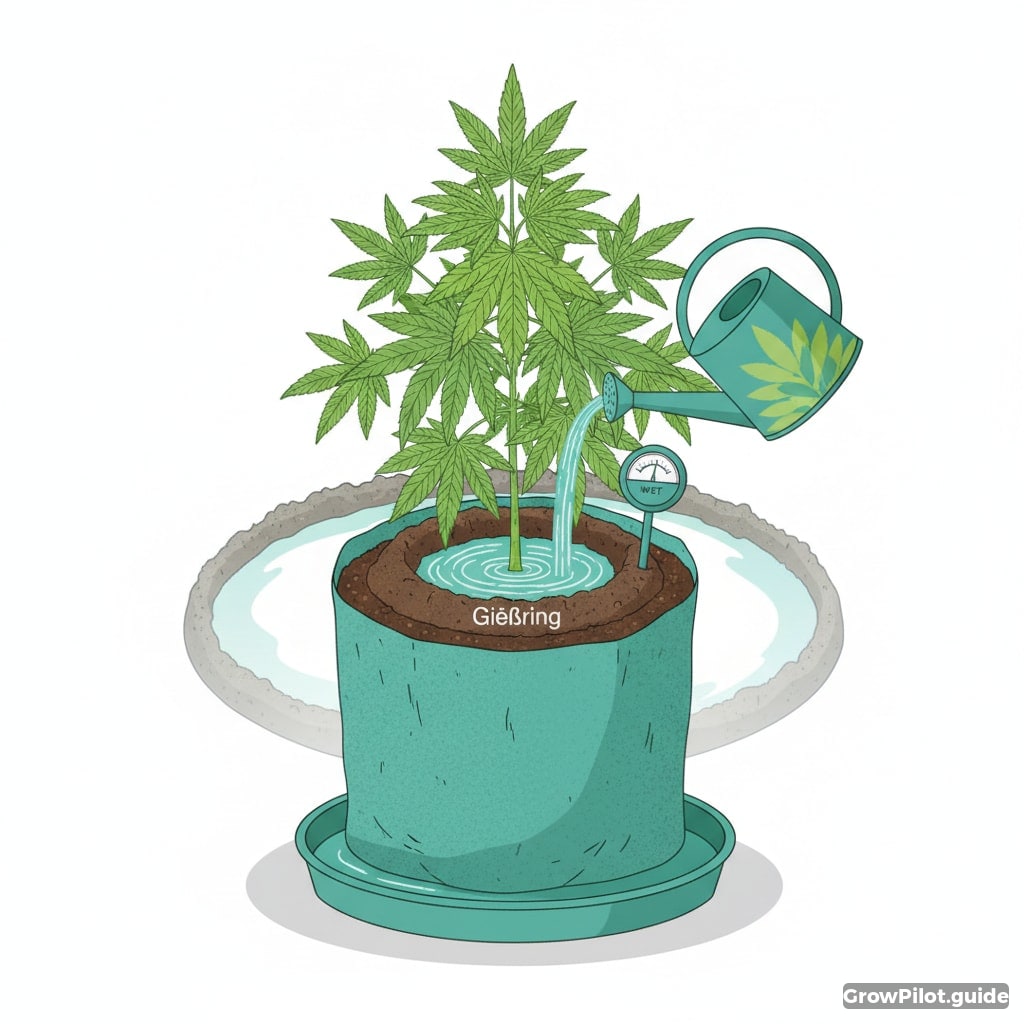
This allows you to correctly place watering rings and drawn watering edges in the pot so that water does not run off to the side, seeps in more slowly and the root zone is supplied evenly.
Introduction
An often overlooked part of watering is the shape of the substrate surface. Especially in pots with soil or soil-coco mixtures, water easily runs to the side when watering, collects at the edge of the pot or shoots through individual areas too quickly. A simple but effective approach is the targeted use of watering rings or watering edges. This does not mean a separate watering system, but a deliberately shaped depression or a slight mound on the substrate surface that keeps the irrigation water where it should seep in.
This guide deals exclusively with how to use, control and adjust such edges when watering.
What a watering ring does
A watering ring is a flat ring-shaped depression or a low edge on the substrate surface. The aim is that the water:
- does not run off immediately to the edge of the pot
- soak in more slowly and evenly
- is better distributed in the upper root area
- can be placed more precisely when watering small quantities
This is particularly useful for substrates whose surface initially takes up water poorly after drying. The ring extends the contact time between the water and the surface.
When this technique is useful
Watering rings are particularly helpful if you notice the following problems:
- Water runs down the side of the pot when watering
- the surface becomes unevenly wet
- small amounts of water disappear too quickly in individual places
- the substrate has hardened or shrunk slightly at the top
- you want to control the watering speed better
This method is less useful if the surface remains very loose anyway and water is already seeping in evenly. In this case, a ring offers little additional benefit.
How to lay an irrigation edge correctly
The edge should be flat and functional, not deep like a trough. The aim is to channel water, not to create pools.
Practical design
- Use your fingers or a clean stick to form a slight depression in the area above the active root zone.
- Leave some distance to the pot wall so that water does not run directly down the edge.
- The ring should only be so pronounced that water is held briefly and then seeps in.
- Do not compress the surface too much**, otherwise you will impair the air flow in the upper substrate area.
In small pots, a single flat ring is often sufficient. In larger pots, a wider watering area may make more sense than a narrow trough.
Watering correctly with a watering ring
The technique only works with slow watering speed. If watered too quickly, even a well-formed ring will overflow or form preferential flow paths.
Procedure
- first pour a small amount of water into the ring.
- wait briefly until the surface has absorbed the first dose.
- only then continue pouring, in several small passes.
- observe whether water remains in the ring or seeps in cleanly.
Important: A watering ring does not replace the control of moisture and water quantity. It only improves the distribution on the surface.
How you can tell if the ring is working
A well-designed watering ring has clear effects:
- the water remains in position for a short time and then seeps away evenly
- There is less lateral run-off at the edge of the pot
- the surface is moistened more evenly and more evenly
- you have to work less against dry edges
If the water remains standing for a long time, the ring is too deep or the substrate is not absorbing water well. If it immediately disappears sideways, the rim is too shallow or incorrectly positioned.
Typical errors
Trough too deep
A deep trough collects water at certain points. This can lead to uneven wetting instead of improving it.
Too close to the pot wall
Then you are encouraging the very problem you want to avoid: Water seeks its way down along the rim.
Press down the surface
Compacted substrate often absorbs water less well. Shape the ring loosely, not compactly.
Too large single doses
Even with a watering ring, water should be given in portions. Large quantities overload the surface.
Care and follow-up
Irrigation edges do not remain permanently stable. They lose their shape through repeated watering, shrinkage of the substrate and handling.
Therefore, check regularly:
- Is the edge still recognizable?
- Is water running faster to the side again?
- Has the surface sunk or hardened?
- Does the ring need to be slightly reshaped?
A quick check before pouring is usually sufficient. The method is simple, but only effective if the edge can actually still hold water.
Conclusion
Watering rings and watering edges are a small surface correction with a practical effect. They do not help with every watering problem, but they can significantly calm seepage and reduce lateral run-off. The decisive factors are a flat shape, slow watering and regular monitoring. This allows you to use the available water more efficiently and supply the root zone more evenly.
Pro Tips
- Lay the ring flat, not as a deep hollow.
- Keep some distance from the pot wall.
- Pour in small portions instead of all at once.
- Reshape the edge if it is washed out.
- Do not press the surface firmly when putting it on.
More Growing Knowledge & Smart Grow Help
GrowPilot.guide is the cannabis grow tracker and weed cultivation app with smart plant analysis, indoor cannabis growing guide, grow diary, community, cups and autoflower grow tracker for growers worldwide.
Open GrowPilot.guide App →