Check residual moisture safely before storage
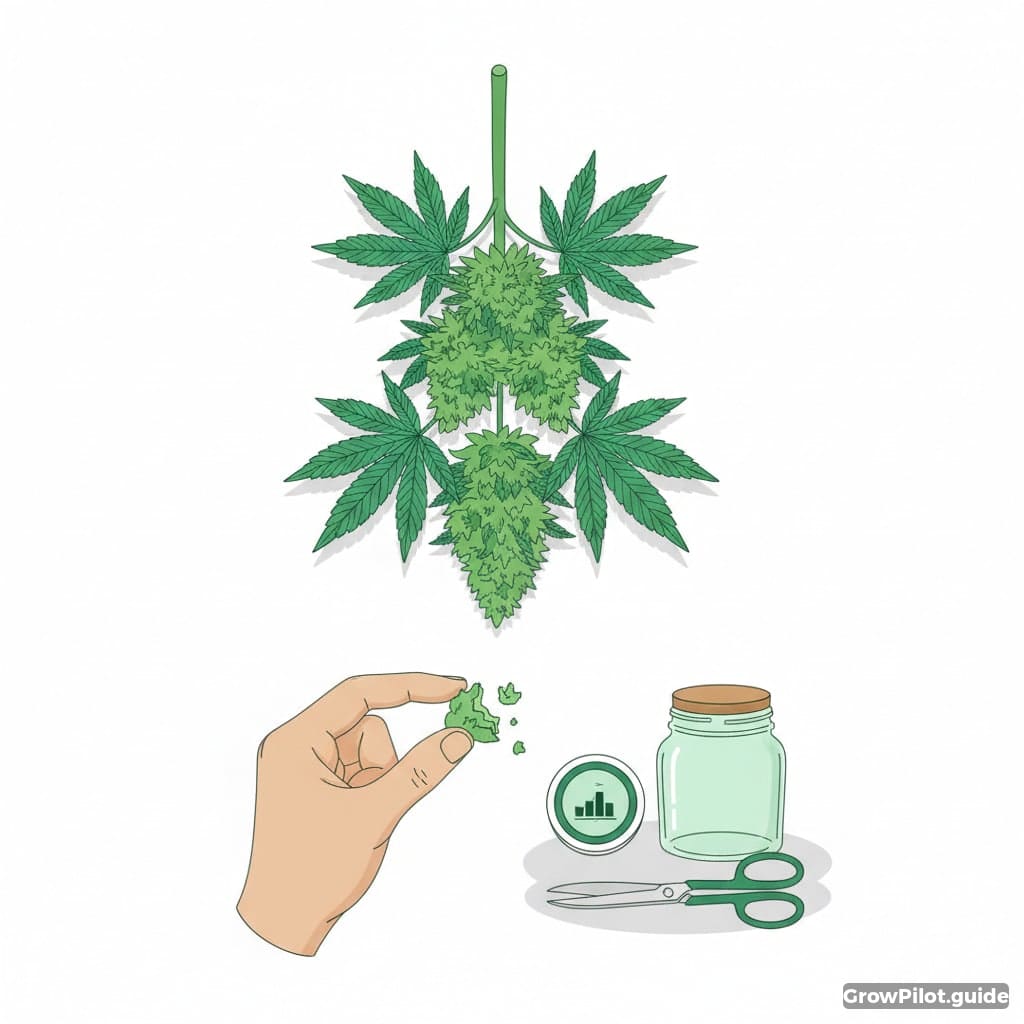
How to tell if cannabis buds are ready for the jar after drying. The guide explains safe testing methods, typical errors and the clean transition to curing.
## Introduction
There is a critical moment between **drying** and **curing**: the correct assessment of **residual moisture**. If buds are stored **too moist**, the risk of **mould, anaerobic odors and loss of quality** increases. If they are placed in the jar **too dry**, the aroma often suffers and clean curing is only possible to a limited extent.
This guide deals exclusively with **checking the drying directly before storage** and the safe transition to **curing**.
## Why residual moisture is so important
After cutting and drying at around **18-22°C** and around **60% relative humidity**, cannabis **does not dry at the same rate** everywhere:
- the **outside** of the buds will dry first
- the **inner core** can be even more moist
- thick flowers and compact tops usually take longer than loose buds
This is precisely why it is not enough to just touch the surface. The decisive factor is whether the flower is **inside dry enough for the glass**, but **not yet overdried**.
## How to recognize sufficiently dried buds
### 1. surface and feel
The outside should feel **dry, but not dusty or brittle**.
Look for these characteristics:
- Sugar leaves appear **more papery** than immediately after harvesting
- the bud surface is **no longer cool and moist**
- when lightly pressed, the bud still yields slightly, but **does not appear wet or soft**
If buds already appear hard on the outside but are still moist on the inside, caution is advised. This is a typical case of **uneven drying**.
### 2. small stem test
A tried and tested practical check is the test on **thin side shoots**:
- **very flexible and fibrous** = usually still too moist
- **bends with a slight audible break** = often a good area for the transition
- **breaks very dry and brittle** = rather already far dried
Important: The stem test is only a **guideline**. Thicker main stems dry more slowly and are less suitable for this assessment.
### 3. check the inner core
Carefully open a **medium-sized flower** with your fingers as a test.
Check as you do so:
- Does the inside still feel **clearly moist or spongy**?
- Do the parts of the plant inside still stick together noticeably?
- Is the smell **fresh, planty and moist** instead of clean and typical of the variety?
If the core still seems wet, the buds should **continue to dry**. They are only suitable for the jar when the inside is **only slightly moist**, but no longer raw and moist.
## Hygrometer method in glass
The safest practical method for hobby growers is a **small hygrometer in a jar**.
### This is how you proceed
1. fill a clean jar loosely to about **70-75%**.
2. place a calibrated mini hygrometer inside.
3. close the jar for a few hours
4. read the relative humidity in the jar.
### Orientation for the evaluation
- above 65 % RH**: still too moist, return to drying
- approx. 58-62 % RH**: good range for curing
- below 55 % RH**: rather too dry for optimal curing
Wait a little after filling so that the humidity in the jar can equalize. Values are often not stable immediately after a few minutes.
## Typical errors in the assessment
### Only go by feel
The outside may appear dry although the bud is still too moist on the inside. This is one of the most common mistakes.
### Storing buds that are too large without checking them
Dense main buds retain moisture longer. Always check **compact tops** separately.
### Put too many buds in the jar at once
If an entire batch is slightly too moist, the humidity in the closed container can quickly rise to a critical level.
### Ignore warning signs in the jar
These are problematic:
- **smell of ammonia**
- Significantly **increasing RH values**
- Buds that become **soft and moist** again after a few hours
The buds must then be immediately removed from the jar and dried again.
## Safe transition to curing
As soon as the buds have reached the target area, the **curing in jars** begins.
The following applies to the start:
- Do not overfill jars
- Store in a cool, dark and clean place
- Check regularly in the first few days
- react immediately if the humidity is too high
The aim is not further rapid drying, but **controlled moisture distribution within the blossom** and a gentle ripening process.
## Conclusion
The right residual moisture determines whether your harvest is **safe to cure** or whether quality is lost. Don't just rely on the dry outside. Combine **haptics, stem test, internal inspection and ideally a hygrometer in the jar**. This way you avoid the risk of mold and start the next phase with clean, dried buds.
## Pro Tips
- Always check compact main buds separately.
- If possible, use a small hygrometer in the glass.
- Re-dry buds with over 65% RH.
- The smell of ammonia is a clear warning signal.
- It is better to dry them a little longer than to store them too moist.
Frequently Asked Questions
How can I test the residual moisture content of my cannabis buds?
A common method is the "snap test": Break off a bud and see if it snaps or bends. If it snaps, it's usually dry enough; if it bends, it needs more time to dry.
What is the ideal residual moisture content for cannabis buds before storage?
The ideal residual moisture content is between 55% and 62%. Within this range, the flavor is preserved and the risk of mold is minimized.
What common mistakes should I avoid when drying cannabis?
Avoid drying it too quickly by exposing it to high temperatures or direct sunlight, as this can damage the terpenes. Storing it in airtight containers too early can also promote mold growth.
More Growing Knowledge & Smart Grow Help
GrowPilot.guide is the cannabis grow tracker and weed cultivation app with smart plant analysis, indoor cannabis growing guide, grow diary, community, cups and autoflower grow tracker for growers worldwide.
Open GrowPilot.guide App →