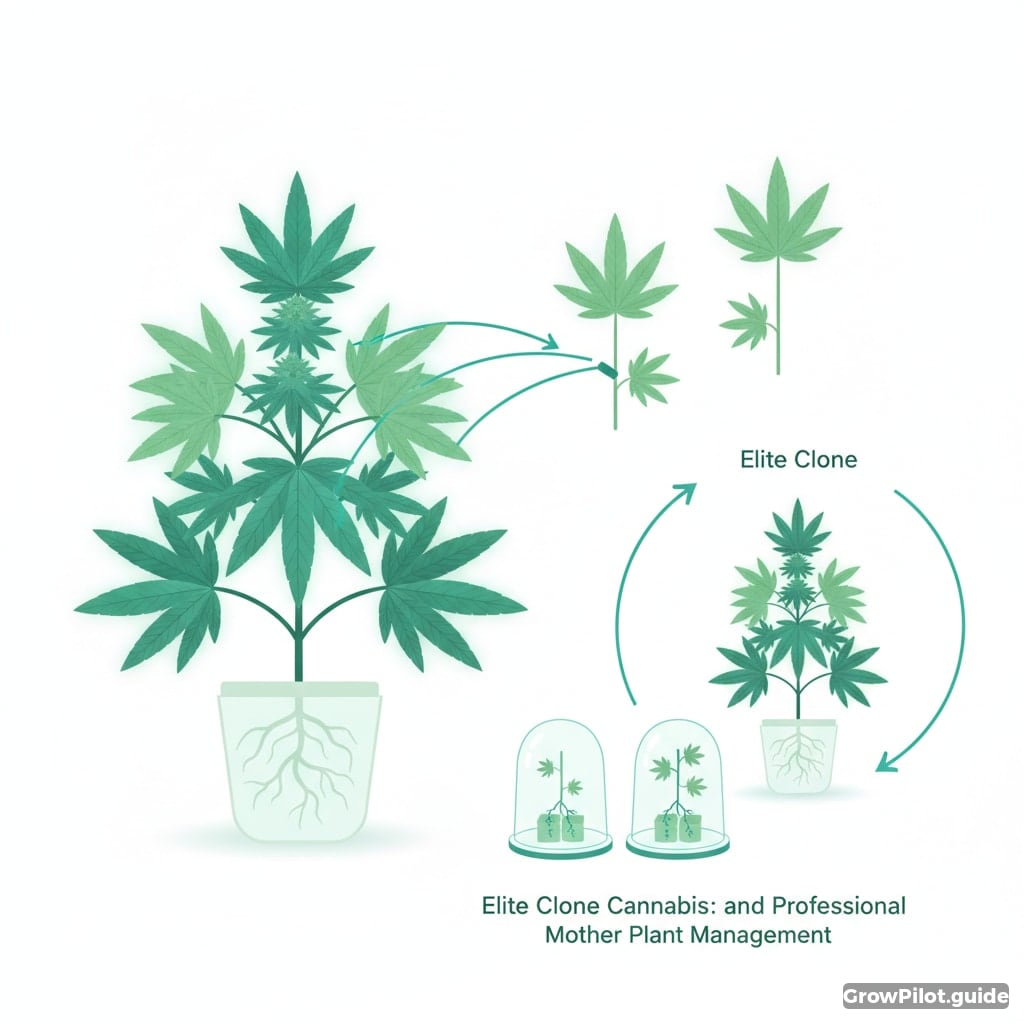
Introduction — What You Need to Know
The term “elite clone” is frequently used in the cannabis community, but surprisingly rarely clearly defined. In forums, shops, and among hobbyist growers, it sometimes simply refers to a “good cutting,” sometimes to a particularly well-known strain, and sometimes even to any mother plant that has already produced a few decent harvests. From a biological and horticultural perspective, this is too vague. A true elite clone is not just any clone of a popular strain, but a specifically selected individual plant with exceptionally stable, above-average, and reproducible characteristics that is propagated vegetatively.
This is important because cannabis, as a seed-propagated species, often exhibits significant variations even within the same strain or the same seed pack. Two plants with the same strain name can differ significantly in growth habit, internode spacing, nutrient requirements, flowering time, resin content, terpene profile, stress resistance, yield, and psychoactive profile. The elite clone is precisely the one plant that stands out from this genetic spectrum and is therefore permanently maintained as a mother plant.
For hobby growers, this topic is particularly relevant for three reasons:
- Consistency: Under proper growing conditions, an elite clone delivers significantly more reproducible results than repeatedly growing from seed.
- Efficiency: Once you’ve found a plant that performs exceptionally well in your setup, you’ll save time, space, and money because you won’t have to keep selecting new plants over and over.
- Quality assurance: Especially with limited growing space, choosing the right phenotype often has a greater impact on the final result than minor differences in fertilizers or lights.
An elite clone is therefore less of a marketing term and more of a selection result. It is the product of genetics, observation, test cultivation, and consistent preservation. That’s exactly why the path to an elite clone is challenging: You have to objectively evaluate traits, test plants under comparable conditions, and keep the selected mother plant healthy over the long term. Anyone who has mastered this process works at a significantly more professional level than someone who merely takes cuttings.
In this guide, we’ll dive deep into the subject: what biologically defines an elite clone, how to recognize one, which criteria really matter, how to distinguish it from “just good” through diagnostic evaluation, how to develop an elite mother plant, and what mistakes even experienced growers regularly make. The goal is not only for you to understand the concept, but for you to be practically capable of identifying, validating, and maintaining an elite clone for years.
Basics
What is an elite clone from a biological perspective?
A clone is a vegetatively propagated copy of a mother plant. With cannabis, this is almost always done in practice using cuttings. The cutting develops from meristematic tissue, roots, and—genetically speaking—continues to grow identically to the mother. This means: When you take a cutting from a plant, you are essentially passing on the same genetics, but not necessarily the same quality. This is because a plant’s observed performance is always the result of:
- Genotype (genetic makeup)
- Environment (light, temperature, growing medium, water, nutrients, pest and disease control)
- Management (training, pruning, pest control, watering schedule)
- Plant age and health
An elite clone is therefore not only genetically strong but also demonstrates its strength robustly and consistently in practice.
Genotype, Phenotype, and Selection
Many misunderstandings arise because genotype and phenotype are confused.
- Genotype: The plant’s genetic makeup.
- Phenotype: The visible and measurable characteristics under specific environmental conditions.
When you grow a seed pack containing 5 or 10 seeds, you’ll get plants from the same cross, but they won’t be identical individuals. These can vary significantly. Among these individuals, you look for the best phenotype. Only when this phenotype consistently performs well over multiple grow cycles—and ideally in different setups—does it make sense to refer to it as an elite clone.
What characteristics define an elite clone?
An elite clone is typically characterized by a combination of the following traits:
- Above-average potency or a particularly balanced effect profile
- Distinctive, nuanced terpene profile
- High resin content
- Good to very good yields relative to area, time, and inputs
- Structural suitability for the respective setup (indoor, outdoor, SOG, SCROG, vertical)
- **Stress resistance to heat, slight nutrient fluctuations, training, and transplanting
- Stability regarding hermaphroditism, foxtailing, maturation behavior, and flower structure
- Health and vitality over the long term as a mother plant
- Ease of rooting for cuttings
Important: An elite clone is almost never absolutely superior in every category. In practice, it is often an optimal overall package. A clone with an extreme aroma but weak structure and high susceptibility to mold is not automatically considered elite. Similarly, a high-yield phenotype lacking in quality is of little interest to many hobby growers.
Why Elite Clones Are So Valuable
Once discovered, an elite clone is valuable to growers because it:
- reduces the uncertainty of seed selection,
- enables a uniform canopy,
- makes the fertilization and irrigation schedule more predictable,
- simplifies harvest planning,
- and, when properly maintained, can deliver reproducible results year after year.
Especially in small grow rooms measuring 60 × 60 cm, 80 × 80 cm, or 120 × 120 cm, the number of plants is limited. In such spaces, selecting the right clone is often more critical than switching from lamp A to lamp B.
The Scientific Background: Somatic Stability and Drift
Cloning implies genetic identity, but not complete immutability. In practice, three aspects play a role:
- Epigenetics: Environmental conditions can influence gene activity without altering the DNA sequence. This can affect growth and yield.
- Somatic mutations: With increasing age and many propagation cycles, mutations can occur in individual cell lines. This is rarely dramatic, but it is possible.
- Pathogen load: Viruses, viroids, fungi, and bacteria can infiltrate dam lines and gradually degrade performance.
The third point, in particular, is massively underestimated. Many supposedly “worn-out” elite clones are not genetically depleted, but rather latently diseased, stressed, or poorly managed.
Mother Plant vs. Elite Clone
Not every mother plant is an elite clone. A mother plant is, first and foremost, simply a plant maintained for cutting production. An elite clone is a selected, validated mother line with proven top performance. This distinction is crucial.
Measurable Performance Parameters
If you want to select professionally, you must make the criteria measurable. These include:
- Flowering time: e.g., 56, 63, or 70 days
- Stretch: e.g., 1.5x, 2x, or 3x after the transition to flowering
- Internode spacing: short, medium, long; ideally documented in cm
- Dry weight yield: g per plant, g/m², or g/W
- Trichome density: documented in a visually or photographically comparable manner
- Terpene profile: sensory evaluation plus, ideally, lab analysis
- Susceptibility: e.g., risk of Botrytis, susceptibility to powdery mildew, calcium requirements
- Rooting time of cuttings: e.g., 7–10 days vs. 14–21 days
Those who do not systematically collect this data can easily confuse enthusiasm with objective selection.
Identification & Diagnosis
How do you recognize a true elite clone?
An elite clone demonstrates its quality not through a single spectacular trait, but through consistent overall performance across multiple trials. Repeatability is particularly important. A one-time exceptional yield under ideal conditions does not make for an elite clone.
Specific Signs During the Vegetative Stage
Important indicators can already be identified during the growth phase:
- Vigorous, symmetrical branching
- Sturdy side shoots capable of bearing weight later on
- Healthy leaf color without persistent symptoms of deficiency or excess
- Short to medium internodes with sufficient air circulation
- Rapid regeneration after pruning or training
- Good rooting of cuttings within about 7–14 days
- No noticeable stress reaction during repotting, defoliation, or mild heat
Specific Signs During Flowering
Flowering reveals whether a candidate is truly exceptional:
- Uniform stretch, easy to plan for
- Early and strong bud formation
- High calyx-to-leaf ratio (plenty of buds, comparatively little foliage)
- Dense, yet mold-resistant bud structure
- Heavy resin production starting in the middle of the flowering phase
- Clear, intense terpene profile even before final maturity
- Clean maturation without excessive foxtailing or unstable bud formation
- Good nutrient tolerance, without an immediate tendency toward burnt tips or lockout
After harvest: The often-underestimated evaluation phase
Many growers select clones too early. An elite clone must also prove itself after drying and curing. Only then can the following be evaluated:
- actual aroma stability
- smokability / vaporizer quality
- Ash formation and combustion
- Duration and nature of the effect
- Bag appeal
- Trimming effort
- Yield after drying, not just wet weight
Diagnostic Chart: Elite Clone, Good Clone, or Reject?
| Criterion | Elite Clone | Good Clone | Reject / Not Worth Keeping |
|---|
| Rooting | 7–10 days, high success rate >90% | 10–14 days, 70–90% | >14 days, unreliable |
|---|---|---|---|
| Growth structure | uniform, vigorous, easy to train | solid, but somewhat inconsistent | weak, spindly, unstable |
| Stretch | predictable, suitable for setup | acceptable | extreme, uncontrollable |
| Flowering time | clear and reproducible | slightly variable | highly variable |
| Resin content | above average | good | medium to low |
| Terpene profile | intense, complex, distinctive | pleasant, but not outstanding | flat or unstable |
| Yield | high relative to flowering time | okay to good | low or inefficient |
| Stress tolerance | high | medium | sensitive |
| Hermaphroditism | no tendency under clean growing conditions | rare isolated cases under severe stress | recurring tendency |
| Suitability as a mother plant | remains vigorous long-term | limited suitability | deteriorates quickly |
Typical diagnostic values for practical use
These values are not laws of nature, but serve as good guidelines for hobby growers:
- Cutting rooting: 22–26 °C air temperature, 24–26 °C root zone temperature, 70–90% RH in the first few days
- Mother plant pH in soil: approximately 6.2–6.8
- Mother plant pH in coco/hydro: approximately 5.7–6.2
- EC for mother plants in moderate cultivation: approx. 1.0–1.6 mS/cm, depending on the system and genetics
- Lighting for mother plants: 18/6 or 20/4, PPFD roughly 200–400 µmol/m²/s
- Flowering PPFD indoors: often 600–1,000 µmol/m²/s, depending on CO₂, temperature, and genetics
- VPD during vegetative growth: roughly 0.8–1.2 kPa
- VPD during flowering: approximately 1.1–1.5 kPa
Warning Signs That a Supposed “Elite” Clone Is Problematic
Watch for these red flags:
- The clone performs well only under extremely specific conditions.
- Cuttings root poorly or unevenly.
- After a few months, the mother plant appears woody, listless, or chlorotic.
- Curled leaves, deformed new shoots, unusual stunting, or loss of terpenes occur repeatedly.
- Under moderate stress, the line is prone to stunted growth or hermaphroditism.
- Yield and quality decline gradually over generations.
In such cases, one must consider pathogens, particularly latent viroid or virus problems. Root diseases, thrips, spider mites, and chronic salt stress can also ruin elite lines.
Step-by-Step Procedures
Goal: Find, validate, and preserve an elite clone
Most hobbyist breeders fail not because of a lack of enthusiasm, but because of a lack of a systematic approach. The following procedure has been tested in practice and minimizes wrong decisions.
Step 1: Select Suitable Starting Material
If you’re selecting from seeds, don’t start with just 1–2 seeds; instead, start with a meaningful sample size whenever possible. For hobbyist conditions:
- 5 plants = minimum preselection
- 10 plants = usable selection
- 20+ plants = significantly better chances of finding a true standout
The smaller the population, the higher the risk that your “elite clone” was merely the best of a weak group.
Step 2: Label each plant clearly
Use unique labels such as:
- Variety_A_P1
- Variety_A_P2
- Variety_A_P3
Also, clearly label cuttings from the same plant. Without precise identification, any selection is worthless.
Step 3: Take backup cuttings before flowering
This is mandatory. Take 2–4 cuttings from each candidate during the late vegetative phase or just before flowering. This way, you can preserve the eventual winner even after the original plant has been harvested.
Recommendation:
- Cutting length: 8–15 cm
- 2–3 nodes
- Clean, sterilized cutting tool
- Root at 22–26 °C and high humidity
Step 4: Grow the plants side-by-side under conditions that are as identical as possible
This is the only way to ensure a fair evaluation. Make sure to:
- Use the same pot size, e.g., 7 L, 11 L, or 15 L
- Same growing medium
- Same distance from the light source
- Same fertilization strategy
- Same training method
- Same watering schedule
If one plant is positioned in the hotspot under the lamp and the other is on the edge, this skews the results.
Step 5: Record data
Document at least the following:
- Germination date
- Growth rate per week
- Internode spacing
- Stretch after 7, 14, and 21 days of flowering
- Start of flowering
- Maturation time
- Signs of pests or diseases
- Trimming effort
- Wet and dry yield
- Aroma during flowering and after curing
- Perceived effects
A simple spreadsheet is all you need.
Step 6: Don’t decide too soon
Don’t select until:
- flowering is complete,
- drying,
- at least 2–4 weeks of curing,
- ideally, a second run of your favorite.
Many plants look spectacular in week 6 but lose a lot of quality after drying. Others only reveal their true potential after curing.
Step 7: Establish the Winner as a Mother Plant
If a candidate stands out, establish the mother plant from a healthy backup cutting.
Optimal conditions for the mother plant:
- Light cycle: 18/6
- Daytime temperature: 22–28 °C
- Night temperature: 18–22 °C
- Humidity: 55–70%
- Soil pH: 6.2–6.8
- Coco/Hydro pH: 5.7–6.2
- Moderate EC: 1.0–1.4 mS/cm is usually sufficient
- Prune regularly to encourage bushy growth
Step 8: Keep the Mother Plant Young and Vigorous
An elite mother plant should not simply be left unchecked for years on end. A rotation system is preferable:
- Take cuttings from the mother plant regularly
- Grow the healthiest cutting as the new mother plant
- Replace the old, woody mother plant after 6–12 months, depending on its condition
This reduces the risk of disease and maintains vitality.
Step 9: Maintain Strict Hygiene
In practice, elite genetics are often lost not due to poor genetics, but due to poor hygiene.
This includes:
- Disinfecting scissors and knives
- Quarantining new clones
- Regular pest inspections with a magnifying glass
- Clean growing media
- Avoid overcrowded, poorly ventilated mother tents
Step 10: Re-evaluate regularly
Even a proven elite clone should be critically assessed from time to time:
- Are rooting rates still high?
- Is the aroma still just as intense?
- Does the structure remain stable?
- Are there any new signs of disease?
This allows you to detect deterioration early on.
Checklist: Systematically Select and Secure Elite Clones
- Test at least 5, preferably 10+ plants from a single line
- Clearly label each plant
- Take backup cuttings from each candidate before flowering
- Cultivate all candidates under conditions that are as identical as possible
- Document growth, stretch, flowering time, yield, aroma, and resistance
- Do not make your final selection before drying and curing
- Run the top candidates at least a second time
- Establish the winner as a mother plant
- Rejuvenate the mother plant regularly
- Maintain strict hygiene and pest control
- Document any drop in performance and diagnose the causes
Common Mistakes & Misconceptions
Mistake 1: Confusing a “Popular Strain” with an Elite Clone
Just because a strain is famous doesn’t mean every cutting from it is elite. An elite clone is a specific selection, not the strain name. “Strain X” can produce 10 different phenotypes, of which perhaps only one is truly top-tier.
Mistake 2: Too Narrow a Selection
If you select the “keeper” from two seeds, at best you’ve found the better of two phenotypes. That may be good, but it doesn’t necessarily mean it’s an elite clone. Small populations severely limit genetic selection.
Mistake 3: Focusing Too Much on Yield
A high yield alone does not make an elite clone. Many high-yield phenotypes fall short in aroma, effect, or resin quality. For hobby growers, the balance between quality, yield, flowering time, and maintenance requirements is often the deciding factor.
Mistake 4: Selecting Too Early Based on Appearance During Flowering
Some plants look spectacular in weeks 5 or 6 but deteriorate significantly after drying. Others appear less impressive but yield the best final product after curing. Never select based solely on the appearance of the living flowers.
Mistake 5: Over-fertilizing Mother Plants
Mothers do not need maximum bloom fertilization or a consistently high EC. Over-fertilized mothers often produce weaker cuttings, show signs of salt stress, tip burn, and poorer rooting. With mothers, less is often more.
Mistake 6: Keeping old mother plants indefinitely
Many growers become emotionally attached to a mother plant and ignore the fact that it is becoming woody, susceptible to disease, or underperforming. A good strain is preserved by rejuvenating it with young successors, not by letting the same plant age indefinitely.
Mistake 7: Not keeping an eye out for pathogens
When a once-vigorous clone suddenly loses aroma, growth, or yield, growers often switch fertilizers. More often, however, the problem lies in:
- latent pest pressure
- root problems
- chronic environmental stress
- or systemic pathogens
Deformed new growth, unusual stunting, and a decline in quality, in particular, should be taken seriously.
Mistake 8: Romanticizing Instability as “Unique Behavior”
Foxtailing, nanners, extreme stretch outliers, or severe nutrient sensitivity are sometimes romanticized as “diva genetics.” In reality, these are often clear reasons against an “elite” classification if they occur regularly.
Mistake 9: Defining an “elite” clone without considering the setup
A clone might perform fantastically in a CO₂-enriched, high-intensity hydro setup but only mediocrely in a small indoor soil tent. “Elite” is always context-dependent. For the hobby grower, what matters is what works in their actual setup.
Mistake 10: Not Training Sensory Skills
Many growers document yield and flowering time, but they don’t accurately record aroma quality and psychoactive effects. These are often the decisive differences when it comes to elite clones. Sensory notes after curing are a must.
Practical Tips from the Expert
1. The best elite clone is often not the loudest plant in the room
Plants with an extremely strong odor during flowering can be very impressive. But some of the best elite clones only reveal their true strength after proper drying and 3–6 weeks of curing. Never judge a plant based solely on its fresh flowers.
2. Select for your system, not for social media
If you’re growing on an 80 × 80 cm setup with 200–300 W LEDs, soil, and limited headroom, a compact, fast-maturing, easily trainable clone is often more valuable than a legendary Haze phenotype with a 12-week bloom cycle and a 3x stretch.
3. Cutting performance is an underrated elite criterion
A clone may produce fantastic flowers, but if it roots poorly, grows slowly, and results in high failure rates, it’s impractical for many hobby growers in everyday use. A true keeper is usually also easy to propagate.
4. Pay attention to how it reacts to mild stress
In real life, no grow goes perfectly. An elite clone often proves itself by being forgiving of minor mistakes:
- getting a little too dry once in a while
- EC that’s slightly too high
- a moderately hot day with temperatures of 29–31 °C
- topping or bending
Plants that wilt at the slightest mishap are rarely ideal long-term mothers.
5. Use standardized photo documentation
Always take pictures:
- from the same angle,
- under similar lighting conditions,
- at fixed time points, e.g., Day 14, Day 28, Day 42, harvest day.
This helps immensely when you want to make objective comparisons months later.
6. Don’t just note “fruity” or “gassy”
Train your sensory skills to be more precise. Example:
- Top notes: lime, unripe mango, pine
- Middle notes: diesel, black pepper
- Base notes: musk, earth, sweet cream
The more precise your descriptions, the better you can distinguish between phenotypes.
7. Keep mother plants smaller and more active
A compact, regularly pruned mother plant with fresh growth is often more productive and healthier than a huge, overgrown bush. For hobby growers, mother plants in 3–10 L pots are often sufficient, depending on cuttings needs.
8. Rejuvenating with apical cuttings often works better than endlessly maintaining the same mother plant
When your mother plant is 6–9 months old, take a particularly vigorous apical cutting, root it, and use it to grow the next mother plant. This keeps the line biologically “fresher,” even though the genetics remain the same.
9. An elite clone doesn’t have to be the highest-yielding one
Many experienced growers prefer to keep a clone with 10–20% lower yield if it:
- tastes significantly better,
- matures faster,
- is easier to trim,
- grows more consistently,
- and clones more reliably.
This is often the more rational decision, especially for hobbyists.
10. Keep a “Keeper Matrix”
Rate candidates on a scale of 1–10 in categories such as:
- Aroma
- Effect
- Resin
- Yield
- Flowering time
- Structure
- Cloning ability
- Resistance
- Trimming effort
Then assign weights based on your priorities. This helps you avoid making decisions based on gut feeling.
FAQ — Frequently Asked Questions
What is the difference between an elite clone and a mother plant?
A mother plant is any plant you keep in the vegetative stage for producing cuttings. An elite clone, on the other hand, is a specifically selected individual plant that has distinguished itself through exceptional and reproducible quality. Each elite line is usually kept as a mother plant, but not every mother plant is elite. The difference, therefore, lies in the quality of the selection, not in the plant’s function.
Can an elite clone “deteriorate” over time?
Yes, but you have to look at the cause in a nuanced way. Many growers refer to “genetic fatigue” when a clone starts to decline. In reality, other factors are often responsible:
- chronic salt stress
- poor mother plant management
- pest pressure
- root problems
- viral or viroid infection
- lack of rejuvenation
The pure clone line generally remains genetically stable, but its practical performance can certainly decline. That’s why hygiene, rejuvenation, and observation are so important.
How many plants should I select to realistically find an elite clone?
The more, the better. For hobby growers, 10 plants are often a good compromise between effort and statistical significance. With 5 plants, you can perform a useful preliminary selection, but the chance of finding a truly exceptional candidate is limited. If you’re serious about selection, you should aim for a range of 10–20 plants for important projects, provided space and legal constraints allow it.
How can I tell if a clone is only good under ideal conditions and isn’t truly elite?
You can tell by a lack of hardiness. Such plants only deliver top results when absolutely everything is perfect: precise climate, narrow pH range, exact EC, no temperature spikes, and no training errors. A true elite clone is usually high-performing yet tolerant of minor errors. Minor deviations do not immediately lead to a massive loss of quality. If a strain is constantly “fussy,” it isn’t a true elite strain for many hobbyist setups in the long run.
Is an elite clone always the most potent plant?
Not necessarily. Potency is just one criterion among many. An Elite clone can also be exceptional because it combines a particularly complex terpene profile, an outstanding high, very good structure, high resin quality, and strong resilience. In practice, the “best” plant is often not the one with the highest theoretical THC value, but the one with the best overall profile.
Should I keep my elite mother plant indefinitely or replace it regularly?
In practice, it’s usually better to replace it regularly with a healthy, vigorous cutting from the same line. This helps reduce woodiness, age-related stress, and the potential accumulation of diseases. Many experienced growers replace their mother plants every 6–12 months, some even more frequently if they only need a few cuttings. The key factor is the plant’s condition, not a fixed calendar date.
Can I identify an elite clone without a lab analysis?
Yes, to a certain extent. Many characteristics can be assessed practically:
- Structure
- Root development
- Flowering behavior
- Resin content
- Aroma
- Yield
- Effect
- Resistance
A lab analysis for cannabinoids and terpenes is, of course, valuable, but it isn’t absolutely necessary for hobby growers to identify an excellent keeper. What’s important is careful, repeated observation and comparison conditions that are as standardized as possible.
What should I do if my previous elite clone suddenly produces weak cuttings?
In that case, approach the situation diagnostically, not emotionally. Check the following systematically:
- Condition of the mother plant’s roots
- Pot size and root penetration
- EC and pH in the growing medium
- Pest pressure, especially thrips and mites
- Humidity and temperature in the mother plant area
- Hygiene during cutting
- Age and vitality of the mother plant
- Symptoms on new shoots
If the mother plant appears woody or depleted, propagate a new mother plant from the most vigorous shoot. In cases of unusual deformities or a significant decline in quality, you should also consider systemic pathogens and critically evaluate the line.
Conclusion
An elite clone is not just a marketing gimmick, nor is it simply any old cutting from a well-known strain. It is the result of targeted selection, objective evaluation, and consistent maintenance. Biologically, it is based on the vegetative propagation of a single, exceptional plant; from a horticultural perspective, its value lies in its repeatability, stability, and suitability for your specific setup.
The key takeaways are clear:
- An elite clone is a specific individual plant, not merely a strain name.
- What matters most is the overall performance in terms of quality, structure, yield, flowering time, aroma, effect, and robustness.
- Without backup cuttings taken before flowering, any serious selection process is risky.
- Select only after harvest, drying, and curing—not based on early flowering appearance.
- An elite line remains elite only if you maintain it hygienically, vigorously, and by regularly rejuvenating it.
- A drop in performance is often not “genetic wear and tear,” but rather an indication of stress, pathogens, or poor mother plant care.
For hobby growers, perhaps the most important concept is this: The best elite clone isn’t necessarily the most famous or spectacular one, but the one that consistently delivers top results in your space, with your style, and under your conditions. That is precisely where true mastery lies: not chasing trends, but precisely understanding a line, documenting it, and cultivating it at a high level over the years.
If you want to delve deeper into this topic, the following related areas are particularly worthwhile:
- Mother plant management
- Cutting propagation and rooting biology
- Phenotype selection and keeper selection
- Plant hygiene, quarantine, and pathogen prevention
- Terpene evaluation and sensory selection
Those who integrate these topics will not only take better cuttings but will also begin to work at the level of a true breeder. And that is precisely where the elite clone is born: at the intersection of biology, observation, discipline, and experience.