Balancing the microclimate in the canopy
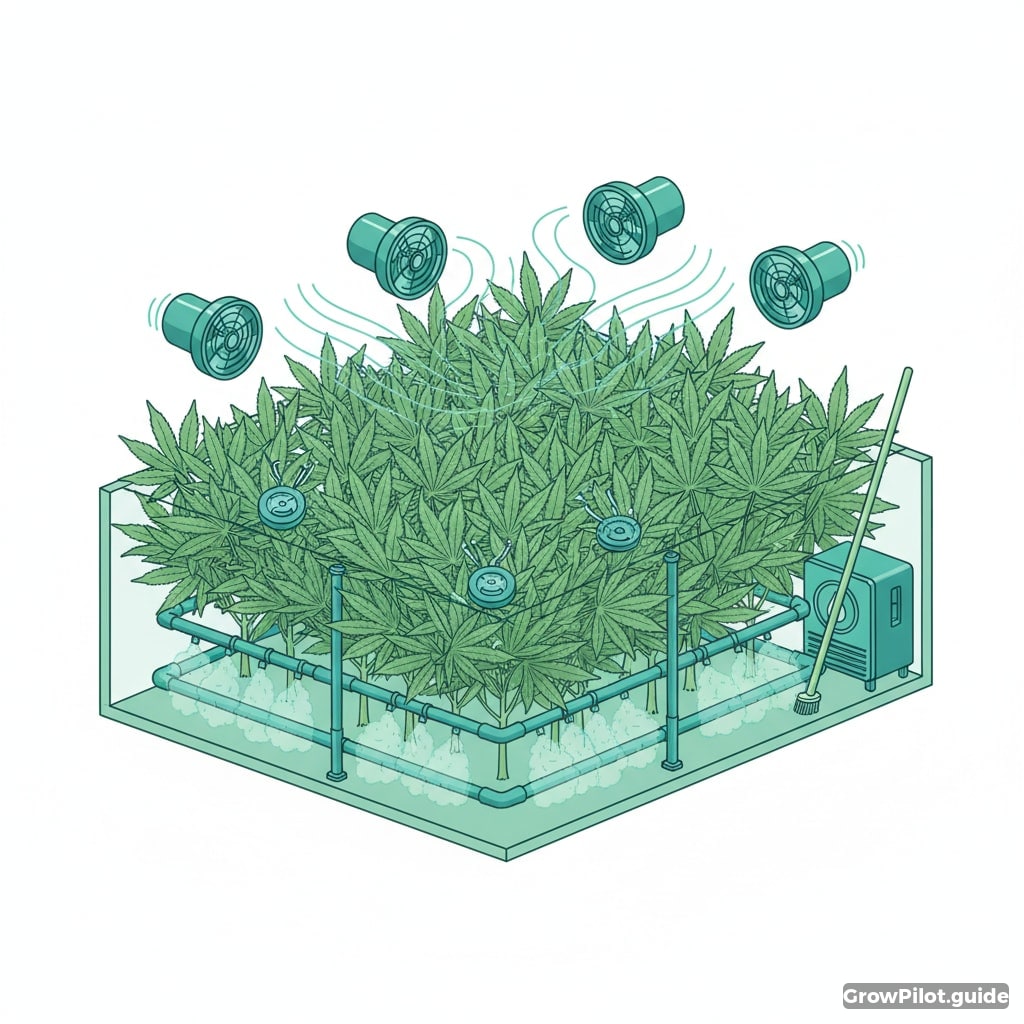
Learn how to recognize temperature and humidity differences directly in the canopy and create a uniform plant climate with air flow, sensors and layout.
## Introduction
A stable measured value in the room does not mean that **every plant has the same climate**. Especially in dense stands, the **leaf canopy** often develops its own microclimate: warmer at the top, more humid inside, drier at the edges and more sluggish in corners. It is precisely these differences that increase the risk of **uneven growth, local mold zones and hidden heat stress**, even though the central room values seem to fit.
This guide focuses on **climatic homogeneity in the crown area**. It is not about general temperature or RH target values, but about recognizing and reducing **deviations within the crop**.
## Why the canopy forms its own climate
Plants constantly release water vapor into the environment. In dense stands, this moisture collects between the leaves and shoots if the air there is not exchanged quickly enough. At the same time, temperature differences occur due to:
- dense leaf mass as an air brake
- warm air cushions in the upper area
- weak air flow in corners
- direct proximity to walls or tent panels
- uneven supply and exhaust air distribution
As a result, the room as a whole may still be on target, while **individual zones are significantly more humid or warmer** than the rest.
## Typical signs of an unbalanced microclimate
Look for patterns, not just individual plants:
- Leaves only move around the edges, but not inside the stand
- Upper areas appear significantly drier than the inside of the plant
- Corners smell duller or more "stagnant"
- individual plants dry out faster or slower than neighboring plants depending on the climate
- Moisture remains trapped longer in dense areas
- Temperature and RH values differ noticeably depending on the measuring point
Such differences are an indication that **air movement may be present, but not where it is needed**.
## Measure correctly: don't just use one sensor
A single sensor is rarely sufficient for assessing the microclimate in the canopy. It makes sense to use **several measuring points at the same time**:
- one sensor in the upper crown area
- one sensor slightly inside the stand, without leaf contact
- one sensor at the edge
- optionally a reference sensor outside the dense leaf mass
Important:
- Do not hang sensors directly in the air flow of a fan
- No direct radiation or warm surfaces near the sensor
- Compare measuring points for at least several hours, not just snapshots
- Pay attention to **differences**, not just absolute values
In practice: If areas in the canopy differ permanently by several percentage points RH or by around 1-2 °C, the air distribution is usually in need of improvement.
## Improve air distribution in the canopy
The aim is not a strong wind load, but **even air exchange**. Good air flow can be recognized by the fact that a slight exchange also takes place within the stand without leaves whipping permanently.
### Sensible measures
- **oscillating air circulation** instead of rigid continuous air flow
- Guide air **over** and **sideways through** the leaf canopy, not just over it
- Break up dead zones in corners with slightly offset fan position
- Align fans so that air flows **complement each other instead of working against each other**
- Use supply and exhaust air in such a way that fresh air actually reaches the plant area
### Common mistakes
- Direct fans only at the tips
- Too few air movement points with a dense plant mass
- Strong direct wind on individual plants
- Move air only in the upper room volume
- Supply peripheral plants well, but neglect the center
## Reduce vertical climate stratification
Warm air rises. This is why the climate between the ground, the center of the plant and the canopy is often stratified. This stratification becomes problematic when **heat builds up at the top and retains moisture inside**.
Help against this:
- Gentle vertical mixing of the room
- Circulate air not only horizontally, but slightly diagonally
- Operate the exhaust air in such a way that no heat build-up remains under the ceiling
- Do not allow plants to become unnecessarily compact so that air ducts are maintained
Especially in densely overgrown setups, it is important that air flows through **not only the room** but also **the plant body**.
## Phase-related evaluation of the microclimate
### Vegetative phase
In vegetation, an unbalanced microclimate often leads to **uneven development** within the stand. Some plants grow more compactly, others softer or more elongated, because temperature and humidity vary locally.
### Flowering phase
A moist plant interior becomes much more critical during flowering. Particularly dense flowering zones benefit from an **even, gentle flow** so that no locally moist pockets are retained.
### Drying phase after harvest
After harvesting, it is no longer a question of the canopy microclimate of living plants. Harvested buds are **dried**, ideally at around **60 % RH and 18-22 °C** with gentle air movement in the room, but without direct strong airflow onto the crop.
## Conclusion
A good room climate is only the basis. The decisive factor is whether this climate **actually reaches the entire canopy**. If you use several measuring points, recognize hotspots and direct air flows through the canopy, you can significantly reduce local moisture pockets and temperature islands. This creates a more homogeneous plant climate with less stress and a lower risk of problematic micro-areas.
## Pro Tips
- Always measure at several points in the canopy.
- Light air exchange is better than a hard direct wind.
- Compare the edge, center and upper plant zones.
- Standing corners are often more critical than the center of the tent.
- Evaluate climate differences over hours, not minutes.
More Growing Knowledge & Smart Grow Help
GrowPilot.guide is the cannabis grow tracker and weed cultivation app with smart plant analysis, indoor cannabis growing guide, grow diary, community, cups and autoflower grow tracker for growers worldwide.
Open GrowPilot.guide App →