Partial harvest with unevenly ripe plants
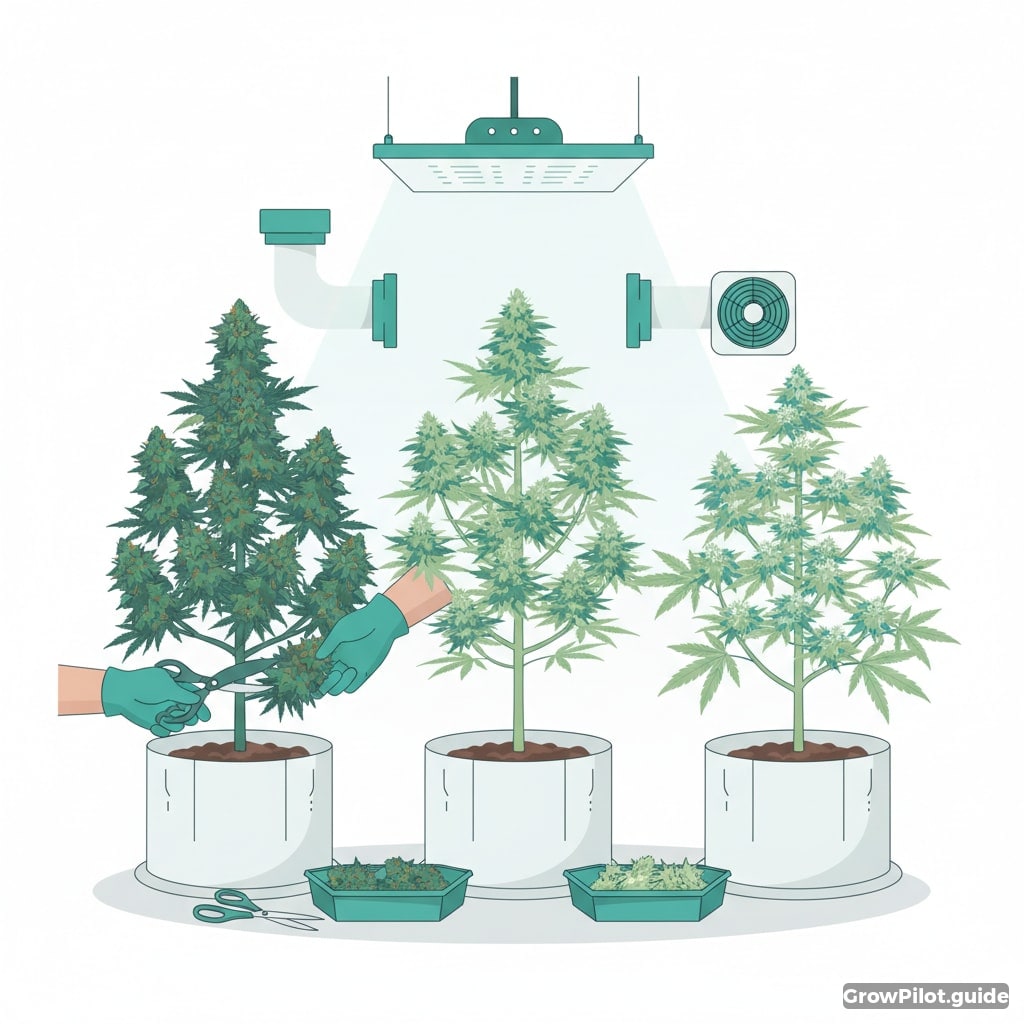
This guide shows you how to harvest buds of varying maturity in several passes without sacrificing quality. Focus: Maturity testing, selective cutting, drying and curing.
## Introduction
Not every cannabis plant matures completely evenly. The upper flowers are often ready for harvest earlier, while the middle or lower buds still need some time. In such cases, a **partial harvest** makes sense: you only cut the really ripe areas and leave the rest until optimum maturity.
This method clearly belongs in the **harvesting phase** because it deals exclusively with the right time to cut, selective harvesting and separate aftercare of the harvested buds. The aim is to obtain **more evenly ripened flowers** and to avoid unripe or overripe batches.
## When a partial harvest makes sense
A staggered harvest is particularly worthwhile if the plant shows visible differences in maturity:
- **Top buds** have predominantly milky trichomes with the first amber-colored parts.
- Middle and lower buds** still show many clear trichomes.
- The pistils are retracted and discolored to varying degrees depending on the flower zone.
- Dense main colas appear finished, smaller side buds not yet.
Important: Always judge the degree of ripeness **by the calyxes**, not by the sugar leaves. Trichomes on sugar leaves often ripen earlier and can give the impression of an early harvest.
## Check the degree of ripeness correctly zone by zone
Before partial harvesting, mentally divide the plant into ripening zones:
- upper main flowers
- middle side shoots
- lower, lower-light flowers
Use a **magnifying glass or microscope** to check multiple buds per zone. Do not rely on a single flower. A **representative average** is crucial.
As a rough guide:
- **clear** = still unripe
- Milky** = main window for harvesting
- Amber** = advanced ripeness, stronger sedative effect
If only the upper buds are in the desired range, harvest these first.
## How to carry out a clean partial harvest
Prepare clean, sharp scissors and separate containers or hanging options for each batch. Work calmly and precisely.
### Procedure
1. cut **only the clearly mature buds or branches**.
2. avoid squeezing or crushing the buds unnecessarily.
3. lay or hang the first batch separately immediately
4. mark the remaining parts of the plant so that you know later which zones are still standing.
Depending on the plant structure, you can either:
- **remove individual mature branches** or
- **cut only finished main colas**
Leave unripe flowers completely on the plant. A partial harvest is not a rough halving by feel, but a **targeted selective cut according to ripeness**.
## Distance between harvesting passes
There are often **a few days to about 1-2 weeks** between harvests, depending on how big the difference in maturity is. Check the remaining buds again with a magnifying glass instead of deciding according to the calendar.
Pay particular attention to whether:
- clear trichomes become increasingly milky
- individual amber-colored trichomes appear
- the flowers visibly swell and mature
The second cut is only made when these areas have also reached their desired stage of maturity.
## Separate drying of each batch
Each partial harvest is a **separate batch** and should be treated as such. Dry freshly cut buds immediately after harvesting:
- **18-22 °C**
- **approx. 60 % relative humidity**
- **darkness**
- **gentle air movement without direct airflow onto the flowers**
Drying usually takes **10-14 days**, but can vary depending on bud density and cut size. Do not mix early and late batches unmarked as they may differ slightly in moisture content and maturity.
## Curing after partial harvest
After drying, the individual batches are placed separately in jars. This allows you to better control quality, aroma and residual moisture.
### Important for curing
- Do not overfill the jars
- Ventilate regularly in the first few days
- Label batches, e.g. with date and plant zone
- Check for musty or ammonia-like odor
Separate curing is particularly useful because upper and lower buds often have different densities and therefore dry slightly differently.
## Common mistakes in partial harvesting
- Cutting lower buds too early**, just because everything looks ready at the top
- Judging ripeness only by pistils instead of additionally by trichomes
- Check trichomes on sugar leaves instead of calyxes
- Throw several unlabeled harvest batches together
- Drying freshly harvested batches differently without checking the conditions
## Conclusion
Partial harvesting is a very practical method for plants with uneven maturity. Instead of cutting everything at once, you harvest each flowering zone in its optimal window. This significantly improves the uniformity of the final quality. A **clean ripeness check**, **selective cutting** and **separate drying and curing** of each batch are crucial.
## Pro Tips
- Always check trichomes on several buds per zone.
- Check the calyxes, not the sugar leaves.
- Label each batch immediately after cutting.
- Dry early and late harvests separately.
- Harvest the second round only after a new maturity test.
🌿 More Growing Knowledge & Smart Grow Help
GrowPilot.guide is the cannabis grow tracker and weed cultivation app with smart plant analysis, indoor cannabis growing guide, grow diary, community, cups and autoflower grow tracker for growers worldwide.
Open GrowPilot.guide App →