Efficient nutrient management in coco cultivation
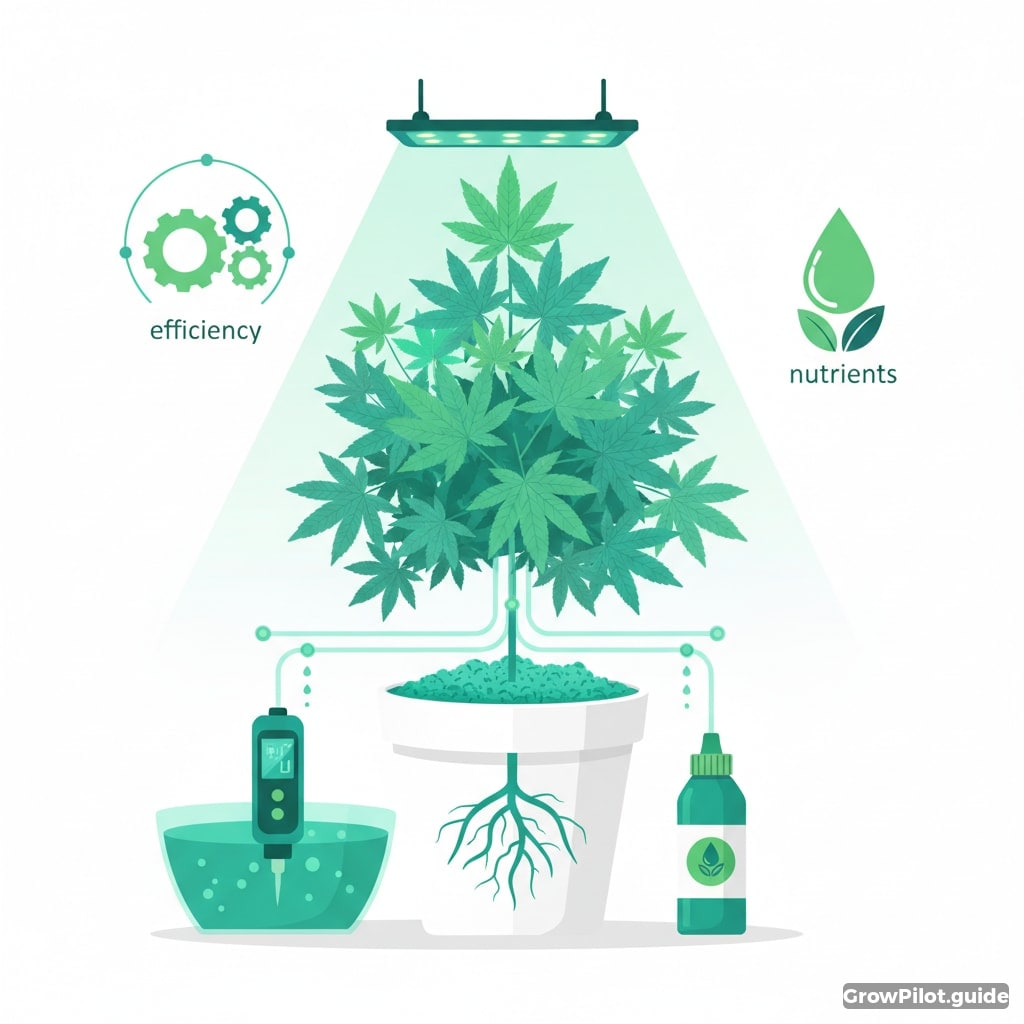
Detailed grow guide for precise nutrient management in Coco. Focus on pH target (5.8-6.0), calcium-magnesium supplementation and EC adjustment in each growth phase.
## Introduction
Successful cannabis cultivation in coco requires very precise nutrient management. Due to the low buffer in the Coco medium, the plants react quickly to nutrient supply and deficiencies. In this guide you will learn how to maintain the **pH value** (target value 5.8-6.0), adjust the **EC values** in the different phases and, especially in Coco, take into account the essential **calcium-magnesium supplementation**.
## Basics of nutrient management in Coco
Compared to soil, coco coir has hardly any natural nutrient storage. This means that any supply of nutrients has an immediate effect - positive, but also in case of over- or underdosing. Important points are
- **pH value:** Target range 5.8 to 6.0. Constant pH control is essential, as even small deviations disrupt nutrient absorption.
- EC value:** Depending on the phase (vegetation or flowering), the nutrient concentration must be adjusted.
- Calcium & Magnesium:** As coco often leads to deficiencies in these elements, supplementation is essential. Pay attention to appropriate supplements to avoid deficiency symptoms.
## Nutrient supply in the vegetation phase
During the vegetative phase, the focus is on rapid growth. Here it is important to fine-tune the nutrient supply:
### pH and EC adjustment
- pH:** Make sure that your irrigation water is always within the target range. Test the pH regularly, as changes in the composition of the water can also occur at short notice.
- EC:** A moderate EC value (in the range of 1.0-1.4 mS/cm) is recommended in this phase. This allows the plant to boost its basic metabolism without being over-fertilized.
### Calcium-magnesium supplementation
- Dosage:** Use special Ca/Mg supplements formulated for coco. A dosage of approx. 2-3 ml per liter (depending on the product) can often help to avoid typical deficiencies.
- Time period:** Start directly from the conversion phase in Coco to ensure a sufficient supply at an early stage.
### Regular nutrient adjustment
As Coco has hardly any buffering effect, even small amounts of additional nutrients need to be adjusted quickly. Carry out weekly EC measurements and adjust the solutions to the respective plant size.
## Nutrient management in the flowering phase
With the transition to the flowering phase, the plant's requirements change significantly:
### Increased EC values
- Target EC:** In the flowering phase, a higher EC range (between 1.4-2.0 mS/cm) is often necessary to cover the increased energy requirements of the flowers.
- Dosage:** Increase the nutrient addition gradually. An abrupt change can lead to stress and nutrient burn.
### Specific nutrients
- Bloom-promoting additives:** In addition to the classic macro and micronutrients, you should also include bloom stimulators in your nutrient mix. These are particularly effective in Coco, as any changes are quickly noticeable.
- Calcium & Magnesium:** Supplementation is also important during the flowering phase. Make sure to adjust the dosage slightly if necessary, as the plant has a higher requirement to support flower development.
## Practical implementation and monitoring
Systematic monitoring is essential in coco cultivation:
- **Measurements:** Carry out at least weekly checks of EC and pH values. Document these in order to recognize trends at an early stage.
- **Adjustment intervals:** Don't adjust the nutrient concentration too frequently - usually an adjustment every 3-4 days is sufficient unless acute problems occur.
- Troubleshooting:** Look for typical signs of over- or under-fertilization. If EC levels are too high, leaf tips can burn, while too low EC leads to slow growth.
## Pitfalls and important tips
- Buffer effect:** In contrast to soil, coco has hardly any buffering effect. Small dosing errors can quickly lead to deficiencies. Work precisely and with high-quality measuring equipment.
- Product selection:** Only use products that have been specially formulated for coco cultivation. Mixtures for soil may have unsuitable nutrient ratios.
- Clear phase separation:** Note that nutrients in the vegetation phase and in the flowering phase have different requirements. Do not mix these approaches.
- Adaptation to strains:** Different cannabis strains may have slightly different nutrient requirements. Individual fine-tuning is often necessary.
## Summary
The key to success in coco cultivation lies in the precise control and adjustment of the nutrient supply. You can avoid typical problems by regularly monitoring the pH and EC value as well as targeted calcium-magnesium supplementation. A systematic approach and adherence to the different requirements in the vegetation and flowering phases form the basis for a healthy, high-yielding grow in Coco. Avoid abrupt changes and always work with a clearly structured nutrient plan to achieve the best possible growth success.
## Pro Tips
- Measure pH and EC regularly
- Work with small dosing steps
- Only use supplements developed for Coco
- Documentation of measured values leads to success
- Considering different phases separately
🌿 More Growing Knowledge & AI Grow Help
GrowPilot.guide is the cannabis grow tracker and weed cultivation app with smart plant analysis, indoor cannabis growing guide, grow diary, community, cups and autoflower grow tracker for growers worldwide.
Open GrowPilot.guide App →