Select coasters and drainage trays correctly
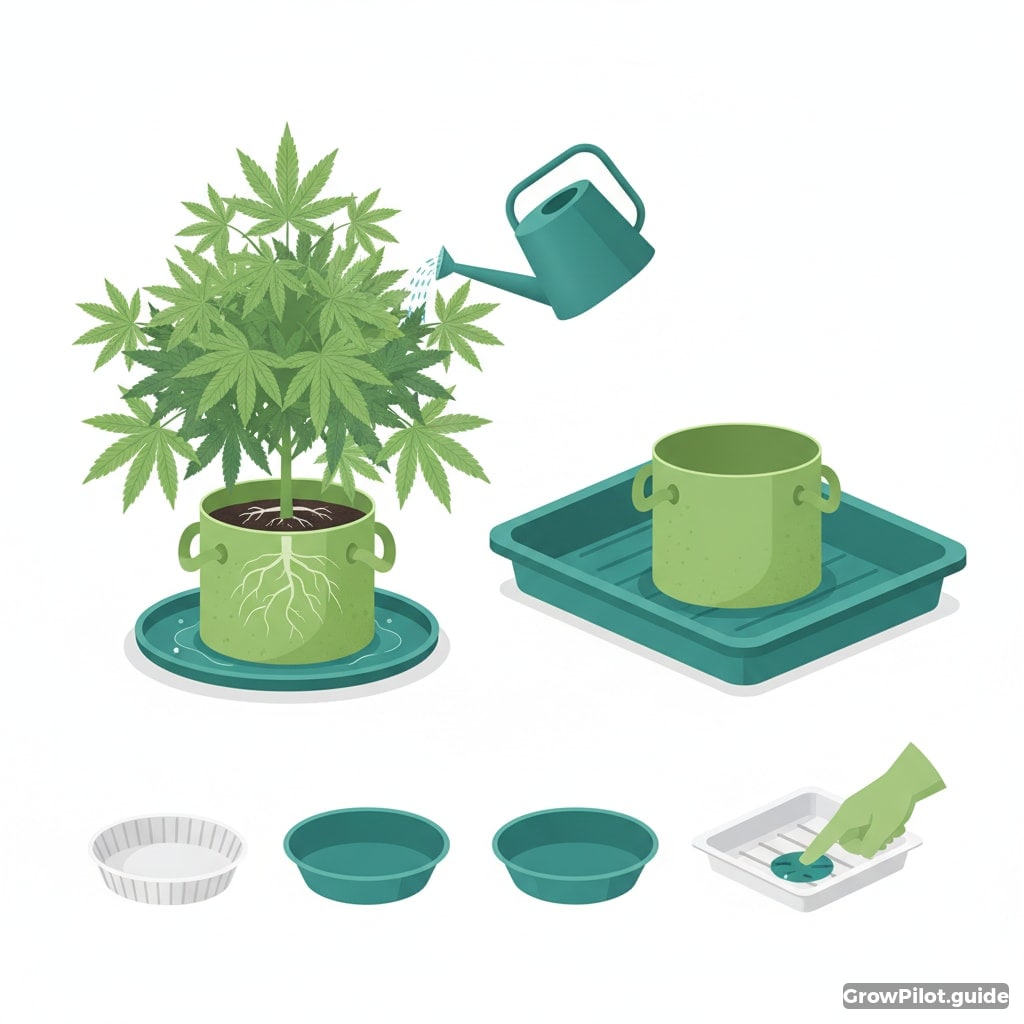
This equipment guide shows you how to select, size and safely integrate saucers, plant trays and drainage trays for cannabis grows into your setup.
Introduction
Coasters, plant trays and drainage trays may seem inconspicuous, but they are among the most important protection and hygiene components in cannabis growing. They catch excess water, protect floors and tent trays, make cleaning easier and help to keep moisture in the grow area under control. This guide deals exclusively with equipment: Construction types, materials, sizes, load capacity and useful accessories. It is not about casting methods, but only about the right hardware.
What types of fall arrest systems are available
Classic pot coasters
Round or square plastic saucers are the simplest solution for single plants.
Suitable for:
- small to medium-sized pots
- Single placements in the grow tent
- Setups with little technology
- Diameter or edge dimension must be larger than the bottom of the pot
- Sufficiently high rim for collection volume
- Dimensionally stable plastic so that the trivet does not warp under load
Plant trays and boot trays
These shallow, larger trays hold several pots at the same time. They are particularly practical when a complete tent area needs to be kept clean and closed.
Advantages:
- Several pots on one surface
- Easier to keep clean than many individual coasters
- Good solution for rectangular grow areas
Deep drainage trays
Drainage trays with higher edges offer more safety reserves in the event of large amounts of water or when working with large fabric pots.
Useful for:
- larger pot volumes
- heavy planters
- narrow tents where leaking water would be problematic
The right material
Injection-molded plastic
Sturdy plastic is the best choice for most hobby setups.
Advantages:
- lightweight
- inexpensive
- rustproof
- easy to clean
ABS or reinforced plastics
Higher quality bowls are often made of more robust, impact-resistant material. These are worthwhile for frequent use or heavier containers.
Metal trays
Metal is rarely necessary in the hobby sector. If metal is used, it should be corrosion-resistant. Uncoated or poorly finished models are unsuitable in damp environments.
Choose the right size and collection volume
A good trivet must do two things:
- Support the pot securely
- hold enough liquid without overflowing immediately
- Pot diameter or pot base area
- Height of the saucer rim
- Available space in the tent or room
- Number of pots per tray
Special care is required with fabric pots: they are often not as dimensionally stable as hard plastic pots and can distribute the load more widely. For this reason, the support surface should support the entire surface and not just support it at certain points.
Shape, height and stability
Flat saucers
They save height and fit well in low tents. The disadvantage is the low collection volume.
High rims
A higher rim increases safety against spillage. This is particularly useful when pots are moved or the floor is not absolutely level.
Reinforced bases
Ribbed or reinforced bases are a quality feature. They prevent sagging and significantly extend the service life.
Useful accessories
Pot risers and spacers
Small platforms or grid inserts raise the pot slightly. This makes it easier to separate the base of the pot from the collected liquid and improves air circulation under the pot.
Rollable plant stands
Rolling coasters can be useful for large, heavy pots.
Important when selecting:
- Sufficient load capacity
- smooth-running but stable castors
- Moisture-resistant materials
- low overall height for tents
Wet vacuum cleaner or suction pump as service equipment
For larger tubs, additional service equipment can be useful for conveniently removing accumulated liquid. This is not a must, but is practical in larger indoor setups.
Cleaning and hygiene
Collection systems should be selected so that they have smooth, easily accessible surfaces. Grooves, tight corners and rough materials make cleaning unnecessarily difficult.
Practical features:
- Wipeable surface
- chemically resistant plastic
- No sharp edges
- easy to grip edge for removal
Light or medium-light colors often make deposits, salt marks and soiling visible earlier than very dark surfaces.
Typical purchasing errors
- Choose a trivet that is too small for the actual base of the pot
- Buying only by diameter without considering the rim height
- Use thin, cheap trays for heavy end pots
- Place several pots on unstable universal trays
- Buy roller coasters without load reserve
- Do not consider cleaning and accessibility in the tent
Conclusion
Coasters and drainage trays are not a by-product, but central protective equipment for clean and safe grow areas. If you pay attention to the right size, stable materials, sufficient collection volume and good cleanability, you can avoid many everyday problems in indoor and greenhouse setups. Robust single trays are often sufficient for small grows, while larger setups benefit significantly from stable plant trays or deep drainage trays.
Pro Tips
- For fabric pots, choose one size larger.
- Make sure the base is dimensionally stable and not too thin.
- High edges offer more safety reserve against overflow.
- Only buy coasters with a clearly stated load capacity.
- Smooth surfaces save a lot of time when cleaning.
More Growing Knowledge & Smart Grow Help
GrowPilot.guide is the cannabis grow tracker and weed cultivation app with smart plant analysis, indoor cannabis growing guide, grow diary, community, cups and autoflower grow tracker for growers worldwide.
Open GrowPilot.guide App →