Plan cannabis plant spacing correctly
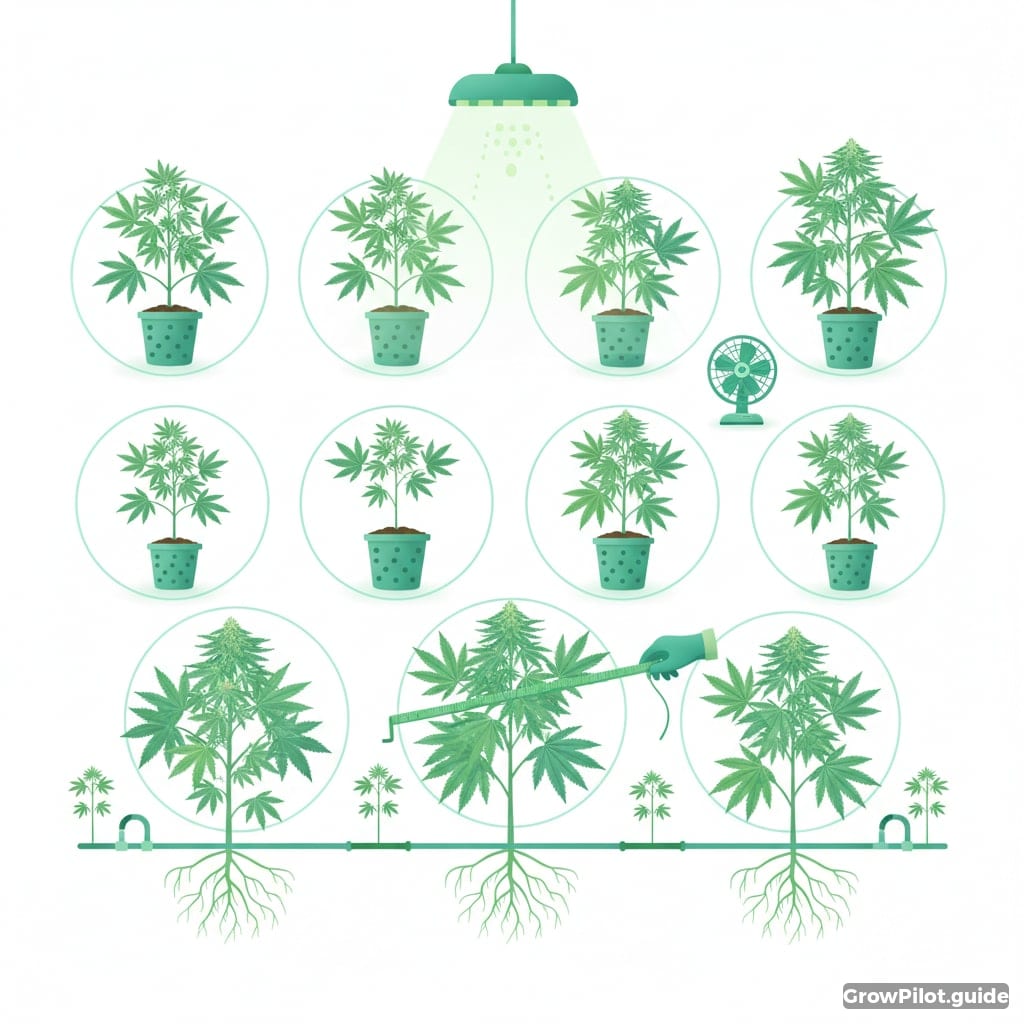
The right plant spacing improves light distribution, air exchange and space utilization. This guide shows you how to adapt spacing indoors and outdoors to suit the genetics, pot and growth habit.
Introduction
The planting distance is often planned too late in cannabis cultivation. Even before the start, it influences how well plants develop, how evenly light hits the leaf mass and how efficiently an area is used. Plants that are planted too close together compete for space early on, shade each other and make cultivation more difficult. Too wide a spacing, on the other hand, wastes valuable growing space.
This guide deals exclusively with the growing aspect of the spatial arrangement of cannabis plants. It is therefore about space requirements, growth habit, pot size, genetics and differences between indoor and outdoor - not about watering, fertilizing, training or harvesting.
Why plant spacing is so important
A sensibly planned spacing affects several fundamentals at the same time:
- Light distribution: Each plant should receive enough direct light space.
- Air movement between the plants:** Densely spaced stands dry out more slowly and build up islands of moisture more quickly.
- Root space in relation to the crown:** Large pots and large plants also need more space above ground.
- Working access:** Checking, repotting or removing individual plants becomes easier.
- Uniformity of stock:** Plants of similar size can be placed much more efficiently than very different specimens.
Which factors determine the spacing
The optimum spacing is not a fixed universal value. It depends primarily on four points.
1. genetics and growth habit
Not every variety grows in the same way. Compact, bushy plants usually require more space on the sides**, while slender, more upright plants can be placed closer together. Particularly relevant are
- Internode distance
- Lateral shoot strength
- typical final height
- elongation behavior of photoperiodic varieties after the start of flowering
- compact or open foliage
Autoflowers often remain smaller, but are not automatically always space-saving. Vigorous autoflowers can also become surprisingly wide.
2. pot size and planned final size
The larger the pot, the larger the expected plant volume. Small young plants can be relatively dense at first. However, as the root and leaf mass increases, the plants must be spaced out. The spacing should therefore always match the expected final size, not just the current state.
3. indoor or outdoor
Indoor areas are limited and artificially lit. Here, the distance must be chosen so that the available light surface is used evenly. Outdoors, the natural position of the sun also plays a role. Plants usually need more space there because they grow more freely and often significantly larger.
4. homogeneity of the stock
A stand of seeds can grow differently. Cuttings from the same mother are usually more uniform. The more homogeneous the plants, the more precise the spacing can be planned.
Guide values for practice
The following values are guidelines, not rigid rules:
Indoor
- Small plants: about 25-35 cm distance between the pot edges
- Medium plants: about 40-60 cm
- Large, wide-growing plants: approx. 60-90 cm
It is important that the crowns do not overlap permanently in the final stage.
Outdoor
- Compact plants in pots: approx. 60-100 cm
- Larger potted plants or vigorous autoflowers:** approx. 1-1.5 m
- Large photoperiod plants outdoors: approx. 1.5-3 m, depending on genetics and season length
Outdoor plants should be planned more generously because plants in full sun can build up considerably more volume than many beginners expect.
How to plan the spacing sensibly
Think about the area from above first
Sketch the growing area as a top view. Plan not only the pot diameter, but also the future crown diameter. Many errors occur because only the ground space is calculated.
Build in a reserve
A completely "full" space looks efficient at first, but often becomes impractical later on. A small space reserve makes things easier:
- turning pots
- removing individual plants
- balancing out uneven growth forms
Do not plan according to seedling size
Seedlings and young plants need little space. If you plan your entire grow according to the early phase, you will almost always end up standing too close together later on.
Typical mistakes
- Place all plants equally close together, even though they grow differently
- Underestimating pot size** and only calculating with stem spacing
- Place them too close together outdoors, even though the season is still long
- Do not plan for access with several rows
- Ignore later growth** and only assess the actual condition
Conclusion
Good plant spacing is not a trivial matter, but part of the basic planning of a stable grow. If you realistically take genetics, pot size, environment and expected final size into account, you will make better use of the space and avoid many subsequent problems. The best guide is always the question: **Will each plant have enough space for its natural growth habit in the end? If this question is answered correctly at an early stage, the entire crop will get off to a more controlled and uniform start.
Pro Tips
- Always plan with the final size, not the starting size.
- Bushy varieties usually need more side clearance than slender ones.
- Measuring between pot rim and pot rim is more practical than measuring between stems.
- Outdoors, it is better to set them a little too wide than permanently too narrow.
- Leave at least one easy working access to the row of plants.
Frequently Asked Questions
How much space do I need between cannabis plants when growing indoors?
For indoor cultivation, the spacing between plants should be between 30 and 60 cm, depending on the strain and growth habit, to ensure optimal light distribution and air circulation.
What is the ideal spacing for outdoor cannabis plants?
Outdoors, a spacing of 60 to 120 cm between plants is recommended, depending on the variety and growing conditions, to provide sufficient space for the plants to develop.
How does pot size affect planting distance?
The pot size directly affects the spacing between plants; larger pots require more space, so the distance between plants should be increased accordingly to prevent root competition.