Repotting cannabis safely without stopping growth
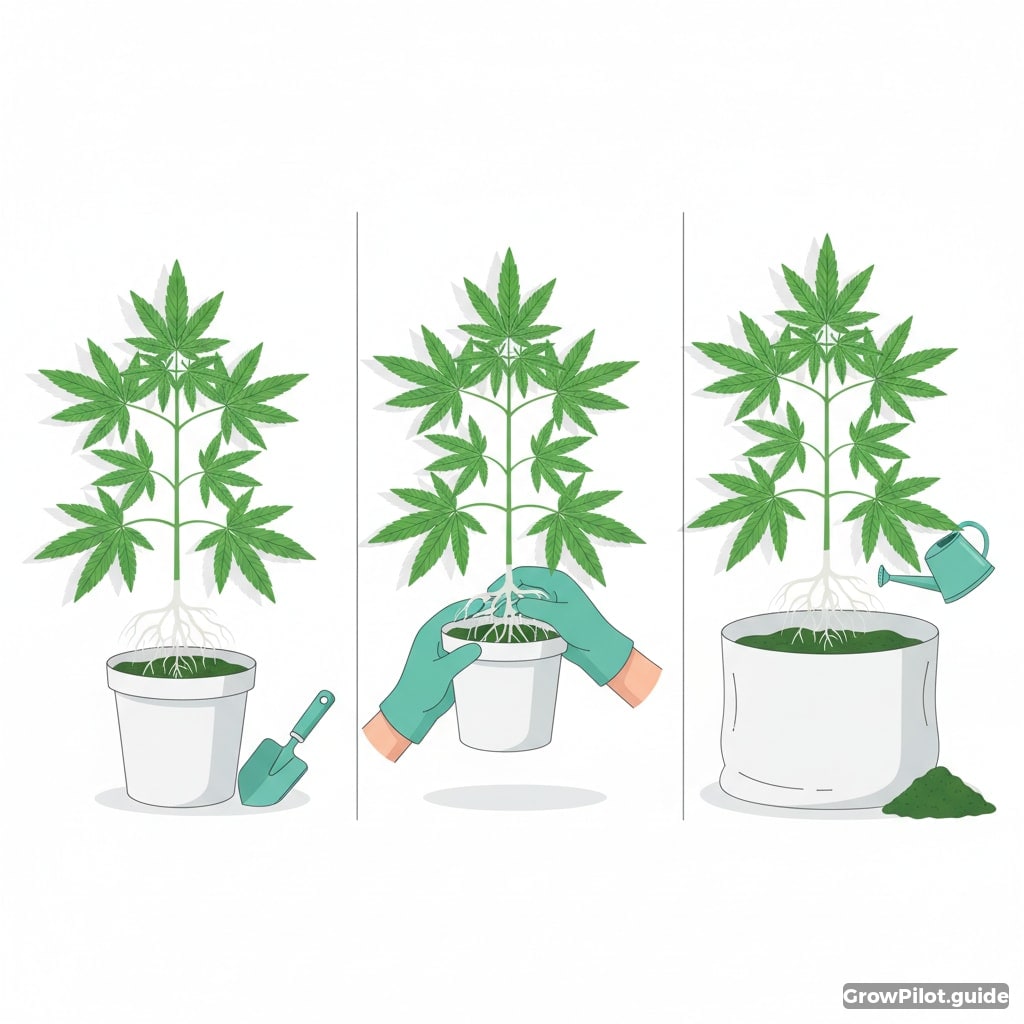
How to plan and carry out the repotting of cannabis indoors and in pots correctly: the right time, suitable container sequence and low-stress technique for stable development.
Introduction
Repotting** is a central step in cannabis cultivation when plants are not cultivated directly in the final pot. The aim is always to give the plant as much root space as it can use sensibly at its current stage of development. A well-timed pot change promotes even root development, improves stability and reduces the risk of growth stagnation.
This guide deals exclusively with repotting in a general growing context**: i.e. timing, potting sequence, preparation and proper execution. It is not about fertilizer schedules, watering regimes or training.
Why repotting makes sense
Cannabis roots through small containers relatively quickly. If a plant remains in the same pot for too long, typical problems arise:
- the root space becomes scarce
- growth slows down
- the plant becomes more unstable to environmental stress
- the substrate loses its uniform structure more quickly
A gradual change to larger containers has several advantages:
- more controlled root development
- better rooting of the entire bale
- more even plant growth**
- less risk due to too large starting pots
The right time to repot
It is not age alone that is decisive, but above all the rooting of the current pot. Good indications of the right time are
- Roots are visible at the drainage holes
- the root ball holds together firmly when carefully removed
- the above-ground growth slows down despite the plant being healthy
- the plant appears clearly too large in relation to the pot
Repotting too early is inefficient because the available root space has not yet been used. Repotting too late, on the other hand, increases the risk of a real root blockage.
Sensible potting sequence
Instead of changing directly from very small to very large, a step-by-step potting sequence usually makes sense. This makes it easier for the plant to develop the new volume evenly.
Typical sensible stages are
- Starter pot or small starter pot
- Small to medium intermediate pot
- final pot
The principle is more important than the exact number of liters:
- each new pot should be significantly larger, but not oversized
- the plant should have already developed the previous pot well
- final pot size depends on genetics, cultivation time and available space
With Autoflower, an attempt is often made to avoid repotting stress altogether by starting directly in the final pot. If repotting is nevertheless carried out, it must be done particularly early and very gently, as autoflowers only have a limited vegetative time window.
Suitable pots and materials
Various types of container are suitable for repotting:
- Plastic pots: widespread, stable, easy to clean
- Fabric pots**: good air circulation on the pot wall, but less practical when repotting
- Air pots or ventilated special pots**: promote air circulation to the roots, but require appropriate handling
What you should look out for:
- adequate drainage holes
- Dimensionally stable construction
- Clean, preferably hygienic containers
- Suitable height and width for the plant size
Preparation before changing the pot
Properly prepared repotting significantly reduces stress. The following should be ready before starting:
- new pot
- suitable substrate
- work surface
- Gloves or clean hands
The new pot is prepared in such a way that the old root ball is later at a suitable height. The plant base should be neither too deep nor too high in the new pot after transplanting.
It is also important to fill the new substrate loosely. It should not be heavily compacted so that there is sufficient pore space for air and root growth.
How to repot correctly
1. check the plant
Only repot healthy, not severely stressed plants. If there is visible damage, severe heat stress or clear signs of disease, changing the pot is often not the first sensible step.
2. loosen the root ball
Carefully loosen the sides of the pot. Then support the plant by the root ball, do not pull on the stem. An intact root ball is crucial to prevent fine roots from tearing unnecessarily.
3. check the roots
A healthy root ball usually shows:
- light to cream-colored roots
- fine branching
- no muddy or heavily discolored areas
Slightly circling roots at the edges are normal for pot-bound plants. Heavily matted ring roots indicate that the change is rather late.
4. planting and filling
Place the root ball in the center of the new pot and fill the edges evenly. Only press the substrate down lightly so that the plant is stable without compacting the root space.
Common mistakes when repotting
- Too large a pot jump**
- repotting too late** when the root ball is already tightly bound
- pulling on the trunk instead of supporting the root ball
- pressing the substrate too firmly**
- transplant sick or severely weakened plants unnecessarily
Conclusion
Correct repotting is not a secondary step, but an important part of cultivation planning. If the timing, potting sequence and implementation are right, the plant remains vital and can quickly develop the new root space. Particularly important are clean work, suitable container sizes and careful handling of the root ball.
Pro Tips
- Only repot when the current pot is well rooted.
- Choose the next pot larger, but not oversized.
- Always support the root ball, not the trunk.
- Fill new substrate loosely instead of compacting it heavily.
- Repot autoflowers very early and very carefully.
Frequently Asked Questions
When is the best time to transplant cannabis?
The best time to repot cannabis is when the roots have completely filled the current pot, usually 2–4 weeks after germination or after the last repotting.
What size pot should I choose when repotting?
Choose a pot that is about 2–3 inches (5–7 cm) larger in diameter than the current pot to provide enough room for root growth without overwhelming the plant.
How can I minimize stress when repotting cannabis?
Minimize stress by thoroughly moistening the soil before repotting, handling the roots with care, and placing the new pot in a shaded spot to avoid direct sunlight.
More Growing Knowledge & Smart Grow Help
GrowPilot.guide is the cannabis grow tracker and weed cultivation app with smart plant analysis, indoor cannabis growing guide, grow diary, community, cups and autoflower grow tracker for growers worldwide.
Open GrowPilot.guide App →