Coordinate pot size and watering volume in soil
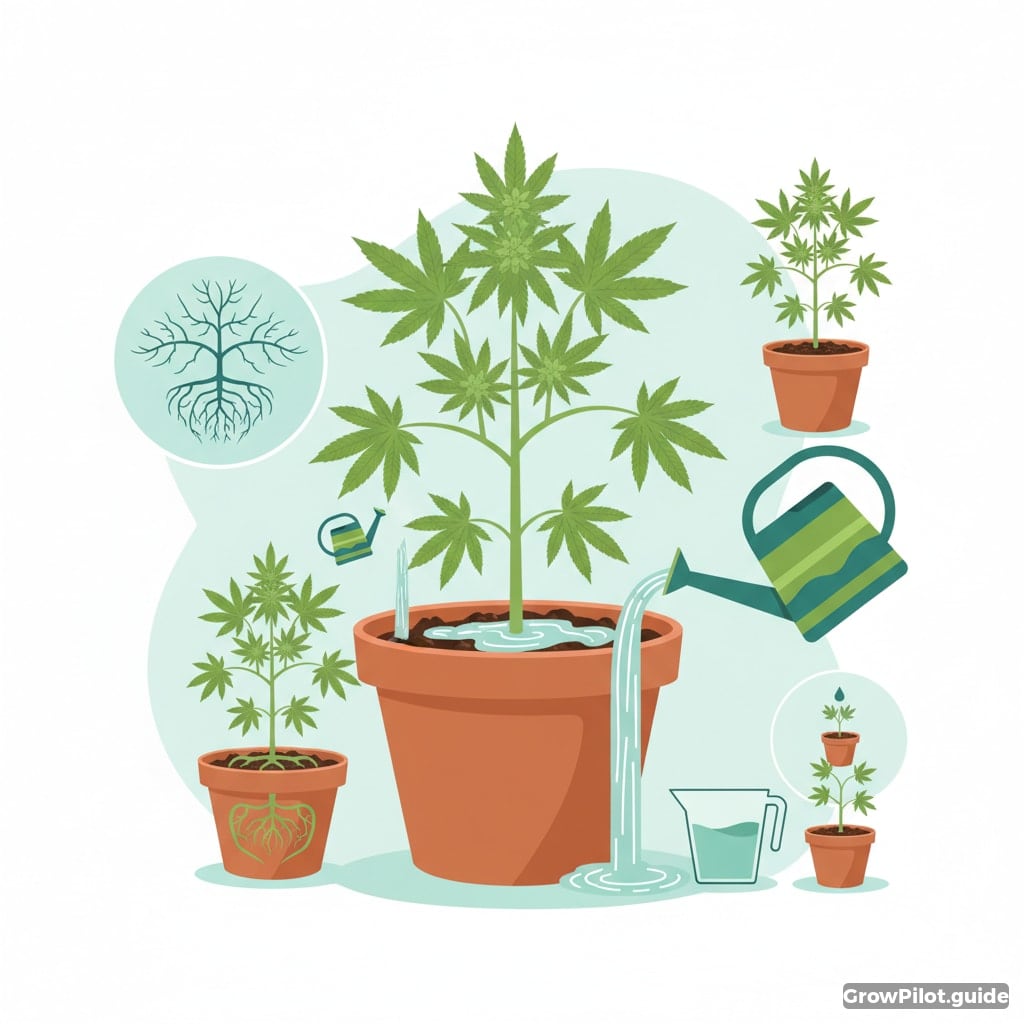
How to match the watering quantity and interval to the pot size when growing in soil. The guide shows you how to water small and large pots correctly and avoid typical mistakes.
## Introduction
In **soil cultivation**, correct watering depends not only on the plant size, but very much on the **pot size**. Small pots dry out quickly and react more quickly to mistakes. Large pots store significantly more water, dry out more slowly and are more forgiving of small deviations in the short term. At the same time, large pots increase the risk of watering too frequently and the root zone remaining permanently too wet.
This guide focuses exclusively on the question of how to adjust **watering volume, watering rhythm and moisture control to the pot size in soil**. Soil buffers water and nutrients, so corrections do not usually take effect immediately. This makes a clean approach all the more important.
## Why pot size is so important when watering
The pot size determines:
- **how much water the substrate can store**
- **how quickly the soil dries out again**
- **how evenly the root zone is moistened**
- **how great the risk of overwatering is**
In soil, the irrigation water should generally be set to **pH 6.0 to 7.0**. As organic soil is microbially active, it should not be constantly watered in small quantities. Better are **clear wet-dry cycles** with a sufficient oxygen phase in the root area.
## Basic rule: Do not water according to the calendar, but according to the pot condition
Regardless of the pot size:
- check with the **finger test**: top 2-3 cm of soil dry, deeper underneath still slightly moist is often a good area before the next watering
- Lift the pot: a significantly lighter pot indicates a need for water
- Never water just because "it's your turn again today"
Frequent watering is particularly problematic in soil because the lower zones can remain moist for a long time even though the surface appears dry.
## Watering strategy according to pot size
### Small pots (approx. 0.5 to 3 liters)
Small pots dry out quickly. The amount of water per watering is low, but the condition must be checked more often.
Practice:
- Water slowly and in small portions
- Moisten the entire root area, but do not water permanently
- Ensure even moisture, as small pots can quickly dry out completely
Typical mistakes:
- Too much water at once
- Watering "a little" several times a day
- Allowing water to run through even though the root zone is still moist
### Medium pots (approx. 5 to 11 liters)
This is often the easiest area to control in the hobby sector. The soil holds enough moisture, but still dries out in a reasonable amount of time.
Practice:
- Water thoroughly and slowly for each watering
- a small amount of drainage is useful if you want to ensure that the root ball is completely soaked through
- then wait until the pot is noticeably lighter and the finger test fits
As a rough guide, the watering quantity is often **about 20 to 30 % of the pot volume**, depending on how dry the soil already is. This is not a rigid law, but a starting value.
### Large pots (approx. 15 liters and more)
Large pots store a lot of water. Most mistakes here are caused by **watering too often**, not too little.
Practice:
- Water slowly in several stages so that the soil can absorb water
- wait briefly after each watering so that nothing runs off in preference
- Accept longer watering breaks
Typical mistakes:
- Surface appears dry, but deep zones are still wet
- Large pots are treated like small pots
- Watering too early leads to a lack of oxygen in the root zone
## How to determine the right amount of watering
Good practice in soil:
1. note pot size
2. start with a moderate amount
3. water slowly
4. check whether the soil has absorbed water evenly
5. observe how long the pot needs until the next sensible watering
Important check:
- **Drain is a control signal**, not a must for every single watering
- if a lot of water immediately runs out at the bottom, the soil was often already too dry, compacted or the watering was too fast
- if no weight loss is noticeable for days, the quantity was usually too high or the environment too cool
## Evaluate drying time correctly
The right drying time depends on the pot size, plant mass, temperature and air movement. The decisive factor is not a fixed number of hours, but whether the pot is allowed to dry out significantly between watering without hardening completely.
Pay attention to these signals:
- **too wet**: heavy pot for a long time, sluggish soil, drooping leaves despite moist substrate
- too dry**: Pot extremely light, soil pulls back from the edge, water runs in poorly at first
## Conclusion
In Soil-Grow, the **pot size is one of the most important factors for correct watering**. Small pots need close monitoring and small, targeted watering. Large pots require patience, slow watering and longer breaks. If you combine **finger test, pot weight, pH 6.0-7.0 and a watering rate that matches the pot size**, your watering rhythm will be much more stable and the root zone will remain healthy.
## Pro Tips
- Never water large pots alone after the surface has dried out.
- In soil, it is better to water less frequently but carefully.
- Water slowly in stages instead of all at once.
- Always use the pot weight and finger test together.
- In the case of organic soil, first evaluate changes over several watering cycles.
More Growing Knowledge & Smart Grow Help
GrowPilot.guide is the cannabis grow tracker and weed cultivation app with smart plant analysis, indoor cannabis growing guide, grow diary, community, cups and autoflower grow tracker for growers worldwide.
Open GrowPilot.guide App →