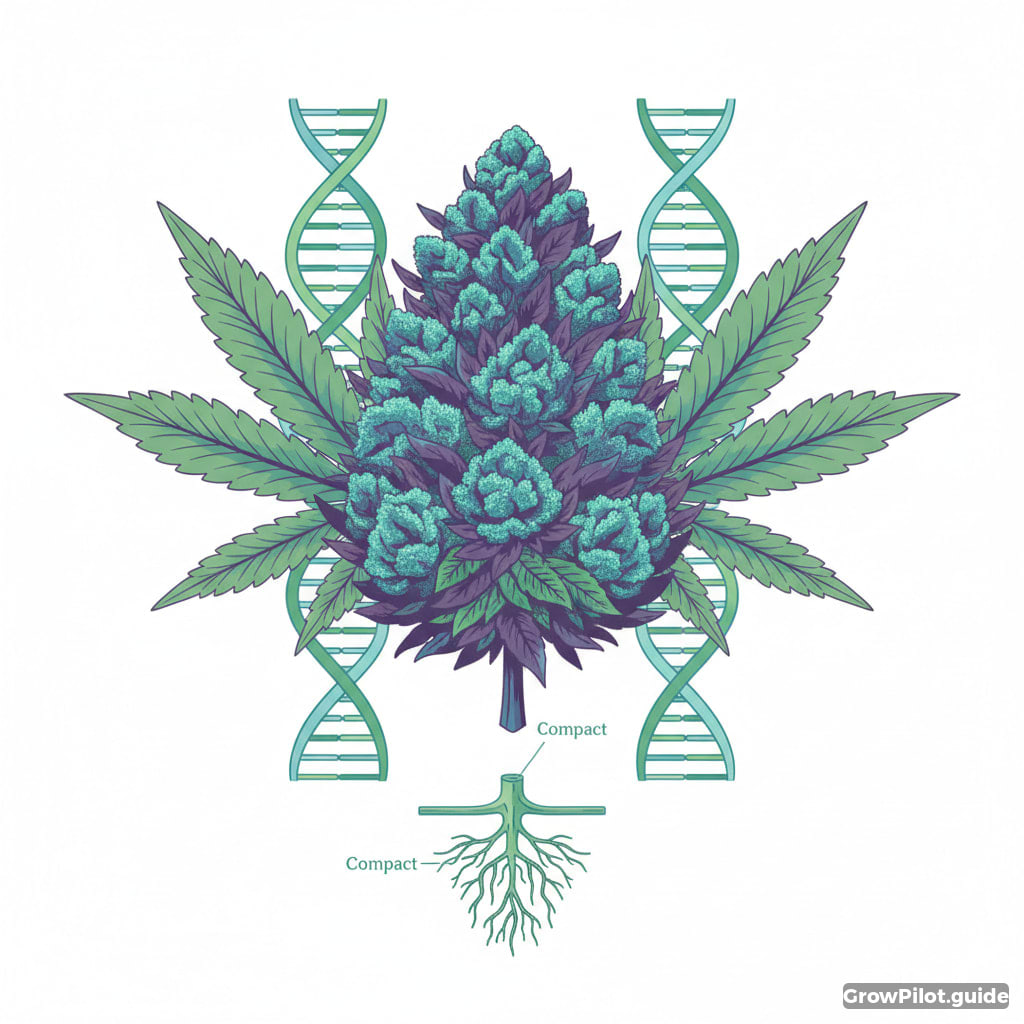
Bubba Kush: Genetics, Compact Growth, and Coffee-Kush Profile

Bubba Kush is one of the most influential Kush strains. This article explains its origins, growth, flowering, yield, terpenes, effects, and what growers should consider in terms of climate and setup.
# Bubba Kush: Genetics, Compact Growth, and Coffee-Kush Profile
Bubba Kush is one of the best-known Kush-dominant cannabis strains of the past few decades. It’s particularly interesting to growers because it’s described with remarkable consistency across strain archives, seed bank listings, and numerous user reviews as having a specific profile: compact to medium-sized growth, broad leaves, moderate stretching, dense buds, and a rich aroma blending earth, coffee, cocoa, and spices. At the same time, “Bubba Kush” is not a name that consistently refers to a completely identical strain worldwide. There may be differences between earlier clone-only versions, later seed releases, and breeder-specific selections.
Nevertheless, a reliable core can be described. Historically, Bubba Kush is most often associated with U.S. genetics from the 1990s. In several archives and breeder descriptions, the strain appears as an Afghani-dominant Kush line, often with references to a cross between an OG Kush-related plant and a Northern Lights or Afghani-related line. The exact origin is not documented beyond a shadow of a doubt in every detail. The practical experience with the strain is better documented than any individual anecdote regarding its origins.
What is well-documented about Bubba Kush’s genetics?
The genetic core of Bubba Kush is generally described internationally as an Indica-dominant hybrid with a strong Kush influence. Unlike with newer marketing names, its profile is not primarily defined by candy, fuel, or fruit terpenes, but rather by a heavy, dark, hash-like aroma and a rather compact plant structure.
Origin and Classification
In strain databases such as SeedFinder, as well as in breeder archives, Bubba Kush is frequently associated with a Pre-98 Bubba Kush line. This designation is important because it refers to an older, particularly well-known conservation line. Many modern seed versions are modeled after this profile but are not automatically genetically identical to the historic, clone-only selection.
According to international grow reports, Bubba Kush is typically characterized by:
- short internodes
- wide, dark fan leaves
- bushy growth habit
- low to moderate stretch during flowering
- compact, often very dense buds
How Does Bubba Kush Grow in Everyday Cultivation?
In practical cultivation, Bubba Kush is usually described as compact, relatively manageable, and space-efficient. It rarely produces extremely long side shoots, but rather develops a dense, robust structure. Indoors, this is often an advantage for smaller spaces because the strain doesn’t get out of control as quickly as strongly Sativa-dominant strains.
Indoor Growth Behavior
Under artificial light, Bubba Kush often remains short to medium in height. Many reports describe final heights of about 80 to 140 cm, depending on pot size, veg phase duration, training, and phenotype. Stretching after the switch to flowering is often moderate. In many setups, the plant height does not double but increases in a much more controlled manner.
This makes the strain suitable for:
- Sea-of-Green-style setups with multiple smaller plants
- limited tent heights
- growers with limited vertical space
- growers who prefer compact canopy structures
Growth Characteristics Outdoors and in Greenhouses
Outdoors, Bubba Kush also tends to remain medium-sized and broad rather than very tall in many climates. While it can grow significantly larger during long growing seasons with ample root space, the basic pattern usually remains typical of Kush: sturdy side shoots, dense structure, heavy buds. In humid regions, this density is something growers need to actively monitor.
How long does Bubba Kush really flower?
For photoperiod versions, Bubba Kush is usually listed in breeder specifications and grow reports as having a flowering time of about 8 to 10 weeks. In practice, many phenotypes fall within the range of 8.5 to 9.5 weeks. This is one of the reasons why the strain has remained popular over the years: it combines Kush-style flower quality with a relatively predictable cultivation timeline.
Outdoors, depending on the climate, maturity is often reached in the early to mid-fall window. Since different lines circulate under the name Bubba Kush, it’s worth focusing less on rigid catalog specifications and more on trichome maturity, bud density, and airflow within the crop.
What’s a realistic yield?
Bubba Kush is rarely described as an extreme high-yield wonder. It’s more realistic to classify it as a solid to good producer, whose strength lies more in flower density, resin content, and consistent quality than in maximum mass yield.
Many international reports cite roughly the following ranges:
- indoor: about 350 to 500 g/m² under good conditions
- outdoor: often about 400 to 700 g per plant, sometimes more with a long growing season and ample root space
Why does Bubba Kush smell so different from modern “candy” strains?
The aroma profile is one of the main reasons for this strain’s enduring reputation. In descriptions by users and growers, Bubba Kush is often associated with earth, coffee, cocoa, hash, spices, wood, and, at times, slightly sweet undertones. In contrast to Zkittlez-, Gelato-, or Tangie-related strains, the profile often comes across as darker, heavier, and less overtly fruity.
Typical Terpenes
Depending on the line and lab analysis, caryophyllene, myrcene, and limonene are often cited as key terpenes in Kush-dominant profiles; in some cases, humulene or linalool are also present. This doesn’t fully explain the aroma, but it aligns well with the frequently described spicy, earthy, and warm notes. The extent to which individual terpenes dominate varies depending on the phenotype and cultivation methods.
How Do Growers and Users Describe the Effects?
Descriptions of effects are, by nature, subjective, but in the case of Bubba Kush, they reveal a relatively consistent core. Many users describe the strain as deeply relaxing, physically heavy, calming, and suitable for the evening. Compared to stimulating Haze or Diesel strains, Bubba Kush is less often associated with creative restlessness or a strong mental drive, but rather with a slow, dense Kush character.
It’s important to note that such descriptions do not replace standardized pharmacological statements. Experiences depend, among other factors, on dose, individual tolerance, method of consumption, chemotype, and terpene profile.
Who is Bubba Kush suitable for when growing?
Bubba Kush is generally considered easy to moderately challenging to grow. It’s not the most finicky Kush strain, but it’s also not a strain that will always forgive major environmental mistakes. Its dense leaf and flower structure, in particular, requires attention.
Suitable for
- Beginners with solid climate control
- Advanced growers who prefer compact Kush structures
- Indoor growers with limited headroom
- Growers looking for classic hash-and-coffee-like terpenes
Less ideal for
- Very humid rooms without strong air circulation
- Setups designed for maximum stretch and massive plants
- Growers expecting extremely fruity or gassy profiles
What growing tips are particularly important for Bubba Kush?
Climate and Humidity
Due to its dense structure, Bubba Kush benefits from consistent airflow and precise humidity control, especially during mid- and late flowering. Excessive humidity increases the risk of internal bud rot in compact buds.
Training
According to many reports, this strain responds well to topping, light LST, and moderate pruning. The goal is less about height control and more about better light distribution and relieving pressure on the plant’s interior. Too aggressive a training regimen shortly before or during early flowering can slow down the growth rate in some Kush-dominant phenotypes.
Nutrition
Bubba Kush is often described as not overly hungry. Excessive nitrogen can further intensify the already dense foliage. A controlled, fairly balanced fertilization strategy is usually advisable, with an eye toward leaf mass and airflow within the bud.
Common Mistakes
Frequent problems mentioned in grow reports include:
- Insufficient pruning of lower and inner branches
- Excessive humidity during late flowering
- over-fertilization with nitrogen
- reacting too late to dense, shaded areas of the canopy
Conclusion: Why Does Bubba Kush Remain Relevant?
Bubba Kush is not a strain that relies on extreme marketing gimmicks. Its reputation is based more on a clearly recognizable growing profile: compact growth, short to medium flowering time, dense, resinous buds, and a classic, dark Kush aroma with hints of coffee and spices. That’s exactly what makes it interesting to this day.
For growers, it’s particularly appealing when height control, dense Kush buds, and a more traditional terpene profile are more important than maximum stretch or modern candy notes. If you have climate, airflow, and leaf density under control, Bubba Kush is a strain whose strengths have been described with remarkable consistency across many sources for years.
Frequently asked questions about Bubba Kush
What is Bubba Kush's genetic makeup?
Bubba Kush is generally described internationally as an indica-dominant hybrid with a strong Kush influence. It is often classified as an Afghani-dominant Kush strain, frequently with references to a plant related to OG Kush and a strain closely related to Northern Lights or Afghani. However, according to the article, its exact origin has not been documented in every detail beyond a shadow of a doubt.
How does Bubba Kush grow indoors?
Indoors, Bubba Kush often remains short to medium in height and is described as compact, relatively manageable, and space-efficient. Many reports cite final heights of about 80 to 140 cm, depending on pot size, veg phase duration, training, and phenotype. The growth spurt after switching to flowering is often moderate.
How long does Bubba Kush bloom?
Photoperiod versions of Bubba Kush typically have a flowering time of about 8 to 10 weeks. In practice, many phenotypes fall within the range of 8.5 to 9.5 weeks. Since different strains circulate under this name, the article recommends not relying solely on rigid catalog specifications.
What does Bubba Kush smell like?
Bubba Kush is often described as having notes of earth, coffee, cocoa, hash, spices, wood, and, at times, slightly sweet undertones. Compared to modern “candy” strains, the article notes that its profile is generally darker, heavier, and less fruity. Depending on the strain and analysis, caryophyllene, myrcene, and limonene are often cited as key terpenes, and in some cases, humulene or linalool as well.
What should growers pay special attention to when growing Bubba Kush?
Due to the dense structure of the leaves and flowers, consistent air circulation and precise humidity control are particularly important, especially during the middle and late stages of flowering. Excessive humidity in solid buds increases the risk of internal flowering problems. The article also lists insufficient defoliation, nitrogen over-fertilization, and responding too late to shaded canopy areas as common mistakes.