Outdoor spiral LST for wind-stable crowns
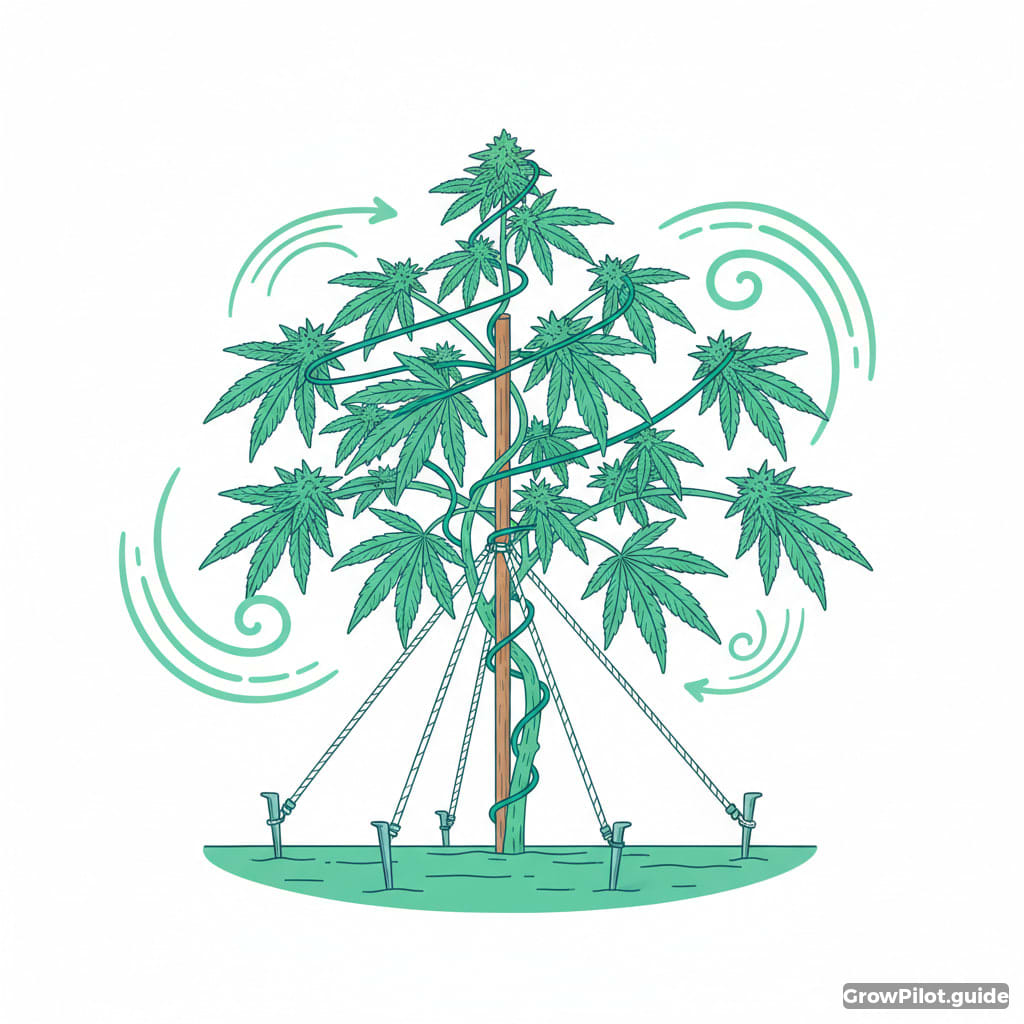
Spiral LST forms outdoor plants in a ring around the edge of the pot or ground spikes. This creates a flat, light-open and wind-stable canopy without hard cuts.
## Introduction
**Spiral LST** is a special form of low stress training for **outdoor/open field cultivation**, in which the main shoot is not only tied down once at the side, but is guided around the plant **step by step in a flat spiral shape**. The aim is a **broad, low canopy** with evenly exposed side shoots. This method is particularly useful outdoors because it makes the plant more **wind-stable**, less top-heavy and easier to control in changeable weather.
In contrast to mainlining, classic topping or SCROG, spiral LST does **not require a net** and only **low tissue stress**. It is particularly suitable for **photoperiodic outdoor plants in the vegetation phase** and for vigorous autoflowers only if worked very early and very gently.
## When spiral LST makes sense outdoors
Start **after the last frost** as soon as the plant continues to grow safely outdoors and the main shoot is **flexible but already stable enough**. This is usually from:
- **4-6 nodes** for photoperiodic plants
- about **15-30 cm plant height**
- active growth at mild night temperatures
Timing is important for outdoors:
- **do not train directly before cold spells, heavy rain or storms**
- ideal are **2-3 dry, mild days** after the procedure
- Better to start early in the season while shoots are still flexible
## Suitable plants and setups
Spiral LST works best with:
- **sativa-heavy or strongly stretching varieties**
- Plants in **pots**, because tie points can be easily placed at the edge of the pot
- outdoor plants in the ground, if you work with **ground spikes or ground anchors**
This method is less suitable for
- very stiff, woody old shoots
- weakened plants
- Plants that are already clearly in bloom
## Material for outdoor spiral LST
Only use soft, weatherproof binding materials:
- rubberized plant wire
- soft plant ties
- Jute twine only loose and controlled
- pot edge clips, bamboo sticks or small ground anchors
Important in the open ground:
- **no thin wire directly on the shoot**
- Check ties regularly, as outdoor shoots quickly gain thickness in the sun and rain
## Step-by-step: Spiral LST
### 1. prepare the main shoot
Choose a warm part of the day when the plant is **not limp** but has good elasticity. Do not bend the main shoot **abruptly**, but only so far that the tip is significantly lower than before.
### 2. make the first bend
Fix the base of the plant lightly against tension so that the root neck is not pulled along. Then pull the tip **sideways to the edge of the pot or to a soil spike** and secure it loosely.
### 3. build up the spiral shape
As soon as the tip grows upwards again, after a few days it is tied **a little further in a circle**. This gradually creates a **spiral guide** for the main shoot along the edge.
### 4. arrange side shoots radially
The now emerging side shoots are individually aligned so that they grow outwards in a **fan shape**. The aim is not a dense center, but an **open, evenly distributed crown**.
### 5. level out the height
Dominant shoots are tied down slightly further, weaker shoots remain upright. This reduces apical dominance and several tips develop to a similar degree.
## Outdoor-specific advantages
In the open field, spiral LST offers several practical advantages:
- **better wind permeability** due to loose crown structure
- **less risk of toppling** than with tall, one-sided plants
- more even sun utilization** throughout the day
- easier handling with privacy screens, close to fences or limited height
- better distribution of rain load on several shoots instead of on a dominant tip
Especially in regions with windy summers or early fall weather, a flat, balanced plant is often more robust than a tall, untrained single stem.
## Common mistakes
### Bending too much
Outdoor shoots appear strong, but can **tear** if pulled quickly. Always work in small stages.
### Training too late
Shoots that are already woody are difficult to spiral. This significantly increases the risk of breakage.
### Ties too tight
In the open field, shoots often thicken quickly due to sun, water and strong growth. Constrictions slow down the sap flow.
### Too dense plant core
Spiral LST only brings advantages if side shoots are **really distributed**. A twisted, narrow center is not a good result.
## Timing limits
**Spiral LST belongs in the vegetation phase** In photoperiodic plants, gentle readjustment may still be possible at the beginning of the stretch, but **no more strong corrections from around the third week of flowering**. This increases the risk of breakage, stress and uneven flower development in outdoor cultivation.
The following applies to autoflowers: only very early, very gently and only with vital plants. If pre-flowering has already clearly begun, do not reshape.
## Conclusion
Spiral LST is a **stand-alone outdoor training technique** for growers who want to grow a **wide, low and wind-stable outdoor plant** without hard pruning. When done correctly, it improves light distribution, controls height and creates a structured crown that copes better with typical outdoor conditions.
## Pro Tips
- Bend outdoor shoots in 2-3 small stages rather than in one go.
- Always fix the base of the stem first before pulling on the tip.
- Do not make new bends after heavy rain and cold weather.
- Check tying points for constriction at least once a week.
- Guide dominant shoots around the outside so that the center remains open to light.
🌿 More Growing Knowledge & AI Grow Help
GrowPilot.guide is the cannabis grow tracker and weed cultivation app with smart plant analysis, indoor cannabis growing guide, grow diary, community, cups and autoflower grow tracker for growers worldwide.
Open GrowPilot.guide App →