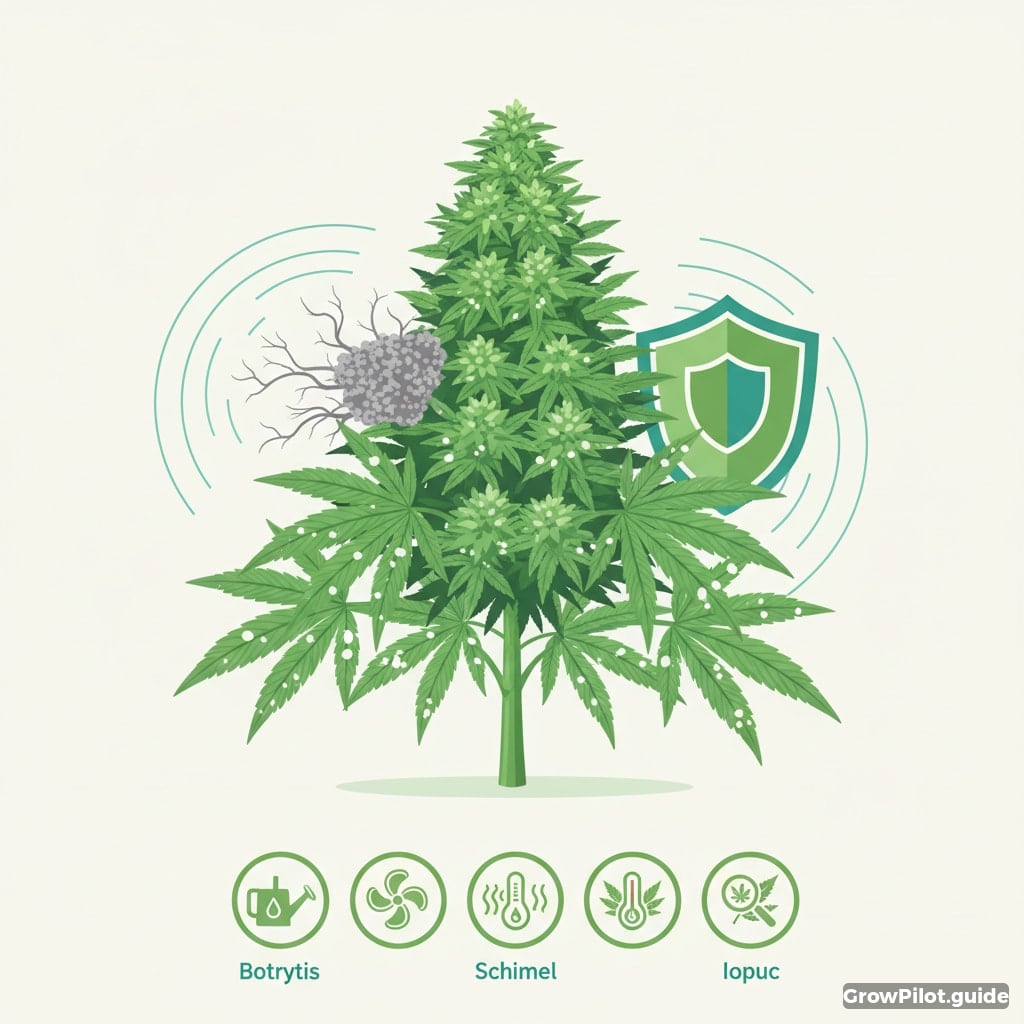
Introduction - What you need to know
Mold is not a cosmetic problem in cannabis cultivation, but one of the most common total loss factors of all. Especially Botrytis cinerea - usually referred to as grey mold or bud rot in everyday grower life - can turn a promising harvest into unusable plant material within a few days. The dangerous thing is that the visible damage is often just the tip of the iceberg. If you see the typical grey, brown or muddy infestation in a flower, in many cases the fungus has already colonized internal tissue.
For hobby growers, the topic is so relevant because Botrytis does not only occur in poor conditions. Even seemingly "clean" grows can be affected if several risk factors come together: dense flower structure, high humidity, weak air movement, temperature differences between day and night, water on flowers, injuries caused by defoliation or training, pest damage and harvesting too late. Modern, highly selected varieties with very compact colas are often more biologically susceptible than plants with a more airy structure.
It is also important to note that not all molds are the same: What growers generally refer to as "mold" can actually be botrytis, powdery mildew, downy mildew, saprophytic surface fungus or a secondary infestation on dead plant material. Control and, above all, prevention differ significantly depending on the pathogen.
This guide focuses on mould in cannabis crops with a focus on Botrytis, but also deals with the adjacent problems that are often confused in practice. The aim is not only to recognize symptoms, but to understand the biological mechanisms behind them. Because only when you know why a fungus has been able to gain a foothold in your crop can you prevent it permanently.
You will learn in this guide:
- how Botrytis works biologically
- which environmental conditions promote infestation
- how to reliably recognize early warning signs
- how to distinguish between botrytis and other mold problems
- which immediate measures are useful - and which are not
- how to make harvesting, drying and storage mold-proof
- what mistakes even experienced growers regularly make
If you only want to take away one key message, then this is it: Mold control doesn't start with the first spot, it starts with microclimate management. Temperature, humidity, air movement, plant architecture and hygiene determine the outcome far earlier than any emergency product.
Basics
What is Botrytis biologically?
Botrytis cinerea is a widespread necrotrophic fungus. "Necrotrophic" means that the pathogen kills plant cells and then feeds on the dead tissue. This distinguishes it from biotrophic fungi, which have to keep living tissue intact for longer. This is crucial for cannabis cultivation because Botrytis is particularly aggressive on injured, ageing or poorly aerated tissue.
The fungus forms spores (conidia) that can be present virtually anywhere in the environment: in indoor air, on clothing, on tools, on plant debris, in intake filters, in the greenhouse, in the garden and in drying rooms. Complete sterility is unrealistic in the hobby sector. That is why the correct technical strategy is not "eliminate spores", but create conditions under which spores cannot germinate or establish themselves.
Life cycle of Botrytis
The typical process looks like this:
- Spores land on plant surfaces
- they germinate with sufficient moisture
- the fungus penetrates through weakened tissue, micro wounds or natural openings
- enzymes and toxins destroy cells
- the tissue becomes soft, brown, gray and collapses
- under suitable conditions, the fungus forms new spore masses
- these are spread by air movement, touch or harvesting work
The late flowering phase is particularly critical because several factors come together:
- dense, watery flower mass
- restricted air circulation in the bud interior
- more dead flower filaments and small leaf parts
- higher probability of micro-damage
- longer periods of moisture in compact colas
Why cannabis flowers are particularly at risk
Cannabis flowers are an ideal habitat for the fungus when the microclimate changes. Dense flowers store moisture locally for much longer than open leaf surfaces. Even if your hygrometer in the room shows 50% relative humidity, the micro-humidity inside a solid cola can be significantly higher. This is exactly where botrytis often begins: not visible on the outside, but in the center of the blossom.
Additional risk factors are:
- high density of the flower structure
- many sugar leaves that trap moisture
- Dew or condensation formation** in outdoor grows
- water droplets from spraying in the flower
- Insect droppings or feeding damage**
- Dying pistils and leaf debris** in the buds
Temperature, humidity and water activity
Fungi do not need "high humidity" in the absolute sense, but available humidity. The relative humidity (RH) is practically relevant, but even more important is the interaction with temperature and surface humidity.
Botrytis is particularly risky:
- RH above 60 % in the flower over a longer period of time
- RH above 65-70% in poorly ventilated areas
- cool nights with a drop in temperature and risk of condensation
- temperature differences > 8-10 °C between day and night
- stagnant air** in flowering zones
As rough practical values for indoors:
- Vegetative phase: 55-70 % RH possible depending on plant size and climate
- Early flowering: 50-55 % RH sensible
- Mid/late flowering: 40-50 % RH, ideal often 45-48 %
- Critical: permanent > 55 % RH for very dense varieties in late flowering
Temperature ranges:
- Light on: 24-27 °C often well controllable
- Lights off: if possible not below 18-20 °C if this causes dew point problems
- Lowering the temperature too much at night increases the risk of condensation on plant surfaces
The dew point - the underestimated core concept
Many growers only look at temperature and RH, but not at the dew point. The dew point is the temperature at which air is saturated with water vapor and moisture condenses. When leaf or flower surfaces fall below the dew point, surface moisture is created - and thus perfect germination conditions.
Practical relevance:
- Indoor air: 24 °C at 55 % RH is much safer than 20 °C at 70 % RH
- If the plant cools down considerably at night, condensation can form locally, even if the room temperature still seems "okay"
- Poorly insulated rooms, cellars, greenhouses and outdoor nights with fog or dew are particularly dangerous
Other relevant types of mold and confusion
Not every fungal infestation is Botrytis. The most important differential diagnoses:
- Powdery mildew: white, powdery coating on leaves; rather superficial, not primarily internal bud rot
- downy mildew**: more leaf-related, spotty, often with underside infestation
- Aspergillus/Penicillium species**: can become relevant during drying or storage
- Saprophytic moulds**: colonize dead plant material secondarily
- Bacterial rot**: can have a similar muddy appearance, but odor and course differ
Why infested material is a health problem
Moldy cannabis should not be consumed - neither smoked, vaporized nor processed. Fungal spores, mycelium and possible metabolic products can be harmful to the respiratory tract and cause serious problems, especially for sensitive, immunocompromised or allergic people. This also applies if the visible infestation has been "cut away" but adjacent material is already invisibly contaminated.
Detection & diagnosis
Early detection often determines whether you only lose individual buds or a large part of the harvest. The problem: Botrytis often starts inside the flower. Therefore, a superficial inspection is not enough.
Typical early signs of botrytis
Pay particular attention to these warning signs:
- Single sugar leaves or small leaves that suddenly wilt or dry up, even though the rest of the plant appears healthy
- Leaves that are unusually easy to pull out of the bud**
- Locally brown or gray-brown spots** in an otherwise green flower
- musty, musty, damp, cellar-like odor**
- soft, mushy or sunken tissue**
- gray, dusty spore material** with advanced infestation
- sudden partial necrosis in dense colas after damp days or high overnight humidity
A very typical sign in cannabis flowers is: A small leaf from the bud turns brown and can be pulled out almost without resistance. Behind this is often the inner rot.
Where you should look first
Check preferably:
- the thickest main colas
- Buds in the middle/lower canopy with little air movement
- Areas near walls, tent corners, humidifiers or poorly ventilated zones
- Areas with pest damage or mechanical damage
- Outdoor: Buds after rain, dew, fog or cool nights
Reliable diagnosis in practice
If you have a suspicion:
- put on gloves
- do not let the fan blow directly onto the plant if possible
- carefully spread the suspected bud
- check for internal browning, gray mycelium, mushy tissue and odor
- isolate suspicious material immediately
Important: Do not shake or squeeze vigorously Mature spores will otherwise be spread throughout the room.
Comparison table: Botrytis vs. other common problems
| Problem | Typical appearance | Main location | Consistency | Odor | Typical trigger | Risk of confusion |
|---|
| Botrytis (Bud Rot) | Brown-grey, inner rot; later grey spore tissue | Inner bloom, dense colas | soft to mushy, later dry-crumbly | musty, moldy | high RH, poor air circulation, dense buds | very high |
|---|---|---|---|---|---|---|
| Powdery mildew** | white, powdery coating | leaf surface, sometimes near the flower | dry, superficial | usually not very noticeable | high humidity, poor air circulation | medium |
| Nutrient deficiency/ageing** | uniform yellowing or necrosis | older leaves | dry | neutral | nutrition, pH, senescence | medium |
| light/heat damage | bleached tips, burnt edges | upper canopy | dry | neutral | too high PPFD/heat | medium |
| Bacterial rot** | wet, slimy, dark | injured areas | very soft, watery | often rotten | waterlogging, injuries | low-medium |
| dying pistils | brown hairs without internal rot | flower surface | normal | normal | ripeness, pollination, stress | high in inexperienced plants |
Concrete diagnostic criteria for botrytis
The following combination strongly suggests Bud Rot:
- dense flower
- Inner tissue brown instead of light green
- Leaf in bud wilted and easy to pull out
- musty odor
- localized instead of uniform damage
- gray or ashy spore appearance in advanced stage
Control rhythm in risk phases
You should check susceptible varieties in late bloom:
- Indoor: at least 1x daily, in risky climates 2x daily
- Outdoor after rain/fog: in the morning and early afternoon
- Drying phase: 2-3x daily visual and odor control
- Curing in jars:** check daily for the first 7-10 days
Step-by-step measures
If Botrytis is discovered, clean, calm and consistent action is what counts. Panic often leads to spore distribution and subsequent errors.
Immediate measures for acute infestation
Step 1: Stabilize the area
- Immediately reduce humidity to 40-45 % RH, if possible
- Keep temperature stable at around 22-26 °C
- Improve air movement, but do not direct strong airflow directly onto infested buds
- If possible, treat affected plant separately or isolate it
Step 2: Work hygienically
- Use disposable gloves
- Clean shears/trimming scissors with 70% isopropanol or suitable disinfectant
- Disinfect tools again after each infected area
- Place infested material directly into a sealable bag
Step 3: Remove generously
If botrytis is visible: Do not cut close. Remove the affected bud plus a safety margin into the healthy-looking tissue. In practice, at least 2-5 cm distance is advisable, more if the colas are very dense. If the main bud is affected, removing a larger section is often the safer choice.
Step 4: Check the surroundings
Check immediately:
- Neighboring buds of the same plant
- Neighboring plants in the vicinity
- particularly dense tops
- Dead leaves inside the crown
- Dehumidifiers, filters, intake paths, drainage areas
Step 5: Eliminate the cause of the climate
Without climate correction, the infestation will return. Check:
- Is the exhaust air sufficiently dimensioned?
- Are there dead air zones?
- Has the defoliation been too weak or too strong?
- Are the plants too close together?
- Is the night-time humidity too high?
- Is condensation forming on walls, pipes or windows?
Checklist: Emergency plan for mold/botrytis
- Do not shake or squeeze infested blossom
- Put on gloves
- Disinfect tools**
- Remove infested material generously**
- Dispose of cuttings in an airtight container
- Reduce humidity to 40-45 % RH
- Improve air circulation
- Check all dense main colas
- Inspect neighboring plants
- Schedule daily follow-up inspections
- Do not consume infested material
- Document cause: Weather, climate, variety, location, irrigation**
Prevention in the vegetation stage
The most effective Botrytis defense begins long before flowering.
Control plant architecture
The aim is to create a structure that brings air and light into the crown:
- moderate LST (Low Stress Training)
- sensible thinning out of the inner areas
- Removal of weak, permanently shady shoots in the lower third
- no overcrowding of the canopy
As a guideline, leaves should not hang in stagnant, moist air for hours after watering or after increased humidity. A slightly moving leaf surface is ideal.
Plant density
A classic mistake is too much biomass in too little space. More plants or too long vegetation does not automatically mean more yield. The risk of mold in particular often increases.
Practical rule:
- Better fewer plants with good aeration than an overcrowded canopy
- Leaves should not permanently overlap each other like a closed, unmoving wall
Prevention during flowering
Target values for climate
For most indoor grows in bloom:
| Phase | Temperature light on | Temperature light off | Relative humidity |
|---|
| early flowering | 24-27 °C | 20-22 °C | 50-55 % |
|---|---|---|---|
| mid-flowering | 23-26 °C | 19-21 °C | 45-50 % |
| late flowering | 22-25 °C | 18-20 °C | 40-48 % |
| drying | 15-18 °C | constant | 55-60 % |
Important: The target values are different in drying than in late bloom. While you want to limit botrytis during live flowering by lowering the RH, you need slow, controlled drying during drying - but without standing moisture and without mold.
Using air movement correctly
Air movement does not mean "wind storm". Direct, harsh fan jets can stress leaves, dry out tissue and still leave dead zones behind dense plants. Better are:
- several gentle, overlapping air currents
- Movement above and below the canopy
- No corner without air exchange
- Exhaust air continuously, not just intermittently in critical phases
Irrigation and substrate management
Overwatering does not directly increase botrytis in flowering, but it often increases the humidity in the room and worsens the microclimate.
Practical points:
- Do not water excessively shortly before the dark phase
- Remove drainage water, do not leave in a tent
- Keep saucers dry
- in damp rooms, water at times when the air and temperature can actively remove moisture if possible
Foliar work with a sense of proportion
Too little defoliation can promote moisture pockets. Too aggressive defoliation, on the other hand, causes wounds, stress and possibly compensatory dense regrowth.
It makes sense:
- selectively remove large leaves that block the air channels
- remove dead or damaged plant parts immediately
- do not carry out heavy work during the most sensitive late flowering period
- Disinfect tools after work
Outdoor strategies against Botrytis
Botrytis is often even more difficult outdoors because weather and dew cannot be controlled.
Choice of variety
If you grow in a humid climate, variety genetics is a major factor. Prefer:
- airier flowering varieties
- robust outdoor or mold-resistant lines
- no extremely compact, late-maturing colas in rainy regions
Choice of location
Ideal are:
- full sun with quick morning drying
- good wind movement
- no permanently damp valley floor
- Distance from dense hedges or poorly drying corners
Weather protection
These are helpful:
- Rain canopy with open side ventilation
- Mobile roofing during critical weeks
- Careful shaking out of water after rain only for robust plants and without damaging buds
- Daily checks after periods of fog
Mold in the harvest, drying and curing phase
Many growers successfully protect the plants until harvest and then lose material in the post-treatment phase.
Harvest
- Never harvest wet plants if it can be avoided
- Check very dense buds in particular
- Keep infested sections strictly separate
- Do not leave trimming residues lying open in the room
Drying
Target area:
- 15-18 °C
- 55-60 % RH
- gentle air movement, but no fan directly on flowers
- Darkness or very little light
Drying too quickly on the outside while the inside is still moist can lead to mold in the jar later on. Drying that is too damp and poorly agitated directly promotes surface and interior infestation.
Curing
Curing jars are not a safe place if the material is stored too damp.
Orientation values:
- Target in the jar: around 58-62 % RH
- If the glass RH rises significantly above 65 % after a few hours, the material is usually still too moist
- Check 1-2 times a day in the first few days, more frequently if uncertain
What you should not do
- "Trim away" visible mold and consume the rest without hesitation
- Shake infested buds to get rid of "just the spores"
- spray on flowers in late bloom
- only measure humidity at the tent entrance and draw conclusions about the bud microclimate from this
- only react when several colas are visibly rotting
Common mistakes & misunderstandings
1. "My room RH is okay, so it can't be mold"
Wrong. The room hygrometer measures a point, not the microclimate inside dense flowers. There can be large differences between the sensor value and the bud center.
2. "Only outdoor has botrytis problems"
Also wrong. Botrytis is often even more treacherous indoors because dense canopies, too many plants, insufficient ventilation or poorly coordinated night cycles create ideal conditions.
3. "A powerful fan solves the problem"
Not alone. Air movement helps, but without dehumidification, temperature stability and a sensible plant structure, the risk remains.
4. "Generously removing infested areas is always enough"
Not necessarily. If several buds are affected or the infestation is discovered late, the plant or the batch as a whole may be compromised. A very critical assessment is then necessary.
5. "You can always see mold immediately"
Unfortunately not. Botrytis often starts on the inside. Visual inspection must be active and targeted.
6. "Denser buds are always better"
Attractive from a yield perspective, often more problematic from a plant health perspective. Extremely compact buds are biologically more susceptible to mold, especially in humid environments.
7. "When drying, the humidity should be as low as possible"
Too dry is also bad. Below around 50 % RH, the surface often dries too quickly while there is still moisture inside. This impairs quality and can cause problems during storage.
8. "pH value prevents botrytis"
The pH value in the root area is relevant for general plant health, but is not a direct protective shield against Bud Rot. Nevertheless, a healthy plant with clean nutrient management is more resistant to stress and secondary problems.
Areas of practice:
- Soil: pH around 6.2-6.8
- Coco/Hydro: pH approx. 5.7-6.2
Practical tips from the expert
Measure microclimate instead of average climate
A hygrometer at pot height at the tent entrance is better than nothing, but often insufficient for botrytis prevention. Ideally use:
- a sensor in the upper canopy
- a sensor in the middle of the plant
- optionally a sensor near the suction or problem zones
This allows you to recognize whether moisture is accumulating in the crown, even though the room value looks acceptable.
The most dangerous time is just before the light comes on
Indoors, the risk often increases in the dark phase and immediately before the light is switched on. This is when the temperature and air movement are often at their lowest and the RH at its highest. If you only measure once a day, you will miss the critical window. Data loggers are worth their weight in gold here.
Not every defoliation is equally effective
Many growers remove fan leaves indiscriminately. It is more effective to create targeted air channels:
- remove problematic leaf barriers in the bud environment
- Prioritize internal, permanently shaded leaves
- No radical clear-cutting action in late bloom
Large colas are beautiful - divided colas are often safer
If you are growing in a humid environment, training that splits the main energy over several medium sized tops can be safer than a few huge colas. Absolute maximum density is rarely your friend when mold is a real risk.
Look for rain outdoors not just from the outside
Many outdoor growers only check the surface. The inside is crucial. After several wet days, you should open and smell any suspicious tops. A single brown leaf in the bud is often a better indicator than the outside appearance.
Hygiene does not end with the plant
Scissors, gloves, drying room, nets, trays, dehumidifier containers, suction filters and even clothing can carry spores. Especially after removing infested buds, you should clean your tools and hands immediately.
Harvest a little earlier rather than too late when the weather turns
Outdoors and in problematic indoor situations, a slightly earlier harvest time is often a better compromise than the risk of losing significant parts of the harvest to botrytis in the last 5-7 days. Perfect ripeness is of no use if the blossom rots.
Dense varieties need different management
If you are growing genetically very compact cultivars, plan more conservatively from the start:
- fewer plants per area
- stricter RH control
- earlier structural work
- more frequent late flowering control
- no experiments with high night moisture
FAQ - Frequently asked questions
Can I still save lightly infested buds if I cut away the mold?
As a rule, you should not want to save visibly infested buds. The problem is that visible mold often only marks the already advanced part of the infestation. Mycelium may have already colonized adjacent tissue without you being able to see it for sure. This is particularly common with Botrytis in dense flowers. Generous removal can be useful for the plant in the stand to slow down the spread. However, infested material is not suitable for later consumption. Safety and health clearly take precedence over yield considerations.
What humidity is really safe during flowering?
There is no universal value that is "safe" under all conditions, because variety, flower density, air movement, temperature and plant mass all play a major role. A practical range in late flowering is usually 40-48 % RH with stable temperatures and good air circulation. For very dense varieties or known problem areas, you should work at the lower end of this range. Values above 55 % RH over longer phases significantly increase the risk, especially at night.
Does a dehumidifier alone help against botrytis?
A dehumidifier is often extremely helpful, but is not a complete solution on its own. If plants are too close together, air cannot get through the crown or temperature drops at night cause condensation, the risk remains. The dehumidifier is a tool in the overall system. It works best together with:
- Sufficient exhaust air
- sensible air circulation
- controlled plant density
- stable day/night temperature
- clean irrigation management
Is Botrytis contagious for the whole grow?
Yes, in the sense that spores are easily spread and can colonize other susceptible areas. However, this does not mean that every plant automatically falls ill. Spores are usually present anyway; the decisive factor is whether they encounter suitable conditions. If you intervene early, cleanly remove infested material and correct the climate, you can often significantly limit the spread. If, on the other hand, you manipulate the infestation openly in the room and ignore the cause, the risk for the entire crop increases massively.
Why does Botrytis often only appear shortly before harvest?
Because this is when the biological and climatic conditions are at their most unfavorable. Late blossoms are denser, heavier and contain more tightly packed tissue. At the same time, individual parts of the plant age, small leaf remnants die off and many growers leave the plants standing for a particularly long time in order to extract "even more ripeness". Added to this are often lower autumn temperatures, higher night-time humidity or, indoors, a dense, barely aerated crop. In short, this is when the flower is most attractive to the fungus and at the same time the most difficult to keep dry.
Can I combat mold with sprays during flowering?
In late flowering, sprays on the buds are generally not a good idea. Additional moisture in dense buds often makes the problem worse. Also, you don't want any residue on plant material that is ready to harvest. In early stages and with other fungal problems, certain preventative measures can play a role, but with Botrytis already visible in flowers, the standard measure is removal of infested areas plus climate correction, not spraying the buds.
How do I distinguish botrytis from normal ripeness or brown pistils?
Brown pestles alone are normal and initially say little about mold. Botrytis is more likely to be indicated by local internal brown rot, wilting small leaves in the bud, musty odor and soft or collapsed tissue. If you are unsure, carefully open the suspected bud. Healthy mature buds are not mushy inside and do not smell musty. The difference lies less in the brown hairs than in the structure and interior of the flower.
Which varieties are particularly susceptible?
Varieties with very compact, heavy, tightly layered flowers are often particularly susceptible, especially if they are cultivated in humid climates or poorly ventilated indoor setups. This does not mean that all dense genetics will necessarily mold, but the risk profile is higher. In problematic environments, more airy, proven outdoor or mold-resistant lines are usually the better choice. Anyone fighting botrytis in the long term should take the variety issue seriously and not just optimize the indoor climate.
Conclusion
Mold and especially Botrytis are not random events, but almost always the result of spore pressure plus a suitable microclimate plus susceptible tissue. Because spores can occur practically anywhere, the key lies not in the illusion of sterile perfection, but in consistent prevention: stable temperature control, controlled humidity, good air movement, reasonable plant density, clean hygiene and a plant structure that does not trap moisture in the bud interior.
The most important take-aways are:
- Botrytis often starts inside the bud - not where you see it on the outside.
- Late bloom is the high-risk phase, especially with dense varieties.
- 40-48% RH** in late bloom is a sensible target range for many indoor setups.
- Temperature stability** and avoiding dew point problems are just as important as the RH value.
- Early detection is based on details: wilting sugar leaves, musty odor, internal brown rot.
- Infested material is generously removed and not consumed.
- Drying and curing** are just as critical phases as the live flower.
If you want to get mold under control permanently, think in terms of systems rather than individual measures. A more powerful fan alone will not solve it. A dehumidifier alone will not solve it. A one-off defoliation alone will not solve it. Only the combination of climate, structure, hygiene, genetics and consistent control will make your grow truly robust.
Depending on your setup, you should pay particular attention to the following topics:
- Dew point and climate control in the grow room
- Defoliation and crown management during flowering**
- Variety selection for humid regions or dense indoor setups**
- Mold-proof drying and correct curing**
- Relationship between pest pressure and secondary infections
The best botrytis plan is ultimately a set of three habits: measure early, monitor daily, act uncompromisingly. This is exactly what separates stable, repeatably successful grows from harvests that collapse just before the finish line.