Durban Poison: Landrace, terpenes and her slender growth

Durban Poison is considered a defining South African genetics with a clear, spicy-sweet profile. The article explains origin, growth, flowering, terpenes, effects and growing practice.
# Durban Poison: Landrace, terpenes and her slender growth
Durban Poison is one of the best-known strains associated with South African landraces. It is of particular interest to growers because it is described in many reports as slender-growing, light-loving and comparatively mold-resistant genetics that can develop a distinctive spicy-sweet aroma profile. At the same time, Durban Poison should also be treated with caution when it comes to simplified narratives: The name is not always used in the market for genetically identical lines, and there are sometimes significant differences between the original landrace base, later selections and modern seedbank versions.
Anyone growing the variety should therefore not regard it as a rigid cliché of a "pure sativa". Botanically and in terms of breeding, this classification is only of limited precision today. It is more useful to look at concrete characteristics: Growth habit, stretch, internodal distance, flowering time, response to training, terpene profile and climate tolerance. This is where Durban Poison shows a relatively consistent picture.
What is certain about the origin of Durban Poison?
Historically, Durban Poison is usually traced back to cannabis populations from the region around Durban in South Africa. In the history of the variety, reference is often made to selection and further development by international breeders in the late 1970s and 1980s. The main certainty is that Durban Poison is not a modern Dessert or Kush hybrid, but a line with strong links to older South African genetics.
It is less clear how close today's versions are to historical populations. Seedbank data, archive material and grower reports show that both stabilized inbred lines and modernly interpreted offspring are in circulation under the name Durban Poison. This is important in practice:
- Some phenotypes remain relatively compact and mature quickly.
- Others show significantly more stretch and a longer flowering time.
- The aroma also ranges from aniseed-like and herbal-spicy to sweet-citrusy and slightly pine-like.
How does Durban Poison grow in indoor, outdoor and greenhouse setups?
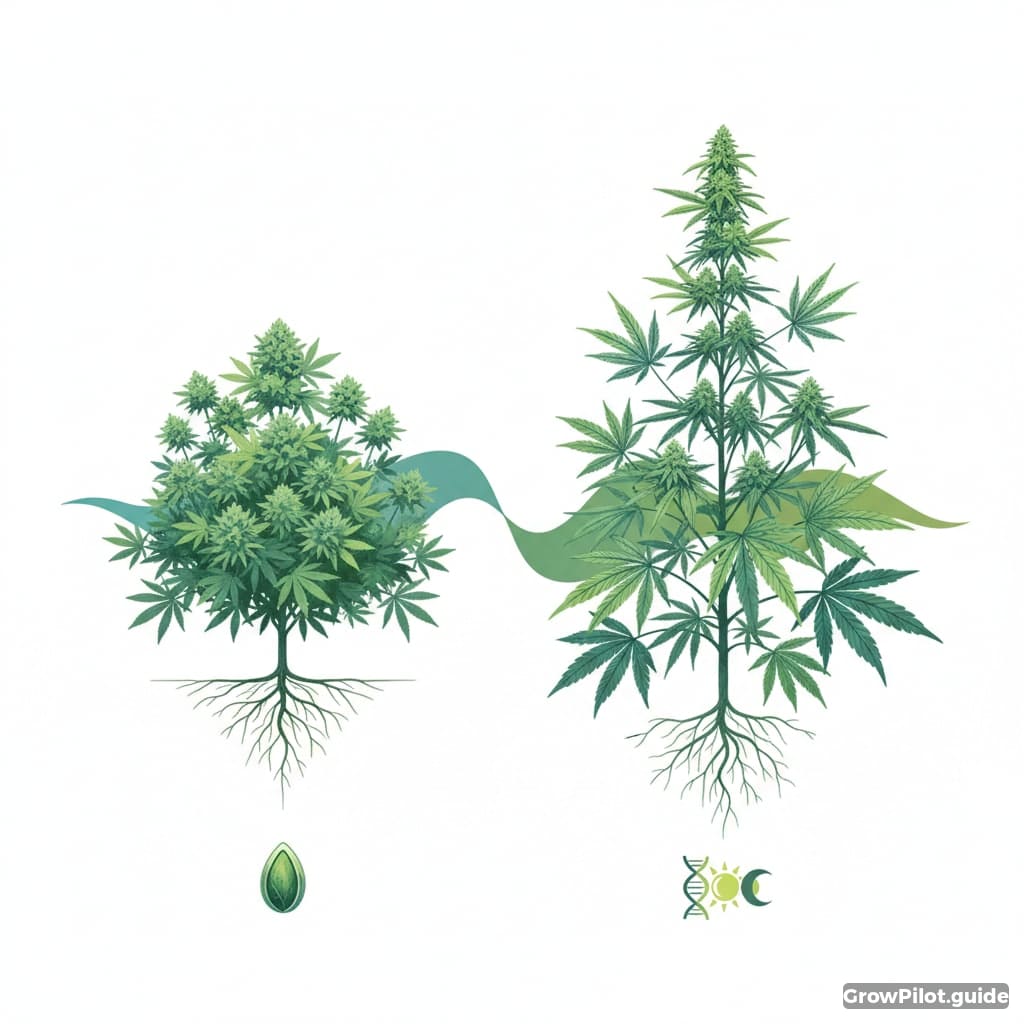
Durban Poison is described in many grow reports as upright, slender and comparatively open-structured. Typical features are a pronounced main stem, medium to long internodes and side shoots that can grow well with good light distribution. Compared to more compact Afghani-dominated varieties, the plant usually appears more airy.
Indoor
Indoors, the final height without training is often around 100 to 160 centimeters, depending on pot size, vegetation period, light intensity and phenotype. The stretch after the flowering transition is usually very pronounced and can greatly increase the plant volume. Many growers therefore work with:
- early topping
- LST to open the crown
- SCROG to bring the shoots to a uniform height
- moderate defoliation only where light and airflow are blocked
Outdoor
Outdoors, Durban Poison can grow significantly taller with a long season and plenty of sun. Reports of 1.8 to 3 meters are plausible in favorable conditions, with climate, starting time and rooting space being strong contributing factors. The open structure can be an advantage in humid late phases because the flowers and foliage dry out more quickly than with very dense indica types.
Greenhouse
In the greenhouse, the variety usually benefits from high light levels and a certain amount of protection from constant rain. At the same time, the height should be planned early. Without training, the main shoot can quickly dominate. Regular tying and clean air circulation are particularly useful here.
What flowering time and yields are realistic?
The flowering time for photoperiod Durban Poison lines is usually around 8 to 10 weeks, although heavily sativa phenotypes can take a little longer. Many modern selections target the lower to mid-range of this window to make the strain more suitable for everyday use.
When it comes to yield, sobriety pays off. Manufacturer specifications are often optimistic. Realistic ranges from grow reports are often included:
- Indoor: around 350 to 500 g/m² under good conditions
- Outdoor: roughly 400 to 700 g per plant, even higher for large, long-grown specimens
Why is the terpene profile of Durban Poison so distinctive?
Durban Poison is often prized for its unusually clear, spicy and sweet aroma. In descriptions from labs, seedbanks and user reports, the following notes appear particularly often:
- aniseed or licorice
- sweet herbal spice
- pine**
- citrus**
- earthy undertones
In terms of aroma, Durban Poison can therefore be clearly distinguished from Kush, Cookie or Candy lines. Those looking for gassy, creamy or dessert-like profiles will usually find something different than expected. On the other hand, those who like herbal, spicy, bright and classic terpene patterns will often find Durban Poison an interesting reference.
How do growers and users describe the effects?
Reports often describe Durban Poison as clear, active, focused and more suitable for daytime use. Terms such as energetic, woke, creative or mentally present are often used. This does not mean that the strain has the same effect on all people. The individual reaction depends, among other things, on the dose, form of consumption, daily form, tolerance and the specific chemotype.
Differentiation is also important here: not every flower offered as Durban Poison produces the same effect. Differences in the terpene profile and degree of ripeness can significantly alter the experience. More mature or later harvested phenotypes are sometimes described as somewhat more physical than very early and lightly harvested specimens.
Who is Durban Poison suitable for when growing?
Durban Poison is usually in the easy to medium range in terms of difficulty. It is often more robust than sensitive modern elite clones, but requires a certain understanding of growth control.
It is well suited to growers who:
- can handle stretch
- like to train and control the canopy
- appreciate a more **open flower structure
- are looking for a spicy rather than dessert-like flavor profile
Which grow tips are particularly important for Durban Poison?
Climate and environment
Durban Poison usually shows its strengths in good light intensity and a rather warm, but not overheated climate. As a rule, the following make sense:
- around 24 to 28 °C during the day
- a slight drop at night, but no sharp jumps
- around 55 to 70 % relative humidity during the vegetation phase
- in late flowering rather 40 to 50 % to limit the risk of mold
Nutrient management
Many reports do not describe Durban Poison as an extremely hungry strain. Too much nitrogen in early flowering can unnecessarily prolong the stretch and delay ripening. A controlled, rather balanced fertilization level is usually sensible instead of aggressive high fertilization.
Training and typical mistakes
These are particularly useful:
- early topping if several main shoots are desired
- LST to convert height to width
- SCROG for limited ceiling height
- Sufficient distance from the light source, because the tips catch up quickly during the stretch phase
- too long a vegetation phase in small indoor rooms
- training too late after the start of the strong stretch
- too dense plant stands with poor air movement
- excessive defoliation in an already airy structure
Conclusion
Durban Poison is not a variety that lives on myth alone. Its enduring reputation can be explained above all by an independent line of origin, slender growth, solid adaptability and an unmistakable terpene profile. Especially at a time when many strains are converging aromatically towards confectionery, gas or dessert, Durban Poison is almost like an antidote: spicy, bright, classic and structurally clear.
For growers, it is particularly exciting if they are looking for vital, trainable and aromatically independent genetics. If you plan for stretch and don't expect miracle yields, you will often get a variety that impresses less with its mass than with its character and consistency.