Bruce Banner: Genetics, Stretch, and Their Vigorous Hybrid Growth
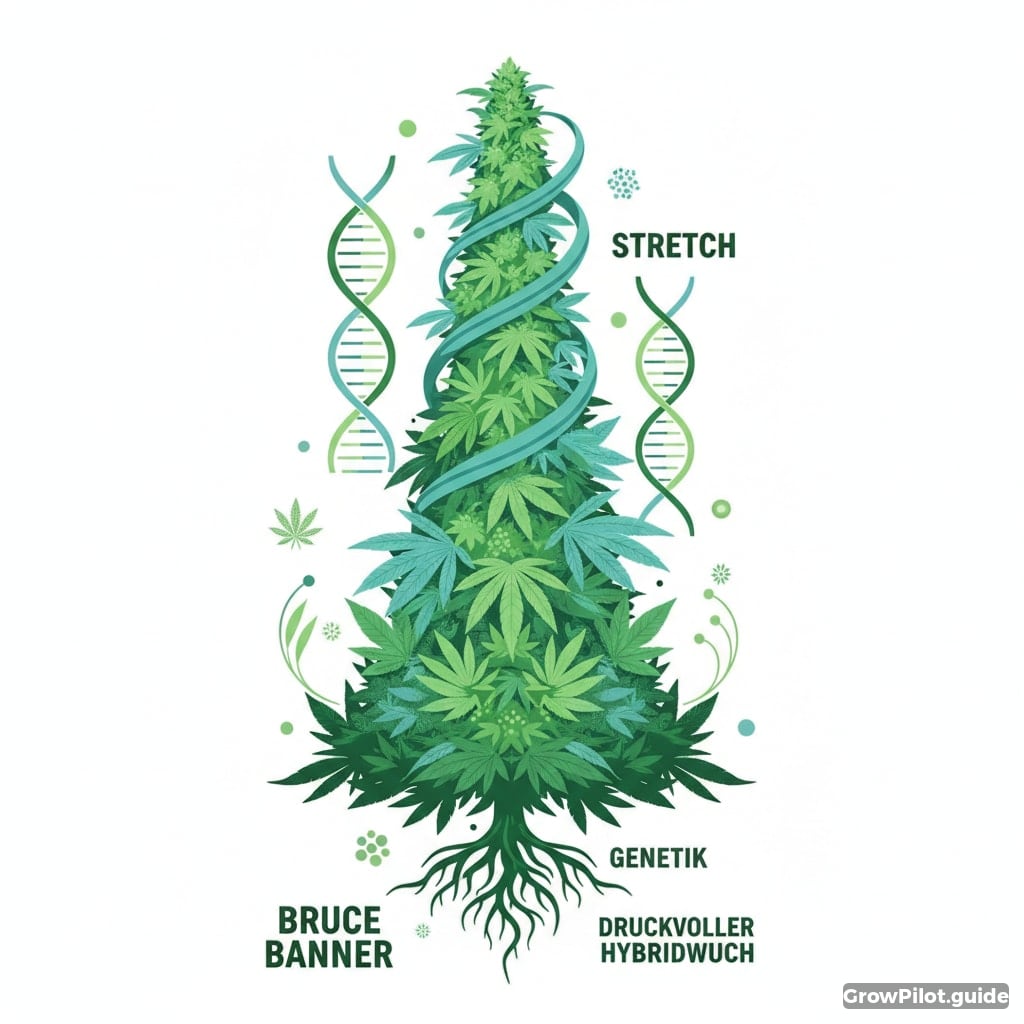
Bruce Banner is known for vigorous growth, significant stretching, and a sweet, fuel-like flavor profile. The article provides an objective overview of its origin, phenotypes, flowering, yield, and growing practices.
# Bruce Banner: Genetics, Stretch, and Its Vigorous Hybrid Growth
Bruce Banner is one of the modern U.S. hybrid strains that is strikingly often described in strain archives, seed bank catalogs, and grow reports with the same basic profile: robust vegetative growth, significant stretching at the start of flowering, heavy resin production, and a flavor profile ranging from sweet and fruity to diesel-like and slightly earthy. At the same time, as with many well-known U.S. genetics, the name isn’t entirely distinctive. Circulating under the name “Bruce Banner” are clone-only strains, reconstructed seed versions, and breeder-specific phenotypes that can differ visibly in structure, maturation time, and the intensity of the “fuel” profile.
For growers, this classification is crucial. Anyone growing Bruce Banner should focus less on the pop-culture name and more on reliable characteristics: exactly which line is being grown, how much the plant stretches, how open or dense its flowering is, and how well the growing environment is managed. This is because Bruce Banner is generally not a strain suited for fully automated grows. It can be very high-yielding, but in many setups it requires precise control of height, light distance, airflow, and nutrient intensity.
What is Bruce Banner genetically?
At its core, Bruce Banner is generally described as a cross between OG Kush and Strawberry Diesel. This lineage appears repeatedly in international strain archives, breeder descriptions, and numerous long-standing community references. Historically, the strain is often associated with the U.S. breeding work of Dark Horse Genetics. Bruce Banner #3, a selected phenotype that served as a reference line in the scene for years, became particularly well-known.
However, it is important to distinguish between:
- Bruce Banner as a specific elite selection, often referred to as #3
- Bruce Banner as a seed line intended to replicate its characteristics
- Bruce Banner relatives that only share parts of its profile
How does Bruce Banner typically grow?
Bruce Banner is usually described as a medium- to large-sized hybrid with vigorous side shoots and significant stretching. Many growers classify the strain structurally as falling between OG-related plants and more vigorous Diesel hybrids: not as delicate as some Haze lines, but significantly more dynamic than compact Kush types.
Typical Growth Characteristics
- Indoor height: usually medium to tall, depending on veg duration and training
- Outdoor height: can grow tall and wide under good conditions
- Stretch: often strong during the first two to three weeks of flowering
- Branching: good lateral branching; quite productive with sufficient light
- Flower structure: medium-compact to dense depending on phenotype; often resinous
What flowering time and yield can you realistically expect?
For photoperiodic Bruce Banner strains, breeders and archives typically cite a flowering time of about 8 to 10 weeks, though many reports indicate that 9 to 10 weeks is the most common range. Faster phenotypes are possible, as are slightly longer maturation times for strains with stronger sativa characteristics.
When it comes to yield, manufacturer claims are often optimistic. Based on a cross-comparison of grow reports and seed bank data, the following ranges seem particularly realistic:
- Indoor: often about 400 to 550 g/m², and even higher in well-optimized setups
- Outdoor: frequently 500 to 800 g per plant, heavily dependent on climate, pot size, growing season length, and training
What does Bruce Banner smell and taste like?
The aroma profile is described across many sources as a blend of sweet-fruity, diesel-like, citrus, and earthy notes. Depending on the phenotype, either the Strawberry Diesel side or the OG side may be more prominent.
Commonly Described Aromatic Impressions
- sweet berry or fruit notes
- diesel and fuel hints
- citrus freshness in the top notes
- earthy or slightly kush-like depth
- occasional spicy or herbaceous undertones
What effects do users describe most often?
User descriptions typically portray Bruce Banner as a powerful, distinctly noticeable hybrid that can combine mental stimulation with physical heaviness. The following terms appear particularly often in user reviews:
- euphoric
- focused or stimulating in the initial phase
- creative or talkative
- physically relaxing later on
- at higher intensities, sometimes significantly more heavy
Why isn’t Bruce Banner considered a very easy strain?
Bruce Banner isn’t extremely finicky, but it’s also not the classic beginner strain for completely foolproof grows. The reason lies less in any single weakness than in the combination of stretch, nutrient requirements, and climate demands during flowering.
Typical Challenges
- Switching to flowering too late, resulting in a loss of height in the setup
- Uneven canopy on untrained plants
- Excessive humidity during late flowering in denser phenotypes
- Over-fertilization in heavily promoted “high-performance” feeding schedules
- Light stress on the top buds due to overly aggressive light intensity after the stretch
Which growing tips work particularly well for Bruce Banner?
Training and Structure
In many setups, Bruce Banner benefits from early training:
- Topping or FIM can defuse the main bud
- LST helps control height and stimulate side branches
- SCROG works well because the strain often grows vigorously outwards
- Targeted lollipopping improves airflow and light distribution in the lower canopy
Climate and Environment
A warm, stable climate with good air circulation is generally recommended for the growth phase. During flowering, it’s especially important to gradually reduce humidity as flower density increases. Dense buds and heavy resin production look attractive, but in stagnant air, they increase the risk of moisture problems.
The following practices have often proven effective:
- Constant air circulation above and below the canopy
- Early height control before the end of the stretching phase
- Avoid planting plants too close together
- Careful defoliation only where it actually improves light and air circulation
Harvest Window and Maturity
Since Bruce Banner strains mature at different rates, it’s more worthwhile to monitor trichome and flower maturity than to strictly adhere to the breeder’s recommended days. Many growers report that the aroma develops significantly between weeks 8 and 10, and the “Fuel” character doesn’t become clearly pronounced until late in the cycle.
Who is Bruce Banner best suited for?
Bruce Banner is best suited for growers who prefer vigorous hybrid plants with active growth and are willing to actively manage the canopy. This strain is particularly well-suited for:
- Growers with experience managing stretch
- Setups with sufficient headroom or good SCROG planning
- Fans of sweet, fuel-like flavor profiles
- Growers who value yield and resin equally
Conclusion
Bruce Banner is not merely a mythical strain, but a genetically distinct hybrid family with clear practical characteristics: an OG Kush x Strawberry Diesel background, vigorous stretching, heavy resin production, and a sweet, fruity, and fuel-like flavor profile. At the same time, the name remains breeder-dependent and phenotypically not entirely consistent. Those who take this into account will find a strain that’s highly appealing to ambitious growers.
The key to success lies less in aggressive maximization than in early structural control, a clean growing environment, and realistic expectations regarding phenotypic variation. It is precisely then that Bruce Banner demonstrates what she is prized for in so many reviews: vigorous growth, distinctive aromatics, and a flower that impresses both visually and technically.
Frequently asked questions about Bruce Banner
What is Bruce Banner genetically?
In the high-yielding core, Bruce Banner is usually described as a cross between OG Kush and Strawberry Diesel. However, the name isn’t entirely precise, because clone-only strains, reconstructed seed versions, and breeder-specific phenotypes are in circulation.
How much does Bruce Banner stretch in The Flower?
Bruce Banner is typically described as a medium- to tall-growing hybrid with significant stretch. The stretch is often pronounced during the first two to three weeks of flowering, which is why more vertical space is required than with compact Indica strains.
How long does Bruce Banner usually bloom?
For photoperiodic Bruce Banner strains, the flowering time is usually reported to be about 8 to 10 weeks. Many reports indicate that the most common range is 9 to 10 weeks, although faster or slightly longer-flowering phenotypes are possible.
What does Bruce Banner smell and taste like?
The profile is usually described as a blend of sweet-fruity, diesel-like, citrusy, and earthy notes. Depending on the phenotype, either the Strawberry Diesel side or the OG side may be more pronounced.
Is Bruce Banner suitable for beginners?
Bruce Banner isn't considered extremely finicky, but it's also not a classic beginner's strain for completely foolproof grows. The article cites the combination of stretching, nutrient requirements, and climate needs during flowering as the main reasons.


