Banana Kush: Genetics, Aroma, and Key Growing Details

Banana Kush combines a Kush-like potency with fruity aromas. This article explains its origin, flowering, yield, terpenes, effects, and what growers should keep in mind regarding climate and training.
# Banana Kush: Genetics, Aroma, and Key Growing Details
Banana Kush is one of those strain names that are relatively well-known on the international market but do not always represent a completely uniform line. This is precisely the most important starting point for growers. Depending on the breeder, conservation efforts, and initial selection, plants bearing the same name can differ noticeably in terms of stretch, flowering time, aroma, and bud density. Nevertheless, strain archives, seed bank descriptions, and numerous grow reports reveal a clearly recognizable core: Banana Kush is usually described as a Kush-dominant hybrid with a fruity, banana-like profile, often featuring dense resin production and a growth habit ranging from medium to vigorous.
In practice, the strain is particularly interesting because it combines two traits that aren’t always easy to stabilize: distinct fruit aromas and classic Kush characteristics such as more compact buds, vigorous side shoots, and a rather heavy, relaxing effect profile. At the same time, many reports indicate that Banana Kush is not considered the most forgiving strain. To achieve good results, growers should monitor climate, nutrient management, and ripeness more closely than they would with particularly robust standard hybrids.
What is the genetic origin of Banana Kush?
The most commonly cited lineage is a cross between Ghost OG and Skunk Haze. However, some archives and breeder descriptions provide differing or simplified information about its origins. This is not unusual for popular strain names. What is historically well-established is that Banana Kush originates from U.S. hybrid breeding and is generally classified genetically as a blend of OG/Kush structure and fruity aromas, sometimes with Haze or Skunk characteristics.
For growers, this means in practice:
- OG influence is often evident in resin production, node spacing, and a vigorous main stem.
- Skunk or Haze components can enhance the plant’s stretch and brighten the aroma profile.
- The strain is often not entirely phenotypically homogeneous.
How Does Banana Kush Grow in Everyday Cultivation?
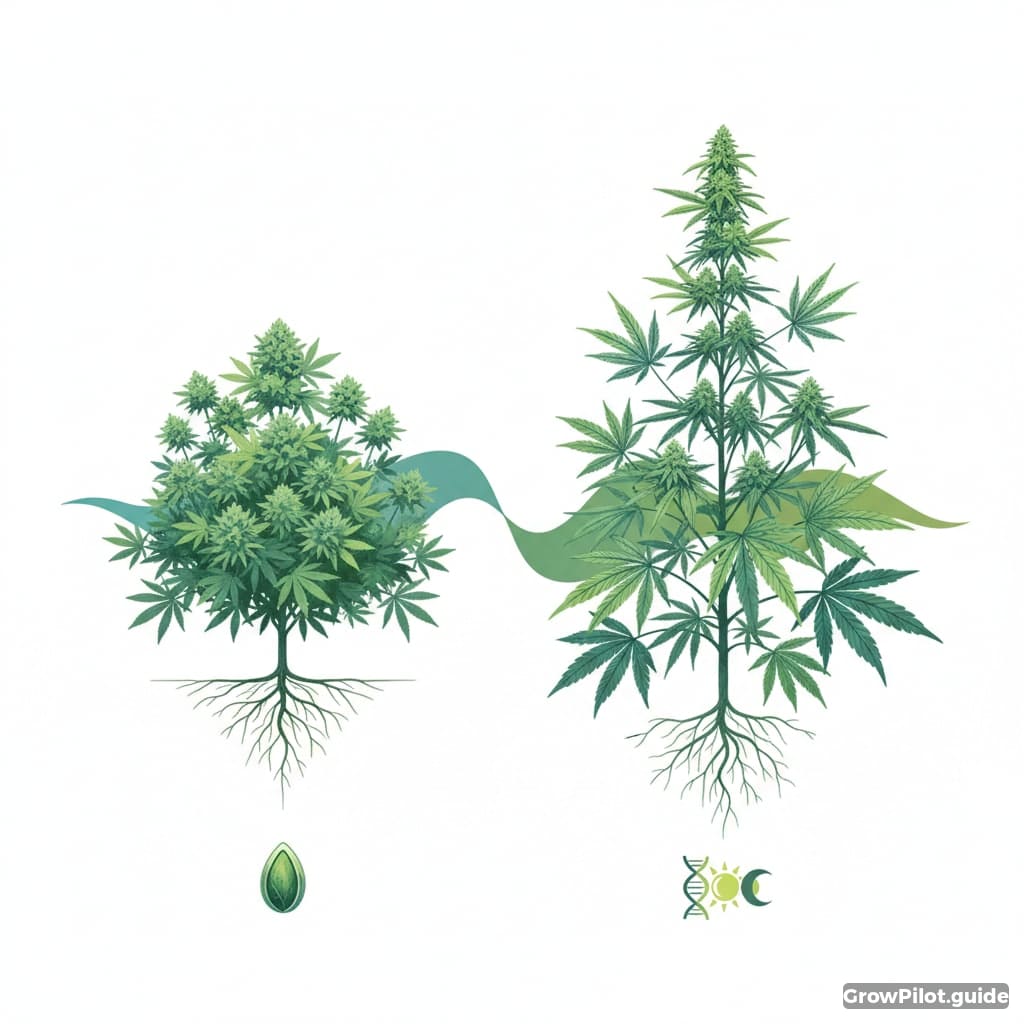
Banana Kush is described in many reports as a medium-sized to medium-vigorous hybrid plant. It typically grows bushier than typical Haze strains, but more open than very compact Afghani-dominant strains. It often develops solid lateral branching and a noticeable stretch after switching to flowering, without necessarily reaching extreme heights like long-flowering Sativa hybrids.
Typical Growth Profile
- Indoor height: often about 90 to 140 cm without heavy training
- Outdoor height: often 150 to 220 cm, depending on pot size, climate, and vegetative period
- Structure: medium internodes, branched, often with a dominant main cola
- Stretch: usually moderate to significant during the first 2 to 3 weeks of flowering
What flowering time and yields are realistic?
For photoperiodic Banana Kush strains, many breeders and archives cite a flowering time of about 8 to 10 weeks. In practice, many plants tend to fall within the 9-week range, while phenotypes with a stronger Sativa influence may take a bit longer. The decisive factor is not just the calendar week, but the actual state of maturity of the flowers and trichomes.
Realistic Yield Ranges
- Indoor: often about 350 to 500 g/m² under good conditions
- Outdoor: often 450 to 700 g per plant, sometimes more for large plants and during a long growing season
Why does Banana Kush have such a distinctive smell?
The strain’s distinctive profile is often described in reviews as banana, ripe tropical fruit, sweet peel, earth, and Kush spice. Not every line actually smells like fresh banana in the strict sense. More common is a banana-like overall impression that arises from several volatile aromatic compounds and the interplay of terpenes.
Frequently Mentioned Terpenes
- Myrcene: can enhance earthy, mellow, and ripe-fruity impressions
- Limonene: is often associated with lighter, citrusy-fruity notes
- Caryophyllene: often contributes spicy, peppery, and Kush-like undertones
- Linalool or Humulene: are occasionally described as complementary, depending on the phenotype
How are the effects typically described?
User reviews and strain archives often describe Banana Kush as physically relaxing, mood-lifting, and, depending on the phenotype, also slightly euphoric or creatively stimulating before the effect becomes more profound. This aligns with its classification as a Kush-dominant hybrid. At the same time, such descriptions are not medical statements and do not constitute a reliable prediction for every individual.
How strongly individual effects are perceived depends, among other things, on:
- Chemotype and batch
- Degree of ripeness at harvest
- Individual tolerance
- Method of consumption and dose
- Set and setting
Who is Banana Kush suitable for when growing?
Banana Kush is generally more suitable for intermediate to advanced growers. Absolute beginners can grow it, but they’ll benefit from a setup where climate and irrigation are already reasonably controllable. The strain is forgiving of minor mistakes, but often won’t tolerate consistently fluctuating conditions throughout the entire flowering period.
Typical Strengths
- Distinctive fruity Kush aroma
- Good resin production
- Attractive appearance in the bag when finished well
- Side branches that are usually easy to train
Typical Weaknesses
- Depending on the phenotype, sensitive to high humidity during late flowering
- Not always completely uniform
- Over-fertilization can visibly impair aroma and leaf health
- Dense buds require precise climate control
Which growing tips work particularly well for Banana Kush?
1. Plan for early stretching
Don’t let the plants get too tall before flowering. Early topping or a flat canopy using LST helps improve light distribution and prevent height issues later on.2. Reduce humidity during flowering
In late flowering, good airflow, a thinned-out canopy, and controlled humidity are especially important. Dense, resinous buds are sensitive to stagnant moisture.3. Don’t keep nitrogen levels high for too long
Many growers report that Banana Kush still takes up nutrients well in early flowering but benefits from a cleanly reduced nitrogen regimen during mid- to late flowering. Excessively dark foliage and clawing are warning signs.4. Keep the temperature moderate
A range of about 24 to 28 °C during the day with slightly cooler nights is well tolerated in many setups. Temperatures that are too high can significantly impair volatile aromatics and cause the buds to become looser.5. Don’t Harvest Just by the Calendar
Banana Kush can gain significantly in aroma when it fully matures without becoming overripe. Harvesting too early often results in less depth in the fruit profile and a less mature flower structure.Conclusion: What Makes Banana Kush Special?
Banana Kush isn’t just a “candy” strain—it’s a fruit-forward Kush hybrid with its own distinct profile. Its appeal lies in the combination of tropical-style aromatics, solid resin production, and a growth habit that can be easily controlled with a little training. At the same time, it is not a completely uniform, standard strain. Differences between phenotypes and lines are real and should be taken into account when planning.
For those with a stable climate, careful nutrient management, and an eye for the right harvest time, Banana Kush often delivers a strain that impresses less with record yields and more with aroma quality, resin, and character.